Showing posts with label fear. Show all posts

Thursday, May 29, 2025

U.S. judges feel threatened

Recently:

Amid rising tensions between the Trump administration and the judiciary, some federal judges are beginning to discuss the idea of managing their own armed security force.

The notion came up in a series of closed-door meetings in early March, when a group of roughly 50 judges met in Washington for a semiannual meeting of the Judicial Conference, a policymaking body for the federal judiciary. There, members of a security committee spoke about threats emerging as President Trump stepped up criticism of those who rule against his policies.

Dozens of judges and their relatives have received anonymous pizza deliveries to their homes—which they perceived as a “we know where you live” message. In March, five days after the Supreme Court upheld a lower court’s ruling that the administration must pay USAID contractors, Justice Amy Coney Barrett’s sister was targeted with a bomb threat, according to police records. Another judge had a SWAT team called on him after he overturned an executive order restricting birthright citizenship.

Judges Weigh Taking Control of Their Own Security Amid Threats U.S. marshals, sworn to protect federal judges, ultimately answer to President Trump, who has ramped up criticism of the judiciary. By Katherine Long, James Fanelli, C. Ryan Barber. Wall Street Journal, May 24, 2025

Now:

The White House deepened its attacks on the judiciary on Wednesday [May 28] as it hit back at a federal court decision striking down President Donald Trump’s reciprocal tariffs.

“[Trade] deficits have created a national emergency that has decimated American communities,” White House spokesperson Kush Desai told HuffPost in a statement. “It is not for unelected judges to decide how to properly address a national emergency.”

And White House senior adviser Stephen Miller went even further, claiming in a post on X that “the judicial coup is out of control.”

White House Lashes Out At Judges After Court Blocks Trump's Tariffs A senior adviser alleged a "judicial coup" in renewed broadsides against the courts. By Li Zhou, HuffPost, May 28, 2025

Unsullied eunuch soldiers stand in formation in Game of Thrones

Relatedly: Trump's circle, says Maggie Haberman, saw Elon Musk as "a source of tension, and he commanded this social media presence where he could intimidate any of them as well. And so I think, you know, they are happy to see this chapter end." (HuffPost, June 2, 2025)

Also:

"President Donald Trump has privately complained that the Supreme Court justices he appointed have not sufficiently stood behind his agenda, according to multiple sources familiar with the conversations. But he has directed particular ire at Justice Amy Coney Barrett, his most recent appointee, one of the sources said.

The behind-closed-doors grievances have been wide-ranging, and while many have been about Barrett, Trump has also expressed frustration about Justices Neil Gorsuch and Brett Kavanaugh, the sources familiar with the matter said. The complaints have gone on for at least a year, the sources said.

The president’s anger, sources said, has been fueled by allies on the right, who have told Trump privately that Barrett is “weak” and that her rulings have not been in line with how she presented herself in an interview before Trump nominated her to the bench in 2020.

* * *

Last week, as Trump raged over a three-judge panel’s decision against his tariff plan, he took aim at Federalist Society leader Leonard Leo, who played a major role in helping Trump identify judges to put on the federal bench.

In a Truth Social post, Trump called Leo a “real ‘sleazebag’ … a bad person, who in his own way, probably hates America.”"

— Trump privately complains about Amy Coney Barrett and other Supreme Court justices he nominated, Kristen Holmes and John Fritze, CNN, June 3, 2025

Trump fears Musk:

"On Tuesday [June 3], MSNBC’s Lawrence O’Donnell suggested why the typically “explosively rageful” president has not yet said a thing.

It boils down to Trump actually being afraid of Musk and the way he could weaponize his vast wealth against him, said “The Last Word” anchor.

“That is how you know who Donald Trump fears in this world,” he said. “If you attack Donald Trump and Donald Trump says nothing, Donald Trump’s silence is the biggest expression of fear that he has.”

— Lee Moran, Lawrence O’Donnell Reveals Why Donald Trump Hasn’t Dared To Clap Back At Elon Musk Yet: The “explosively rageful” president hasn’t said a thing, and the MSNBC anchor suggested why. HuffPost, June 4, 2025

Judges are politicized:

Trump's appellate judges have formed a nearly united phalanx to defend his agenda from legal challenges. How often they ruled for him in 2025: Trump appointees: 92% Other Republican appointees: 68% Democratic appointees: 27% @schwartzesque.bsky.social Emma Schartz www.nytimes.com/2026/01/11/u...

[image or embed]

— Peter Baker (@peterbakernyt.bsky.social) January 11, 2026 at 9:43 AM

Stephen Miller understands that the criminal system is the most powerful on the state level, so he is going after local and state sovereignty.

[image or embed]

— Jessica Pishko (@jesspish.bsky.social) January 22, 2026 at 3:14 PM

Relatedly, on an August 2026 episode of NBC’s Meet the Press, host Kristen Welker asked Sen. John Kennedy (R-LA) about the prosecution of David Hearn for touching the Reflecting Pool and allegedly damaging it. U.S. Attorney for the District of Columbia Jeanine Pirro had just asked to dismiss charges. Kennedy said, essentially, that the president can lie all he likes and prosecute someone for a personal or political vendetta, but a U.S. attorney can't:

"The president says it was caused by vandals. I don’t know whether he really believes that, or it’s part of his political messaging, or he’s just thinking out loud. You and I both know the president well. He exists loudly, and he grows anxious when he has an unexpressed thought. I’m not saying he doesn’t really believe it, I just don’t know. Now, the stakes are a lot higher for U.S. Attorney Pirro. You can’t lie to a federal judge. If she can’t prove her case, she was right to pull back. Because if you fool around with a federal judge, you will find out." (See Parker Molloy's post about this: plainly, Trump is "trying to throw this random guy behind bars for a decade for absolutely no reason," so is he doing it ignorantly or knowingly? Both options ought to be "gigantic scandals.")

Sunday, April 26, 2020

A podcast on fear

The "Ologies" podcast with Alie Ward: Fearology Pt. 1 (FEAR) with Mary Poffenroth

This episode discusses the limbic system's fight-or-flight response, in which the amygdala sends chemical signals to the thalamus. We tend to relabel "fear" as "stress" because it's socially acceptable, even encouraged, to talk about how stressed we are about our lives. "We feel confident talking about stress because we can commiserate, but we don't feel confident talking about the f-word because there's so much shame associated with fear in our society." (13:28-41) Yet we can't eliminate fear, because it's one of four basic human emotions: happy, sad, afraid/surprised ("afrised"), and angry/disgusted ("angrusted"). "How much do you think of our anger in general is just fear that comes out the wrong pipe?" Ward asks. "So much," Poffenroth responds. (48:25)

Poffenroth distinguishes "factual fear" ("actual threats to your life, that are happening in a shared reality, right now, that your body is responding to") and "fictional fear" ("just like a good fictional book might have a nugget of truth in it, but most of it is just made up"). (25:10-26:45) The latter is a good candidate to focus on to change our responses.

In the second part of the interview, which is delivered as a separate podcast episode, Pt. 2, Poffenroth mentions a study finding that extremely successful businesspeople used the word "fear" more frequently than "stress." (at the beginning of the episode) We tend to "dress rehearse" our fears so that we can feel prepared (at about 38 minutes), but, if your body is in a heightened state of stress chronically, that stress can negatively impact cellular regeneration. (at about 34 minutes)

Saturday, August 24, 2019

Hurt me 15 degrees less: On cruelty, fear, justice, order, and challenging the conservative white evangelical worldview

Yes, indeed, for white evangelicals in the US today, the catchphrase the cruelty is the point (as distilled by Adam Serwer in the Atlantic) is indeed the case, John Stoehr wrote in August 2019. They act this way simply because when they hurt "people deserving cruelty," it "feels good" to them, and they put effort into coming up with other rationalizations for their actions. (On this point, Stoehr cites Richard Rorty's Achieving Our Country.) And they are not so much afraid of their victims (making words such as "homophobia" misnomers) as they are afraid that they will go to Hell if they are more tolerant of others who they are told are going to Hell (i.e. others who are deserving of cruelty). This system makes them unwilling to listen to anyone who does not also subscribe to their evangelical group and concept of divine reward and punishment. This leaves them unable "to reason their way out of fear" and "is not a moral compass at all."

Daniel Schultz replied affirmatively to Stoehr, quoting the Atlantic's recent interview with conservative evangelical Ben Howe, in which Howe said:

"Trump became their hero, because he hated the establishment, and he beat up on the media, and he was fighting back against all these forces. The more he fights, the more they feel justified, like, He’s our hero because we needed someone to do this for us.

Trump’s appeal is not judges. It’s not policies. It’s that he’s a shit-talker and a fighter and tells it like it is. That’s what they like. They love the meanest parts of him."

Conservative white evangelicals, Schultz claims, believe in "justice and order." "Order" means that "God has ordained certain ways of being and doing in the world...Daddies are leaders, then mommies, then kids," and many also believe in a "racial hierarchy." (For many, "their whiteness outweighs their Christianness.") In this belief system, "God tells you not just the way you should be, but the way you actually are, and if you accept that, you will be blessed." "Justice" means that those who "violate or subvert" this social order are "threats to innocents" and "inherently deserving punishment." Someone who challenges a significant part of this system is basically suggesting that the conservative evangelical should "rewire their entire sense of reality," and indeed, "nobody really wants to give up on their world view. But the result of this stiff-necked epistemology is a tremendously brittle faith, one unable to tolerate the challenge of multiple perspectives." Schultz adds that "the refusal to be challenged also becomes perverse — a wrong choice for no good reason — because the social domination it protects is easily conflated with being the instrument of God’s righteous punishment. Sadists always have to justify themselves."

/ begin digression

On the topic of justice within evangelical thinking, I also found:

1. Owen Amos wrote for the BBC on 5 January 2018 that many evangelicals, including those who identify as "Premillenialists," believe there will be a great war (the "Tribulation" or "End Times") that will result in one thousand years of peace. Christopher Rollston, a professor at George Washington University, says: "Anything that's supportive of the modern state of Israel, for them is a good thing," because they believe that the Bible foretold the existence of the State of Israel. David Brog, executive director of Christians United for Israel, says that "they believe they are powerless to change the date of End Times" so it cannot be true that their support of Israel is motivated by a desire to hasten the End Times.

2. "There is no framework for restorative justice within evangelical thinking," Tori Williams Douglass wrote on May 8, 2018. Instead: "Punishment is a central theme in evangelical theology. They sincerely believe punishment works, and the data shows they are favorable to the harshest forms of punishment which are socially acceptable in any given situation." They tend to believe in spanking children "to punish them for any infraction, no matter how minor"; in penalizing poor people, which they prefer to frame as "teaching personal responsibility, employing the use of bootstraps, and encouraging hard work"; and in harsh punishment for crime, including the death penalty ("White evangelical protestants also have the highest group support of the death penalty, which is disproportionately used against people of color"). As someone employed in a neuroscience research lab, she says: "We know that hitting children doesn’t work, and we know what does work instead. We know that poverty and imprisoning people are traumatic events."

/ end digression

Returning to Schultz, who continues insightfully:

"Faith deployed in service of social hierarchy is also easily conflated with authoritarian power structures, even those led by [cough cough] corrupt awful human beings. Conservative white evangelicals respond to Trump not as a perfect or even good person, but as an imperfect instrument of God’s work to maintain the sacred order of the world. The cruelty is indeed the point because the cruelty manifests the justice that maintains the proper order."

Since a counterargument from "reason," "values," or "identity" won't succeed in this situation, it's probably more effective

"to point out the failures. How do you get a conservative evangelical to stop thinking the entire Queer community is evil? Show them not just a 'good' gay, but how anti-gay ideology has failed to protect them. How do you get them to turn against Trump? Show them how Trump has failed to carry out his promises. Not easy with a rabid culture warrior like Mike Pence in the #2 role. But probably the best evidence for somebody like this would be the ICE raids in Mississippi last week. Here’s Trump the authoritarian carrying out his promise to keep them safe — and the result is a terrorized, deflated community. People notice that kind of thing, especially when their church is called on to assist the victims."

I must personally note that such a line of argument may be emotionally difficult for someone to make. A gay person (me, for example) may note that anti-gay ideology has all kinds of negative social effects, but for me also to note that the social hierarchy hasn't worked out the way you hoped it would may be seen to imply that the way you hoped it would had any moral validity in the first place. If the (mysterious) way you hoped it would turn out was based on the idea that it feels good to you to hurt me because who you believe I inherently deserve to be hurt, that is alarming to me, and the fact that your bullying behavior toward me did not turn out to your own advantage is something I don't feel the need to help you with. I am not sure what magical beanie 'thinking cap' I'd need to don to be willing to have that head-spinner conversation.

On the other hand, it may be easier to have such a conversation based on a shared identity. A white American (me, for example) may note that anti-immigrant ideology has all kinds of negative social effects that hurt everyone-which-yes-includes-white-people. e.g. "However good you might feel hurting those other people and whatever you thought you were trying to accomplish, could you take a look at whether you've helped yourself and helped me? No? You have helped neither of us? Then could you please stop?" That is potentially a more coherent conversation if I am at least provisionally seen as belonging to the in-group and can make a request that at least appears to be on my own behalf. But if I'm seen as belonging to the out-group and if indeed the cruelty is the point, the conversation is a no-go.

I suppose maybe this is an example of pointing out a way in which Trump has failed. "We" wanted a negotiator; "we" didn't get that.

One right-wing organizer of Trump supporters, worrying about the "ugly, corrosive," violent "radicalization" of young men who "conclude there’s no space for them or their voice in the political process," commented anonymously to a writer: "the way to help these people is not to turn them 180 degrees, but to turn them 15 degrees.” This incrementalism may be the way the world really works. It may be the most effective strategy. But if we are observing the feelings of the hypothetical disaffected young men, we should also observe the feelings of their hypothetical shepherds who are put in a position of saying, "Could you please hurt me 15 degrees less?"

Sometimes trade-offs are made. New York City reversed its two-year-old ban on so-called "conversion therapy" (programs aiming to change sexual orientation) because it feared that it would lose a Supreme Court case over the matter which would cause permanent damage to LGBTQ rights. "The move is a gambit designed to neutralize a federal lawsuit filed against the city by a conservative Christian legal organization," the New York Times explained.

Loretta Ross wrote an August 2019 opinion in the New York Times about "call-out culture" which presents food for thought. (A "call-out" is a public criticism of someone's prejudice, often leading to a social media pile-on of thousands of negative comments. The prejudice in question is usually unexamined prior to the call-out, since, if the person already knew they were prejudiced and was being deliberately hurtful, there would be little point in "calling out" their behavior.) Ross acknowledges the importance of giving and receiving criticism. However, she suggests the reframe of a "call-in": "a call-out done with love." By this, she says, she doesn't mean that the critic should monitor their words for the purpose of "tone policing, protecting white fragility or covering up abuse." Rather, the critic should be attentive to whether their call-out will actually be effective. Complaints hurled as "personal therapy" are naturally ineffective. Complaints lodged by "self-appointed guardians of political purity" are also ineffective, she says, a point that may also be true, though it is a little harder to swallow. It gets at the difficult question, not only of how the critic knows that they're right (let's assume for the moment that the critic is indeed in the right), but how the critic knows what is a baseline level of righteousness that they can reasonably demand from others and what is an exacting level of purity that they'll never realistically achieve and that is counterproductive to request. In other words, to illustrate: What is the 15-degree turn in the preferred direction that the critic must demand, and what is the 180-degree turn that would be beautiful to see but which, unfortunately, if requested directly, will only result in a hostile 15-degree turn in the opposite direction. The general concept of negotiation and compromise is clear. It is just that it is difficult in any given situation, when we are dealing with words, feelings, and values (not numbers), to assess what's an appropriate level of "tough love" to dish out and which of our own words, feelings, and values we're prepared to compromise away.


A post-2020 election update: Monica Hesse's November 5 column for the Washington Post.

“Let’s make liberals cry again!” Donald Trump Jr., the saddest adult son, encouraged crowds at an election-eve rally in Wisconsin. His father, meanwhile, went on to a different Midwestern rally to fondly reminisce about the time in 2016 when liberal women wept at the announcement of his victory: “At the end of the evening when they’re all crying, and I remember they were crying,” he asked Grand Rapids, Mich. “Remember?”

A day later, as votes were counted, "25-year-old Republican Madison Cawthorn won a North Carolina district and, in his first public act as a future U.S. congressman, tweeted: 'Cry more, lib.'"

To point out that this is juvenile and mean and weird doesn’t get at the half of it. “Make liberals cry again” is the more synergistic, ball-cap-friendly version of “Own the libs.” A version of “Make America Great Again” that does away with the gauzy nostalgia and goes right for the bad sportsmanship. It is the version one uses when one wants to drop the pretense that this is about America at all and just acknowledge that it’s about reveling in someone else’s pain and perceived humiliation.

“Cry” is the most deliberate word in the phrase. It could have been subbed out for “pay.” Make liberals pay again. That phrase would imply that liberals had done something bad, requiring retribution. It could have been subbed out for “lose,” which would be a little gratuitous but still within the technical vocabulary of competition.

“Make them cry” turns the phrase specifically into a narrative of power.

For these Republicans, Hesse writes, the "game" isn't about any set of policies, and that allows the spirit of Trumpism to go on indefinitely. "When the goal is not victory but humiliation, there is no way to tell when the game is over." After all, "liberals can always be made to cry more, and longer. Long after Trump’s followers have forgotten why this was the goal, or what they gave up in order to achieve it, they can still make a liberal cry, again and again and again — a medicine for an ailment they will never cure."


In a November 7 New York Times article, reporter Ellen Barry quoted a Trump supporter as saying: “I’m just tired of all the arguing that people are doing. I wish sometimes Trump would just say — he doesn’t even have to mean it [emphasis mine] — that he would be the president for everybody. Just say those words.”

The cry against 'cancel culture' is an antipathy of being criticized

The way conservatives use "cancel culture," they refer to others' ability and right to criticize them.

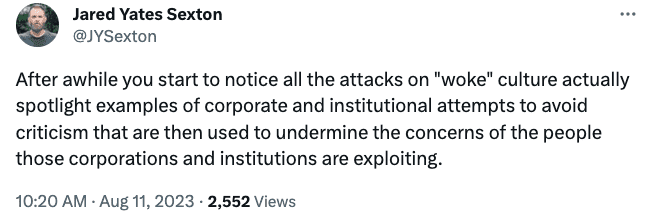
Jared Yates Sexton
tweets Aug 11, 2023: After awhile you start to notice all the attacks on 'woke' culture actually spotlight examples of corporate and institutional attempts to avoid criticism that are then used to undermine the concerns of the people those corporations and institutions are exploiting.
Jared Yates Sexton continues: And let's make it clear: there are no 'woke' corporations or institutions. There are wealthy and powerful people who either see an opportunity to profit or are concerned their exploitation will be laid bare. That's it. Period.

"...once you start pulling on the thread of conservative bad faith you inevitably notice that it makes its way through the entire national sweater." — A.R. Moxon, "One Must Imagine Charlie Brown Happy," The Reframe, Feb 18, 2024

"...a four-letter word...has, in some ways, come to stand in the place of traditional partisan orientations: care. Do you care or don't you?
* * *
Care is deeply political. ... To stand on the right side of history is to care. To be committed to social justice is to care. Self-care is imperative..."
— Hil Malatino (Trans Care, University of Minnesota Press, 2020)

Wednesday, September 12, 2018

Highlights of Bob Woodward's two Trump books: 'Fear' and 'Rage'

This blog post looks at Bob Woodward's two most recent books. It was originally devoted to Fear and has been updated with Rage. Please also see my 2020 story about these books.


In his book Fear, Bob Woodward's interviews with White House insiders fill in the backstory to many publicly embarrassing moments of the Trump presidency. The title, Fear, refers to Trump's concept of what "real power" is. He also believes, however, that personal rapport matters more than strategy. Thus, Trump acknowledges that China is an "economic aggressor" and President Xi may be "using" President Trump to meet some agenda, but Trump nevertheless feels that he is powerful in this situation insofar as he feels he has a friendship with Xi. According to Steve Bannon, however, Trump did not have any "genuine friends."

Military

Afghanistan

As the attacks of Sept. 11, 2001 were traced to Afghanistan, U.S. policy for the past 17 years has centered on preventing another major terrorist attack from launching from that specific place. U.S. funds were poured into the pockets of Afghan warlords with the idea that they will help fight terrorism even though these funds are diverted to their own internal corruption and violence. Today, the U.S. spends $50 billion per year in Afghanistan. Neither Bush nor Obama wanted to end the war. Trump wanted to end it completely. (His opinion: "We’ve got to figure out how to get the fuck out of there. Totally corrupt. The people are not worth fighting for...NATO does nothing. They’re a hindrance. Don’t let anybody tell you how great they are. It’s all bullshit." His mentors, however—Lindsey Graham, for one—repeatedly explained to him the risks of pulling out. In July 2017, he said: "You should be killing guys. You don’t need a strategy to kill people."

Iran

Trump always wanted to pull out of the Iran nuclear deal that had been negotiated under Obama. Priebus, Tillerson, and Mattis argued with the president about this, as they knew that Iran was in compliance with the terms of the deal. Trump persisted: “They are in violation, and you should make the case that this agreement is done and finished....And that maybe we’d be willing to renegotiate.” Tillerson eventually caved.

Syria

When Bashar al-Assad chemically attacked his own people on April 4, 2017, Trump was emotionally affected. His position was: “Let’s fucking kill him! Let’s go in. Let’s kill the fucking lot of them.” Mattis told Trump he'd do it, but privately he told everyone else: "We’re not going to do any of that. We’re going to be much more measured." The middle ground turned out to involve launching 59 missiles at Syria. Trump bragged: “A hundred countries have called...patting me on the back." Trump was interested in launching additional strikes, but he "soon forgot his questions."

North Korea

The public is aware of how Trump nearly escalated a nuclear war via Twitter. Woodward reveals that Trump wanted to evacuate dependent family members of the 28,500 U.S. troops serving in South Korea, an action that would have lent credibility to his plans to attack North Korea. Lindsey Graham had to talk Trump out of this step.

Transgender soldiers

Trump wanted to stop the military from paying for transgender-related surgeries and he wanted to remove transgender troops from service. He had incorrect information about how much certain surgeries cost. Woodward noted:

Gender reassignment surgery can be expensive but also is infrequent. In a Pentagon-commissioned study, the RAND Corporation “found that only a few hundred of the estimated 6,600 transgender troops would seek medical treatment in any year. RAND found those costs would total no more than $8 million per year.”

Priebus gave Trump four options — make no changes, ban all transgender people from service, and two more moderate options — and Trump agreed to discuss it later that morning at 10 a.m. At 8:55 a.m., however, Trump tweeted that transgender people would not be allowed "to serve in any capacity in the U.S. Military." Dunford refused to make the change, as, in Woodward's words, "tweets were not orders," and he advised the service chiefs: "we will continue to treat all of our personnel with respect...we will all remain focused on accomplishing our assigned missions.” Mattis claimed he would reflect upon next steps, but this was a delaying tactic. Four courts entered preliminary injunctions against Trump's order. On Jan. 1, 2018, the military began accepting new servicemembers who are transgender, following the original schedule of Obama's policy.

Interpersonal problems

In 2015, Trump had said of a Republican senator, John McCain, "He’s not a war hero. He’s a war hero [only] because he was captured. I like people who weren’t captured." He also gave out the cell phone number of another Republican senator, Lindsey Graham, during his rival presidential campaign, but he soon reconciled with Graham. As Trump prepared to take office, Graham warned him about the sorry state of the Republican Party: "We have no idea what we’re doing. We have no plan for health care. We’re on different planets when it comes to cutting taxes. And you’re the biggest loser in this."

Woodward shows Trump maligning his own staff and supporters. To Rudy Giuliani, he once said: "Rudy, you’re a baby! I’ve never seen a worse defense of me in my life. They took your diaper off right there. You’re like a little baby that needed to be changed. When are you going to be a man?" On the advice of Rosenstein, he fired Comey via a letter. He said Reince Priebus was "like a little rat. He just scurries around...Just come talk to me. You don't have to go through him." He eventually fired Priebus and replaced him with Kelly; both men learned about the job change via a tweet. Kelly felt he had no option but to accept the job. Priebus later said: “The president has zero psychological ability to recognize empathy or pity in any way.”

Of the scandal with Russian prostitutes, he once said: "I’ve got enough problems with Melania and girlfriends...I can’t have Melania hearing about that." The allegations were compiled into a dossier. Woodward once appeared on television calling the dossier a "garbage document...Trump’s right to be upset about that." At the beginning of Fear, Woodward said he still holds this opinion, although, as a journalist, he was "not delighted to appear to have taken sides." The dossier "played a big role in launching Trump’s war with the intelligence world, especially the FBI and Comey."

Economy

Of the economy, Cohn had to keep explaining to Trump that an increase in the trade deficit is the sign of a growing economy and that Trump should abandon his goal of shrinking the trade deficit at all costs. Furthermore: "The president clung to an outdated view of America—locomotives, factories with huge smokestacks, workers busy on assembly lines. Cohn assembled every piece of economic data available to show that American workers did not aspire to work in assembly factories." Soon after the G20 summit, Trump wrote "TRADE IS BAD" on a draft of a speech he was editing with Porter. He could not understand that, if China is the world's leading manufacturer of penicillin, refusing to buy directly from China does not save money; it only increases the price of penicillin because another country will serve as the middleman. Trump tried to make Mnuchin declare China to be a currency manipulator, while Mnuchin said there was no legal validity behind that statement.

Trump had a letter drafted that he intended to sign to pull out of a trade agreement with South Korea, an important ally. "Tillerson, Mattis, McMaster, Kelly — everyone on the national security side — agreed that if the trade deficit with South Korea had been 10 times greater, it still wouldn’t justify withdrawing." To solve this problem, "at least twice Cohn or Porter took [the letter] from his desk. Other times, they just delayed. Trump seemed not to remember his own decision because he did not ask about it. He had no list—in his mind or anywhere else—of tasks to complete."

Racism

After a white supremacist rally in Charlottesville, Va., he gave comments that took many aback. After his scripted comment, “We condemn in the strongest possible terms this egregious display of hatred, bigotry and violence,” he ad libbed, “On many sides. On many sides. It’s been going on for a long time in our country..." Rob Porter had a difficult time explaining to him what he'd done wrong." Trump insisted that no side has a monopoly on hate. "It’s not as if any one group is at fault or anything like that. With the media, you’re never going to get a fair shake. Anything that you say or do is going to be criticized.” Porter explained, "There’s no upside to not directly condemn neo-Nazis," and he played to Trump's ego by telling him he could be a uniter. White House speechwriters provided a draft, and Porter edited it with Trump looking over his shoulder (the President cannot type, Woodward tells us). Trump felt ambivalent and disappointed, not wanting to seem weak or nodding toward political correctness. Two days after his original "on many sides" comment, he delivered the five-minute canned conciliatory speech "[l]ooking stiff and uncomfortable, like someone coerced to speak in a hostage video." Steve Mnuchin and Gary Cohn praised Trump: “This was one of your finest moments as president," and Fox News hailed it as a "course correction." Trump, however, was angry: "I can’t believe I got forced to do that. That’s the worst speech I’ve ever given. I’m never going to do anything like that again." The next day, he said, “There is blame on both sides... you also had people that were very fine people on both sides. You had a lot of bad people in the other group too...there are two sides to a story.” For this, he was praised by ex-Ku Klux Klan leader David Duke. The leaders of the military branches then came out and stated their opposition to racism. Privately, Trump told Cohn: "I said nothing wrong. I meant what I said." In Porter's words, "This was no longer a presidency. This is no longer a White House. This is a man being who he is.”

[Update: see also Jonathan Karl's book Front Row at the Trump Show, from which this adapted excerpt was published in June 2020: "Never again would he be browbeaten into delivering a speech of reconciliation, a speech unequivocally condemning racial injustice and violence. Never again would he let anybody talk him into admitting a mistake or doing anything with even the faintest hint of an apology. There would be no more course corrections."]

At a meeting, he said he wanted more immigrants from Norway and Asia and fewer from Haiti, El Salvador, and Africa, which he famously referred to as "shithole countries," and which he repeated in 2025.

Immediately after approving a $8.6 trillion two-year budget without any money for building a wall on the U.S.-Mexico border, he assured his crowd: "You’re getting the wall. Don’t worry. Had a couple of these characters in the back say, oh, he really doesn’t want the wall. He just used that for campaigning....every time I hear that, the wall gets 10 feet higher...we’re going to have the wall."

Odd behavior

Trump "doesn’t touch type or use a keyboard" and has others type for him. He referred to Twitter as "the reason I got elected." Woodward wrote: "He ordered printouts of his recent tweets that had received a high number of likes, 200,000 or more. He studied them to find the common themes in the most successful." He watched as many as eight hours of television a day and usually started work at 11 a.m.

Woodward wrote: "The operations of the Oval Office and White House were less the Art of the Deal and more often the Unraveling of the Deal. The unraveling was often right before your eyes, a Trump rally on continuous loop. There was no way not to look." In Cohn's view, Trump's "theory of negotiation was that to get to yes, you first had to say no." In Bannon's view, "Grievance was a big part of Trump’s core, very much like a 14-year-old boy who felt he was being picked on unfairly. You couldn’t talk to him in adult logic. Teenage logic was necessary."

Dowd told Mueller: "And the fact is, I don’t want him looking like an idiot. And I’m not going to sit there and let him look like an idiot. And you publish that transcript, because everything leaks in Washington, and the guys overseas are going to say, I told you he was an idiot. I told you he was a goddamn dumbbell. What are we dealing with that idiot for? He can’t even remember X, Y, Z with respect to his FBI director."

Another response

Julian Zelizer wrote for CNN on Sept. 14, 2018:
"So Woodward has once again offered a fascinating account of parlor politics, this time in the Trump White House, but he has not provided an understanding about why this all happened and why it is allowed to continue. ... Until we have answers to these questions, we won't be able to have any assurance this will turn out OK, or that after Trump's presidency ends, his brand of politics won't outlast him."

After Fear, Trump regretted not speaking to Woodward, so he agreed to a series of interviews with Woodward for a second book. Woodward based his next book Rage on 17 interviews with Trump, together with other source material.

In my view, these are the highlights:

Intelligence: At the beginning of the Trump administration, Sen. Dan Coats of Indiana was given the job of Director of National Intelligence. Before the election, his wife, Marsha Coats, had disapproved of Trump, but she considered him the lesser of two evils. To encourage other conservatives to vote for Trump and not to sit out the election, she wrote an open letter saying: “Trump was not my first or even my second choice. He is not a humble man.” Having criticized him, she went on: “I truly believe the office will change Donald Trump.” This phrase, therefore, was originally meant as criticism and as obviously baseless flattery — an expressed aspiration or hope. As I see it, it seems that some people took it more realistically and actually expected that the office of the presidency would exert some magical change capability over Donald Trump. Marsha Coats later told someone: “He’s the kind of person that would inspire crazy people.” The job of DNI was unpleasant under Trump, from Coats' perspective (and in Woodward's phrasing), because “he saw the intelligence people as enemies.” He acted as if he were “impervious to facts,” saw “nearly everyone as an idiot, and [believed] almost every country was ripping off the United States.” His tweets related to foreign policy alarmed Coats who felt that he needed to wake up in the middle of the night to see if anything had been tweeted. “Coats heard the president was starting his work day later and later, now 11:30 a.m.” In Coats' view, as Woodward paraphrased it: “In effect, and often literally, the president said, I don’t need that to be done. I don’t need these people. I don’t need a National Security Council. I just need myself, a and perhaps three or four people I trust and work with. Trump didn’t care for assessments or options. It was just whatever Trump wanted to do...Trump’s attitude was: ‘I can solve all these problems.’ He thought he could get better intelligence on his own. Coats knew that key leaders such as Putin, Xi of China and Erdogan of Turkey would lie to Trump. They played Trump skillfully. They would roll out the red carpet for him, flatter him, then do what they wanted.”

Russia: Shortly after the 2016 election, the Republicans vetted Rex Tillerson, CEO of ExxonMobil. He told them that Putin was “his closest relationship” and they often met in person. ExxonMobil did a lot of exploration in Russia — it was their “biggest oil exploration area in the world.” Trump talked about Tillerson this way: “Not part of the Washington establishment, untainted by the swamp. He was a dealmaker who negotiated oil contracts all over the world, including billions with Russia. For years he has negotiated with Putin, who awarded him the Russian Order of Friendship.”

Israel/Palestine: On May 22, 2017, Israeli prime minister Netanyahu showed Trump a video with “a series of spliced-together comments from Palestinian Authority president Mahmoud Abbas, who was supposed to be Israel’s partner in the peace deal that Kushner was trying to put together. It sounded like Abbas was ordering the murder of children.” Trump was immediately convinced and was outraged: “They got the guy on tape saying it,” Trump said. But to Tillerson the video seemed “faked or manipulated, taking words and sentences out of context and stringing them together.”

Military: On July 21, 2017, Bradley Byers, a Trump appointee at the Pentagon who worked with Mattis, was at the White House for the signing of an executive order. Trump said — with Byers there — “my fucking generals are a bunch of pussies. They care more about their alliances than they do about trade deals.” White House trade adviser Peter Navarro was also there and seemed to feel that his own role was being complimented. Byers reported the comment to Mattis who was horrified and asked Byers to document it in writing, which he did.

North Korea: Woodward wrote: "The diplomatic courtship between Trump and Kim in 2018 and 2019 is captured in 27 letters that I obtained and 25 are reported here for the first time...they reveal a decision by both to become friends...They resemble declarations of personal fealty that might be uttered by the Knights of the Round Table, or perhaps suitors.” He notes: “The CIA never figured out conclusively who wrote and crafted Kim’s letters to Trump.” Although North Korea did not give up its nuclear weapons, on June 13, 2018, Trump tweeted: “There is no longer a Nuclear Threat from North Korea.” He was referring to a new 391-word agreement that, as Woodward explains, “was less specific regarding denuclearization than prior agreements Kim’s predecessors had signed in 1992 and 2005 during the Clinton and Bush administrations” and only rehashed North and South Korea’s April 2018 agreement with each other. The relations between the two leaders were not as permanently constructive as Trump had conveyed. In the summer of 2019, Kim Jong Un wrote to Trump saying that he was “really, very offended” that the US had not stopped war exercises with South Korea as promised, since “the main target of the war preparatory exercises is our own military.” On August 9, 2019, Trump told the press that he’d received a “very positive letter” from Kim, but he declined to give specifics.

Humility: On December 30, 2019, Woodward interviewed Trump at Mar-a-Lago. He asked Trump if he’d considered apologizing publicly for the Zelensky quid pro quo, but Trump said that he didn’t want to admit wrongdoing. So Woodward asked him: “When’s the last time you apologized?” Trump said: “If I’m wrong — I believe in apologizing.” But this was against a relevant background belief: “Here’s the thing: I’m never wrong.” Later, during the coronavirus pandemic, Dr. Fauci said: “His attention span is like a minus number.”

Coronavirus: The CDC realized on January 13, 2020 that the coronavirus was spreading human-to-human outside China. By early February, President Xi wouldn’t let American health scientists into China and wouldn’t accept other help from Trump. On February 7, Trump called Woodward to talk. He expected the virus to disappear “in two months with the heat” because the weather would “kill the virus. You know, you hope.” Trump said at a news conference on February 26 that there were 15 coronavirus cases in the US and said that the number of infections was “going down” and would be “close to zero” within just a couple days. On March 9, he tweeted that, although there had been 22 deaths, “the common Flu” was still worse and yet “life & the economy go on.” On March 15, HHS informed Jared Kushner that there were just over 1 million swabs available in the entire country to administer COVID tests. In a March 19 interview, he told Woodward: “I wanted to always play it down. I still like playing it down, because I don’t want to create a panic.” (Woodward did not reveal this statement until his book was published in September.) Later in March, FEMA told the Trump administration that they needed 130,000 ventilators immediately. On April 10, when there had been about 20,000 U.S. deaths, Trump acknowledged that the government was predicting there would eventually be more than 100,000 deaths, but he said, “I think we’ll be substantially under that number.” By the end of the month, the death toll had tripled, and he was saying, “It’s gonna leave. It’s gonna be gone. It’s gonna be eradicated.”

"To understand bigotry, study the bigot not its victim. The exercise is a repudiation of the poison but it is also rational: bigotry is fostered, nurtured, and manifested by all manner of factors which affix to a victim – usually (but not always) a vulnerable one – but which have little to do with them. Bigots are protecting something internal, something to which they lay claim and pledge loyalty. The victim bears the brunt of those imbalances."

— Celeste Marcus, CIS Or Subhuman, Liberties Journal, November 2024

Wednesday, December 7, 2016

Quotes: Talking oneself into fear

"Anxiety is continual death."
Nicolas Berdyaev. The Divine and the Human. London: Geoffrey Bles, 1949. p 61.

"In the actual victim, according to various Gothic Tales, this glorying in impenetrability takes the form of admiration, even love of the cruel one while he is coiled to strike. And in the spectator there is a sense of identify [sic] or empathy with both the sufferer and the agent of that suffering. This double identity is the ‘terrible and indefinite curiosity of despair’ we call ‘horror.’"
Philip P. Hallie. The Paradox of Cruelty. Middletown, Conn.: Wesleyan University Press, 1969. p. 73.

"[The wise do] not put a wrong construction upon everything."
Seneca, quoted by Alain de Botton, The Consolations of Philosophy, New York: Vintage Press, 2000. p 103.

"Then I realized that we [Jews] have something better [than Christmas traditions]. We have fire. Think about it. The whole shpiel of Hanukkah is lighting the menorah to commemorate the miracle of the lamp oil that lasted for eight days (whatever.) Little kids like myself were handed matches and told to light the candles. I remember standing mesmerized in front of the flames as my mother and father gave us our nightly presents. It felt so dangerous. And in my book, just like rock beats scissors, danger beats tinsel."
"In Defense of Hanukkah," Barbara Rushkoff. Fresh Yarn. December 2004. Accessed December 25, 2004.

“...reason is often a casualty of fear...
* * *
Both religious faith and uncomplicated explanations of the world are even more highly valued at a time of great fear." [Al] Gore isn't slamming religion but is instead criticizing an interpretation of faith that contradicts reason. Faith is not the enemy of reason; fear is, something we seem to forget when we're afraid and searching for answers."
Nikki Stern. Because I Say So: The Dangerous Appeal of Moral Authority. Bascom Hill Books, 2010. p. 48, 121. Quoting Al Gore, The Assault on Reason (New York: Penguin Books, 2007) p. 55.

"To be afraid is to behave as if the truth were not true."
Civil rights activist Bayard Rustin, quoted in PhillyMag.com, quoted in The Week, May 18, 2012, p. 19.

"
Western psychologists call this biological response to experience an ‘affect.’ * * * Only in mammals do cognition and memory interact with affect to create the emotion of fear."
Tara Brach. Radical Acceptance: Embracing Your Life with the Heart of a Buddha. Chapter 7, "Opening Our Heart in the Face of Fear." p. 166.

"Our worship of heroes who brave fear and go beyond the call of duty distracts us from the importance of those who simply (not easily) fulfill their duty in the face of fear—those, that is, who avoid cowardice. If it is a dangerous idea, as we shall see again and again, it is also a bracing one. More abstractly, pondering cowardice illuminates (from underneath, as it were) our moral world. What we think about cowardice reveals a great deal about our conceptions of human nature and responsibility, about what we think an individual person can and should have to endure, and how much one owes to others, to community or cause. Cowardice and cowards have something to teach us. Let us speak of them."
Chris Walsh. Cowardice: A Brief History. Princeton University Press, 2014. p. 21.

"We believed our paranoia would protect us; after all, what are the odds that two girls so well versed in disaster would be the ones to fall prey to it?"
Koethi Zan, The Never List

Wednesday, April 27, 2016

Rats and other fearsome things

Tara Brach:

”Who doesn’t know the experience of fear? Fear is waking up in the night, like Barbara, terrified that we can’t go on. Fear is the jittery feeling in our stomach, the soreness and pressure around our heart, the strangling tightness in our throat. Fear is the loud pounding of our heart, the racing of our pulse. Fear constricts our breathing, making it rapid and shallow. Fear tells us we are in danger, and then urgently drives our mind to make sense of what is happening and figure out what to do. Fear takes over our mind with stories about what will go wrong. Fear tells us we will lose our body, lose our mind, lose our friends, our family, the earth itself. Fear is the anticipation of future pain.”

Stephen Batchelor:

“Disease, ageing, and death are forms of an internal violence that afflicts all creatures; whereas natural disasters, viral infections, and terrorist attacks are examples of an external violence that threatens to break out anywhere. The globalized, interconnected world has become a body that is prone to these outbursts without warning. In a way that Baudelaire could not have imagined, we are capable of feeling the instability and vulnerability of the living system of which we are a part and on which we depend. Whether it be the appearance of a virus, a hole in the ozone layer, or a hijacked plane, such events are rapidly and vividly made known through the electronic media. They do not have to impinge on our personal existence or occur very often to frighten us. Mara’s most effective weapon is sustaining a climate of fear.”

George Orwell:

"You asked me once," said O'Brien, "what was in Room 101. I told you that you knew the answer already. Everyone knows it. The thing that is in Room 101 is the worst thing in the world." * * * "The worst thing in the world," said O'Brien," varies from individual to individual. It may be burial alive, or death by fire, or by drowning, or by impalement, or fifty other deaths. There are cases where it is some quite trivial thing, not even fatal." * * * "In your case," said O'Brien, "the worst thing in the world happens to be rats."

Dean Koontz:

"Here but a step from the bathroom threshold, Erika experienced another kind of fear: of the unknown.

That which is abnormal to nature is a monster, even if it might be beautiful in its own way. Erika, created not by nature but by the hand of man, was a lovely monster but a monster nonetheless.

She supposed that monsters should not fear the unknown because, by any reasonable definition, they were part of it. Yet a tingle of apprehension traced the contours of her spine.

Instinct told her that the rat was not a rat, that instead it was a thing unknown."

Sources

Tara Brach. Radical Acceptance: Embracing Your Life with the Heart of a Buddha. Chapter 7, "Opening Our Heart in the Face of Fear." pp. 165-166.

Stephen Batchelor. Living with the Devil: A Meditation on Good and Evil. New York: Riverhead, 2004. p. 45.

George Orwell. 1984. (Originally published 1949.) New York: The New American Library, 1961. p. 233.

Dean Koontz. Frankenstein: Prodigal Son (#1 of 5 in the Frankenstein series) (2005) Bantam, 2007.

In case you missed it

Have you seen inside the book 'To Climates Unknown'?

The alternate history novel To Climates Unknown by Arturo Serrano was released on November 25, the 400th anniversary of the mythical First ...