Friday, April 8, 2016

Ideas in tension

The essayist Joseph Joubert wrote, "It is better to debate a question without settling it than to settle a question without debating it." Sometimes the wisdom is in the debate itself, or at least in the perception of two or more alternatives. "A wise man of our own time," wrote Gilbert Highet, "was once asked what was the single greatest contribution of Greece to the world's welfare. He replied 'The greatest invention of the Greeks was men and de. For men means 'on the one hand,' and de means 'on the other hand.' Without these two balances, we cannot think."

However – or, to borrow a phrase, on the other hand – Lee Siegel warned that if we always silo ideas that are in tension and focus on the resulting dichotomies, we will never be able to make connections, find common ground, and help each other move forward. He wrote:

"Now just about every political debate comes down to one phrase: economic policy.

* * *

What we never hear about in the popular media – where intellectual discussion once took place – is debate over fundamental meanings, or essential definitions, or connections between seemingly unrelated phenomena. Those are the elements of an idea, which is the challenge consciousness makes to concrete reality. When Archimedes said, 'Give me a lever that is long enough, and I will move the world,' he was talking about how you can think your way into a new actuality.

Instead of ideas, we have 'issues,' which are the way the world tricks consciousness into believing that things never really change. Because an issue has two sides to it, both sides will still be there whichever one prevails. The 'issue' – consider abortion – never goes away. But an idea – e.g. the issue of abortion is more fundamentally about the social limits of sexual pleasure, not merely about reproductive rights – leaps beyond the two sides of an issue into the essential condition from which they spring. It makes you stop to think, instead of provoking you to start to argue. An issue is the place where ideas run out of steam.

As a result of our yapping, endlessly banal, issue-dominated culture, the intellectuals, who work with ideas the way a Realtor works with property, are out of work."

Matthew E. May presented this insight: "When U.S. Supreme Court Justice Oliver Wendell Holmes Jr. said generations ago that ‘I wouldn’t give a fig for simplicity on this side of complexity, but I would give my life for simplicity on the other side of complexity,’ he meant that to find elegance, you must appreciate, embrace, and then travel beyond complexity." The judge's comment favors the assumption that there is a problem to be solved. He says that a simple solution is better than a complex solution, but it would be even worse to arrive at no conclusion at all.

On the third hand, analytic philosophical inquiry itself – whether it is content to remain in a perpetually unsatisfied debate or whether it progresses toward a conclusion – may not be the best way to find truth. Robert M. Pirsig wrote:

Once it's stated that "the dialectic comes before anything else," this statement itself becomes a dialectical entity, subject to dialectical question.

Phaedrus would have asked, What evidence do we have that the dialectical question-and-answer method of arriving at truth comes before anything else? We have none whatsoever. And when the statement is isolated and itself subject to scrutiny it becomes patently ridiculous. Here is this dialectic, like Newton's law of gravity, just sitting by itself in the middle of nowhere, giving birth to the universe, hey? It's asinine.

Sources

Joseph Joubert, quoted in the Montreal Gazette. The Week, April 4, 2014, p. 15.

Gilbert Highet. Man's Unconquerable Mind. New York: Columbia University Press, 1954. p 19-20.

"The Intellectual Crash of 2009." Lee Siegel. TheDailyBeast.com. March 25, 2009.

Matthew E. May, In Pursuit of Elegance: Why the Best Ideas Have Something Missing. New York: Broadway Books, 2009. p. 25.

Robert M. Pirsig. Zen and the Art of Motorcycle Maintenance. (1974) New York: Bantam, 1975. p. 385.
The wisdom of your enemies

"Remember the good things that you hear, and do not consider who says them," counseled Thomas Aquinas in the 13th century. The source of an apparent pearl of wisdom is often irrelevant. Yeats highlighted our universal connection: "If what I say resonates with you, it's merely because we are both branches on the same tree."

Those who appear to be "enemies" may be better understood as social critics who have important feedback to give us. Jeff Schmidt wrote:

"Professionals generally avoid the risk inherent in real critical thinking and cannot properly be called critical thinkers. They are simply ideologically disciplined thinkers. Real critical thinking means uncovering and questioning social, political and moral assumptions; applying and refining a personally developed worldview; and calling for action that advances a personally created agenda. An approach that backs away from any of these three components lacks the critical spirit."

Nikki Stern noted the tendency to ostracize even those allies who attempt to understand the true enemy:

"[William] Bennett [in his 2002 book Why We Fight: Moral Clarity and the War on Terrorism] focused on [Ward] Churchill's statement [describing World Trade Center workers as "little Eichmanns"] in order to launch an attack against 'terrorist sympathizers.' The group included those who were trying to understand the underlying ideology that motivates terrorism."

Rollo May pointed out that brave, nonconformist thinking is often an especially effective deliverer of wisdom. "The authentic rebel knows," he wrote, "that the silencing of his adversaries is the last thing on earth he wishes: their extermination would deprive him and whoever else remains alive from the uniqueness, the originality, and the capacity for insight that these enemies – being human – also have and could share with him. ... We would lose not only our enemies' good ideas, but the restraints they give us as well." Consider that we sometimes inflate the value of what our friends say, and are inclined to discount what our enemies say; so, if our enemies seem to be telling us something true and good, that counterintuitive situation is an indicator of the rightness of what they are saying.

The musician Jascha Heifetz said: “No matter what side of an argument you're on, you always find some people on your side that you wish were on the other side.” To understand this, one might refer to a phrase circulated on the Internet in 2015: "You're not wrong, you're just an asshole," to which someone coined the fake German word Waltersobchakeit, based on the character Walter Sobchak from the movie "The Big Lebowski." To paraphrase it one more time, the tone in which a statement is delivered can make a true or moral statement seem unpalatable, or, vice versa, a false or immoral statement seem appealing. It is important to cultivate a proper tone. Alfred North Whitehead said, "It is a disease of philosophy when it is neither bold nor humble, but merely a reflection of the temperamental presuppositions of exceptional personalities."

To add yet another dimension: One's history of perceiving a person as generally saying things that are good (or bad) may serve as a reason to forgive (or to refuse to forgive) a one-time deviation from their norm. There is no known word for this.

Sources

Thomas Aquinas, quoted by Mary Daly, The Church and the Second Sex, New York: Harper and Row, 1968. p 15.

William Butler Yeats

Jeff Schmidt. Disciplined Minds: A Critical Look at Salaried Professionals and the Soul-Battering System that Shapes Their Lives. (Rowman & Littlefield, 2000) Kindle Edition.

Nikki Stern. Because I Say So: The Dangerous Appeal of Moral Authority. Bascom Hill Books, 2010. p. 47.

Rollo May, Power and Innocence: A Search for the Sources of Violence, New York: W. W. Norton and Co., 1972. p 237.

Jascha Heifetz, quoted in the Associated Press. Quoted in The Week. Aug. 9, 2013. p. 15.

Alfred North Whitehead. Process and Reality. (Originally 1929.) Part 1, Chap. 1, Sect. 6. New York: Harper, 1960. p 24.

Wednesday, March 30, 2016

The angle at which I see the office...from these shoes

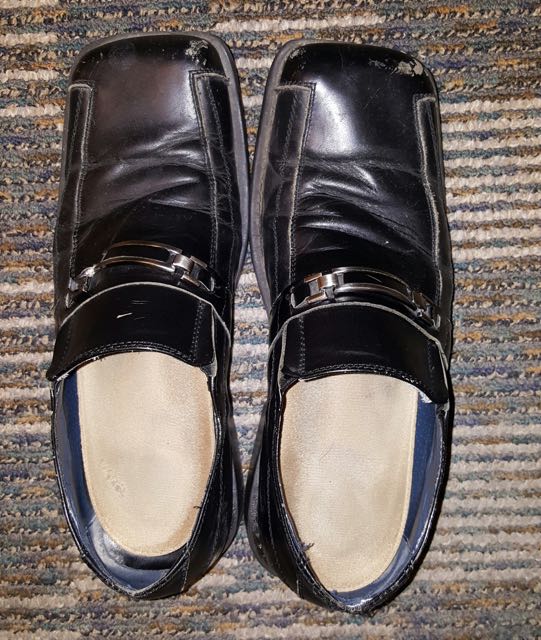
This pair of office shoes isn't too shabby, considering I've worn them about 10 years. At least, I thought they still looked OK when I looked down at my feet every day.

A pair of men's black dress shoes on the floor, seen from above.

Recently I began running and my knees demand a little more special attention. For some reason, I picked up my old pair of shoes and viewed them from an angle I'd never seen before. The heels surprised me. The inside of each heel had a sole 1 and 1/4" high. This contrasted with the way the sole had worn down on the outsides. The outside of the left heel was only 5/8" high, and the outside of the right heel was only 3/8" high. My feet must roll out to the side when I walk.

A pair of men's black dress shoes held on a person's lap, viewing the back of the heels.

Lessons:

  • Walk in a pair of shoes for ten years.
  • Change the pace at which I walk.
  • Go barefoot for a moment.
  • Look at the shoes from a new angle.
  • My right leg carries more weight than my left leg. I already knew this. But did I ever think about how it affects my shoes, and how my shoes might affect my knees?
  • I probably stand a little shorter when my feet roll outward and stand taller again when my feet roll inward.
  • Take care of my knees. Buy new shoes.
  • Check the tread on my car tires, while I'm at it.

Saturday, March 19, 2016

A receptive mind

We all carry preexisting beliefs, preferences, judgments. "An empty head is not really empty; it is stuffed with rubbish. Hence the difficulty of forcing anything into an empty head," Eric Hoffer said. We must be careful about the thoughts we cultivate. As Upton Sinclair put it: "And here is the crucial fact, never to be forgotten; what we believe about this spring [the wellspring of the soul] helps to determine what flows out of it!
"

One pitfall to avoid is obsessive thought or unrelenting inquiry. All thought is a kind of illusion, and to be unable to loosen one's grip is to drown what merit the thought might have had if it had been kept in its proper context. "To the mind which pursues every road to its end, every road leads nowhere," said Alan Watts.

One rule of thumb is K.I.S.S., "Keep it simple, stupid." Albert Einstein said, "If you can't explain it to a 6-year-old, you don't understand it yourself."

It's also important to admit when we are ignorant or uncertain, but not – depending on the degree of uncertainty and the relevance of the information – let our imperfection stop us from moving forward. Leah Hager Cohen wrote: "Firefighters, surgeons, triage nurses, hostage negotiators, miners, loggers, police officers, and soldiers all regularly face situations in which they have to take action based on imperfect knowledge – and where the repercussions of those actions might mean the difference between life and death. These are people who have to deal with the discomfort of acknowledging, 'I don't know,' and then get on with it."

Better to admit the gap in one's knowledge than to stuff it with rubbish!

Sources

Eric Hoffer, quoted in the Nashville Tennessean, quoted in The Week, August 10, 2012, p. 17.

Upton Sinclair, What God Means to Me. New York: Ferris Printing Company, 1935. p 4.

Alan Watts. Nature, Man, and Woman (1958). New York: Vintage Books, 1991. p 84.

Albert Einstein, quoted in the Chicago Tribune, Cited in The Week, September 14, 2012, p. 19.

Leah Hager Cohen. I Don't Know: In Praise of Admitting Ignorance (Except When You Shouldn't). New York: Riverhead Books, 2013. p. 33.

Wednesday, March 16, 2016

Thought requires language

The finger that points to the moon should not be confused with the moon itself, as the proverb has it. Osho wrote, “You become so obsessed with the word God that you forget that God is an experience, not a word. The word God is not God, and the word fire is not fire, and the word love is not love either.”


And yet we do not, cannot, experience things exactly as they are. We experience them mediated through thought, and that seems to require words. Lance Morrow:

”We know what we think when we find words. Language is the vessel that carries us, our home and spaceship, and outside its protection, there is no oxygen for us. Outside the dimension of language lies a void in which the human conscience cannot breathe. To abandon language is suicide.”


Mark Haddon wrote in a novel: "The word metaphor means carrying something from one place to another, and it comes from the Greek words meta (which means from one place to another) and pherein (which means to carry), and it is when you describe something by using a word for something that it isn't. This means that the word metaphor is a metaphor.
"

Marie-Jean-Antoine-Nicolas Caritat:

"In the infancy of language nearly every word is a metaphor and every phrase an allegory. The mind grasps the figurative and the literal sense simultaneously. The word evokes the idea and at the same time the appropriate image by which the idea is expressed; but after a time the human mind becomes so accustomed to using the word in this figurative sense that by a process of abstraction it tends to fix on this alone and to lose sight of its original meaning: and so the secondary and the metaphorical sense of the word gradually becomes its ordinary, normal meaning. The priests, who were the guardians of this original allegorical language, used it in their dealings with the people who were by now incapable of understanding it properly for, having used it so long in only one way, they had come to think of this as the only way of doing so; with the result that when the priests used some expression and meant by it a quite simple truth, the people understood by it heaven knows what absurdity. The priests exploited the written word in a similar fashion, for when they used signs to represent some astronomical phenomena or some incident in the cycle of the seasons, the people saw only references to human beings, animals, and monsters.
"

Our language deserves to exist as much as anything else has its place on Earth. Alan Watts:

”'Words are noises in the air; they are patterns of thought, patterns of intellect, like a fern. Do you put down a fern because it has a complicated pattern?'
'No,' he said. 'But the fern is real – it's a living, natural thing.'
And I said, 'So are words! I'll make patterns in the air with words, and make all sorts of concepts and string them together, and they're going to be great! So don't put it down – it's a form of life like any other form of life.'”

By allowing us to communicate, language gives us political life. Giorgio Agamben:

”The question 'In what way does the living being have language?' corresponds exactly to the question 'In what way does human life dwell in the polis?' The living being has logos by taking away and conserving its own voice in it, even as it dwells in the polis by letting its own bare life be excluded, as an exception, within it. Politics therefore appears as the truly fundamental structure of Western metaphysics insofar as it occupies the threshold on which the relation between the living being and the logos is realized. In the 'politicization' of bare life – the metaphysical task par excellence – the humanity of living man is decided. In assuming this task, modernity does nothing other than declare its own faithfulness to the essential structure of the metaphysical tradition. The fundamental categorical pair of Western politics is not that of friend/enemy but that of bare life/political existence, zoe/bios, exclusion/inclusion. There is politics because man is the living being who, in language, separates and opposes himself to his own bare life and, at the same time, maintains himself in relation to that bare life in an inclusive exclusion.”

Sources

Osho. Autobiography of a Spiritually Incorrect Mystic. New York: St. Martin's Griffin, 2000. p 162.

Lance Morrow. Evil: An Investigation. New York: Basic Books, 2003. p 219.

Mark Haddon (in the character of Christopher). The Curious Incident of the Dog in the Night-Time. New York: Vintage Contemporaries, 2004. p 15.

Marie-Jean-Antoine-Nicolas Caritat, Marquis de Condorcet. Sketch for a Historical Picture of the Progress of the Human Mind. (1794) Translated by June Barraclough. Westport, Conn.: Hyperion Press, Inc. 1955. p 37.

Alan Watts. What is Zen? Novato, CA: New World Library, 2000. p 100.

Giorgio Agamben. Homo Sacer: Sovereign Power and Bare Life. (1995) Translated by Daniel Heller-Roazen. Stanford University Press, 1998. p. 8.

Sunday, March 13, 2016

Quotes on uncertainty in philosophy

Mark Corner:

"It is the beliefs of which we can be most certain, [John Henry] Newman [author of University Sermons] argues, that play the least significant part in our lives. We can possess a mathematical certainty that two and two make four, but this rarely matters to us. On the other hand, we can never possess such a certainty that someone loves us. There is always a possibility of deceit or self-deception. But it is precisely the possibility of being wrong in believing that someone loves us that makes it appropriate to talk in this context of trust."

R. I. Page:

"According to Snorri (not in Voluspa but in Vagprudnismal), two humans will survive the holocaust [in Norse mythology at the end of the world], nourished by the morning dews. From them the new race of men will be born. So the whole sad business starts again. Gangleri would doubtless have wanted to know more, but High shuts him up firmly. ‘If you want to know anything after this, I’ve no idea where you are going to learn it from. I’ve heard nobody tell of the future of the world beyond this point. So make the most of what you have learnt.’ Which is probably as far as any philosopher has got."

Rene Descartes

"I will say nothing of philosophy except that it has been studied for many centuries by the most outstanding minds without having produced anything which is not in dispute and consequently doubtful and uncertain."

Alexander McCall Smith:

"She stopped. It was time to take the pumpkin out of the pot and eat it. In the final analysis, that was what solved these big problems of life. You could think and think and get nowhere, but you still had to eat your pumpkin. That brought you down to earth. That gave you a reason for going on. Pumpkin."

Sources

Mark Corner, Does God Exist? New York: St. Martin's Press, 1991. p 28-29.

R. I. Page. Norse Myths. Austin: University of Texas Press, 1990. p 66.

Rene Descartes. "Discourse on the Method of Rightly Conducting the Reason and Seeking Truth in the Field of Science." Discourse on Method and Meditations. Translated by Laurence J. Lafleur. Indianapolis: Bobbs-Merrill Educational Publishing, 1960. p 8.

Alexander McCall Smith. The No. 1 Ladies' Detective Agency. (1998) New York: Random House, Anchor Books, 2002. p 85.

Thursday, March 10, 2016

Atto Melani in 'Imprimatur'

Imprimatur by Rita Monaldi and Francesco Sorti (2002) and translated from Italian into English by Peter Burnett (2008) features Atto Melani, a castrato singer and abbot who is a friend of the narrator's on a 17th-century Da Vinci Code-esque adventure. He was a real person – "a castrato opera singer, also employed as a diplomat and a spy," according to his Wikipedia entry – who appears in this novel as a fictional character.

The narrator knows early on that Atto is a eunuch. “I realized at that point that I had not asked the abbot whether he was a composer, an organist or a choirmaster. Fortunately, I withheld that question. His almost hairless face, unusually gentle and womanish movements, and above all his very clear voice, almost like that of a small boy who had unexpectedly attained maturity, revealed that I was in the presence of an emasculated singer.” (pp. 22-23) At one juncture, Atto sings “non ti chiedo mercĂ©” [I ask you no mercy] and “Lascia ch’io mi disperi” [Let me despair]. (p. 253)

He knows Nicolas Fouquet, who is described as “a mere bell-ringer’s son who, from his beginnings as a poor castrato, had so risen as to dispense counsel to the Sun King.” (p. 80) This does not entail that he always acts with decorum nor that he always receives respect. Atto prods Dulcibeni: “You should thank Huygens and that slobbering old Feroni if they did her the honor of ripping open her maidenhead before they threw her into the sea.” To which Dulcibeni responds: “Silence, castrato, shame of God, you who can only get your arse ripped open...That you liked plunging your cock in the shit, that I knew; but that you head was full of it too...” (p. 461)

Overall he has a strong attitude:

“Very well,” conceded Atto, reaching forward with his lantern to show the way. “It is always up to me to resolve everything.” (p. 84)

The posse includes a sidekick Ugonio who speaks like this: “To obtain more benefice than malefice, and to be more padre than parricide, I abominate the artefactor of this revolting, merdiloquent and shiteful spectacule. He is a disghastly felonable!” (p. 391) They are fixated on medications to ward off plague, such as this recipe: “four drachms of Armenian bole, terra sigillata, zedoary, camphor, tormentil, burning bush and hepatic aloes, with a scruple of saffron and cloves, and one of diagrydium, juice of savoy cabbage and cooked honey.” (p. 54)

Rita Monaldi and Francesco Sorti. Imprimatur. (2002) Translated from Italian to English by Peter Burnett (2008). Edinburgh: Polygon, 2008.

The sequel is Secretum:

In case you missed it

Have you seen inside the book 'To Climates Unknown'?

The alternate history novel To Climates Unknown by Arturo Serrano was released on November 25, the 400th anniversary of the mythical First ...