Showing posts with label eunuchs in italy. Show all posts

Friday, February 23, 2018

Perceptions of eunuchs in Claudian's 'In Eutropium'

Claudian wrote In Eutropium (Against Eutropius) to denounce the prominent eunuch by that name. Eutropius was a Roman consul in the late fourth century CE and Claudian acknowledges him as the third founder of the city after Byzas and Constantine (2.83), but that doesn't stop Claudian from making pejorative references to eunuchs as "half men" (1.171, 2.22). Jacqueline Long writes, “Any androcentric culture would find emasculation a natural invective tactic.” (Long, p. 122) Claudian depicts Eutropius as greedy, a stereotype of eunuchs that may have formed from the assumption of the displacement of lust for sex toward lust for money. A spin on the meaning of a eunuch’s childlessness — namely, that it leaves him emotionally stunted and not learning how to bond or serve others (rather than affording an opportunity for displacement of the tendency to bond and serve) — appears in Claudian’s words: “a eunuch is moved by no devotion, nor does he fear for family and children,” (1.83-88, as quoted by Long, p. 135).

Much of the criticism is not just abstract, but sensory:

“The figure of the eunuch makes an irreconcilable antithesis with all the honors Eutropius achieves. Creating a vivid sensory impression that will remain in the audience’s mind is the imagery’s most important task. An example of its effect, with supporting details further elaborated, is given by the contrast of the slavish, effeminate, shameless, sagging, filthy, whining, bibulous eunuch’s impersonation of a triumphator.” (Long, p. 121)

Claudian asked sarcastically, "Have we ever seen a temple built or altars raised to a eunuch god?" Of course we have — the Egyptian god Osiris. This point of Claudian's does not stand up to scrutiny.

Furthermore, within Claudian's poem, Cybele watches the self-mutilating Curetes dance. See also Luc. 1.559-63; after this section, there is mention of Bellona and Cybele’s self-mutilating priests. (Long, p. 110)

In "Don Juan: Dedication," George Gordon Lord Byron (1788-1824) used the term "intellectual eunuch" to complete the metaphor of the adoration of a sultan in Stanza XI. In Stanza XV, the words "emasculated" and "Eutropius" appear, associating castration with servitude.

Sources

Jacqueline Long. Claudian's In Eutropium: Or, How, When, and Why to Slander a Eunuch. Chapel Hill: University of North Carolina Press, 1996.
Elagabalus, 3rd century Roman emperor: A eunuch?

Was the Roman emperor Elagabalus castrated?

His full name was Marcus Aurelius Antoninus (born 204 CE, ruled 218-222 CE). He was better known as Elagabalus or by a spiritualized version of that name, Heliogabalus, helios being Greek for "sun." He was a sun-worshipper who participated in the taurobolium and possibly was castrated or infibulated (genitally pierced). His goal was to unite all Roman religions, but this was not achieved during his reign that lasted merely three years and nine months.

The 12-century Michael Glycas said that the emperor asked surgeons to castrate his husband Hierocles and construct female genitalia for him, while the 12-century John Zonaras said that the emperor requested such a surgery for himself. (Lascaratos and Kostakopoulos, p. 234)

Regarding his possible castration, Georges Duviquet wrote: “Il alla agiter sa tête avec les prêtres châtrés de Cybèle, se liant comme eux les parties génitales, observant toutes leurs coutumes; puis il emporta, our le déposer dans le temple de son dieu, leur trésor sacré.” (Duviquet, p. 51) An endnote to this comment added: “Genitalia devinxit. Saumaise et Gruter proposent defixit pris dans le sens d’enlever, arracher. On a vu dans Aurélius Victor qu’Héliogabale, s’étant coupé les parties génitales, abscissis genitalibus, se consacra à la Mère des dieux.” (Duviquet, p. 286) Duviquet included a diagram of a statue that shows Heliogabalus with intact genitalia. (Duviquet, p 55)

Sources

"Operations on Hermaphrodites and Castration in Byzantine Times (324-1453 AD)." John Lascaratos and Athanastos Kostakopoulos. Urologia Internationalis 1997; 58:232-235.

Georges Duviquet. Héliogabale. Paris: Société du Mercure de France, 1903.

Tuesday, June 2, 2015

A stereotype of a castrato (London, 1784)

The following passage in an 18th-century magazine of prurient interest shows how castrati were perceived in England. The universalized "Signior Castrati" is portrayed as vain, "frequently viewing" himself in a mirror. He is "deprived of the grand essence of manhood" and is an "apology for a man," yet, as a singer, he is "almost deified" by his women admirers. Furthermore, as a sexless "piece of neutrality," he appeals sexually to both men and women, the latter especially because he cannot cause them to fall pregnant.

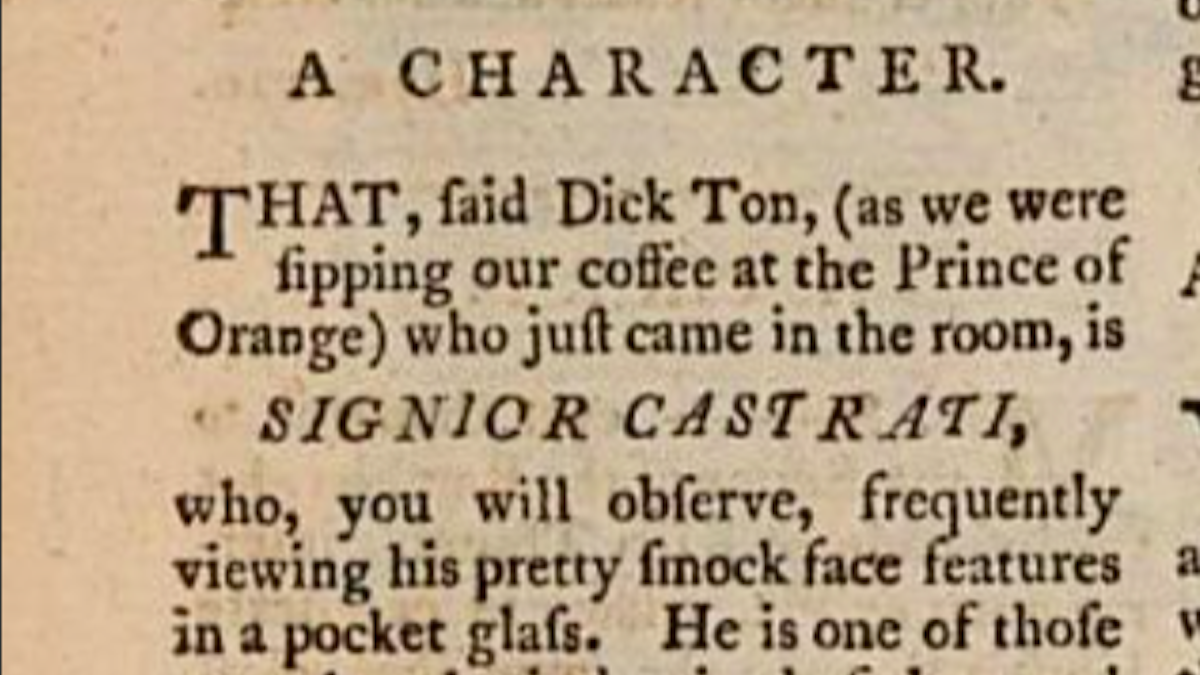
That, said Dick Ton, (as we were sipping our coffee at the Prince of Orange) who just came in the room, is Signior Castrati, who, you will observe, frequently viewing his pretty smock face features in a pocket glass. He is one of those mortals, who is deprived of the grand essence of manhood, in order to qualify him for the amusement of the delicate and polite part of mankind in the vocal way. He is descended from obscure parents in Italy; being bred to music, the chief study and pursuit of the inhabitants of that part of the world, he came over to England to try his talents, where having succeeded to his utmost wishes, he cuts what may be called a fine figure. He has made the tour of Great Britain and Ireland, and such is the depravity of the reigning taste, that this apology for a man, through the charm of sound, has as many admirers, as the first actors; and particularly among the female world, by which he has been almost deified.

You may wonder, as you please, at his universal reception among the ladies, as his excellency in one point, cannot make up for his deficiency in another; but you will wonder more when I inform you, that this piece of neutrality, neither male nor female, has charmed into the married state a very fine woman with a considerable fortune. These mutilated fellows are objects of choice to some wanton lascivious persons, because they are adapted to gratify the inordinate craving of those rank beldams, as they can keep the field in one regular series, and never decline the encounter ‘till they have the word of command. They are also extremely convenient for those precise ladies, of such extraordinary mock modesty, who are mightily concerned for their virtuous reputation, as they can indulge their little wanton sallies, without running the danger of any disagreeable consequence.

The above is the entire text of the article “A Character.” The Rambler's Magazine (London), February 1784, p. 74. Available to read for free on Google Play.

The first sentence of A Character in the original typesetting. That, said Dick Ton, (as we were sipping our coffee at the Prince of Orange) who just came in the room, is Signior Castrati, who, you will observe, frequently viewing his pretty smock face features in a pocket glass.

Monday, May 25, 2015

Castration at the Battle of Adwa (1896)

May 25, 2026: After eleven years, I have moved this article to Medium. It's paywalled there. Thank you, thirty thousand people who have viewed this. If you pay $5/month to Medium, you can read my article (and millions more by everyone who writes there).

Ethiopian painting of the Battle of Adwa, showing one army aiming a cannon at the other, which is about to decapitate a prisoner.

Detail of Ethiopian painting commemorating the Battle of Adwa, Catalogue No. E261845-0, Department of Anthropology, NMNH, Smithsonian Institution. Photo by Joshua Sherurcij, 2007.


My books

If you are interested in castrated villains in fiction, please check out Painting Dragons: What Storytellers Need to Know About Writing Eunuch Villains. If you are interested in the Western literary treatment of castration in history, please check out Ten Past Noon: Focus and Fate at Forty. Both are by Tucker Lieberman.

In case you missed it

Have you seen inside the book 'To Climates Unknown'?

The alternate history novel To Climates Unknown by Arturo Serrano was released on November 25, the 400th anniversary of the mythical First ...