Showing posts with label false beliefs. Show all posts

Monday, June 24, 2024

Speaking of bearing false witness

Louisiana has mandated posting the Ten Commandments in public school classrooms.

"Louisiana classrooms now required by law to display the Ten Commandments," Stephanie Gallman Dianne Gallagher, CNN, June 19, 2024

Here's the law (PDF).

Donald Trump's reaction:

"'Has anyone read the ‘Thou shalt not steal’? I mean, has anybody read this incredible stuff? It’s just incredible,' Trump said at the gathering of the Faith & Freedom Coalition. 'They don’t want it to go up. It’s a crazy world.'

Trump a day earlier posted an endorsement of the new law on his social media network, saying: 'I LOVE THE TEN COMMANDMENTS IN PUBLIC SCHOOLS, PRIVATE SCHOOLS, AND MANY OTHER PLACES, FOR THAT MATTER. READ IT — HOW CAN WE, AS A NATION, GO WRONG???'"

— "Trump Endorses Ten Commandments In Schools, Urges Evangelical Christians To Vote: Donald Trump has told a group of evangelicals that they 'cannot afford to sit on the sidelines' of the 2024 election, imploring them at one point to 'go and vote, Christians, please!'." Michelle L. Price and Ayanna Alexander, HuffPost, Jun 22, 2024

The reason that people who are secular or pluralistic don't think the Ten Commandments should be put up in public schools and other public buildings isn't that we think it should be legal to steal.

Speaking of bearing false witness.

U.S. Capitol building

Read more on Medium: Rep. Jamie Raskin’s book Unthinkable

"An initial review by The Texas Tribune of the proposed textbooks showed that religious references are featured prominently, with texts sourced from the Bible being the most heavily used." Texas is a really large textbook market which then sets the standard for those markets nationwide.

[image or embed]

— Nails Nathan (@chadstanton.bsky.social) Jun 27, 2024 at 6:38 PM

if you squint, you can see some of the last dying vestiges of principled bipartisan conservatism that used to be fairly common in oklahoma governance

[image or embed]

— GOLIKEHELLMACHINE (@golikehellmachine.com) Jun 25, 2024 at 11:01 AM

Oklahoma State Superintendent Ryan Walters issued this memo today requiring teachers in all schools to keep a Bible in their classroom and teach from it as a historical document. (Via KOCO 5 News)

[image or embed]

— David S. Bernstein (@dbernstein.bsky.social) Jun 27, 2024 at 12:54 PM

Sunday, May 26, 2024

If we have abundance right now, how would new computing systems increase it?

Samantha Murphy Kelly writes this for CNN a few days ago ("Elon Musk says AI will take all our jobs," May 23, 2024).

"Elon Musk says artificial intelligence will take all our jobs and that’s not necessarily a bad thing.

“Probably none of us will have a job,” Musk said about AI at a tech conference on Thursday.

While speaking remotely via webcam at VivaTech 2024 in Paris, Musk described a future where jobs would be “optional.”

“If you want to do a job that’s kinda like a hobby, you can do a job,” Musk said. “But otherwise, AI and the robots will provide any goods and services that you want.”

For this scenario to work, he said, there would need to be “universal high income” – not to be confused with universal basic income, although he did not share what that could look like. (UBI refers to the government giving a certain amount of money to everyone regardless of how much they earn.)

“There would be no shortage of goods or services,” he said.

A question within a capitalist framework: If in the future no one will be paid for maintaining the AI and the wealth will be redistributed, what's the incentive for anyone to work to develop the AI today?

A question outside a capitalist framework: If there's "no shortage of goods or services" and hence enough abundance or wealth for everyone to have a universal income to meet all their needs and receive luxuries too, while playing with "AI and the robots" as an unpaid hobby to help distribute the goods and services to others...why do we need to wait for new computers that are technically able to do this distribution? Why don't we begin enjoying that wealth right now?

She is talking about how AI has longterm certainty when they can barley afford the servers they run on and that AI generators are not being sued left, right, and center right now. If had this much delusion, I could be a NYT bestseller right now. 🤣

[image or embed]

— Georgina Kiersten (they/them) (@ingloriousgigi.bsky.social) Jun 21, 2024 at 8:26 AM
purple flowers in grass

Wednesday, January 11, 2023

What would it take for someone to decide to get the COVID vaccine?

Originally published March 12, 2021 to Bob Lane's Episyllogism blog, which has gone offline.


When we are speakers, we may ask: How can I present my argument in a better way? Other times, as seekers, we need to ask what we can do to search, listen, and judge correctly.

A focus group of vaccine-hesitant Trump-Republicans

In mid-March 2021, Frank Luntz and Brian C. Castrucci held a focus group by videoconference with “19 vaccine-hesitant Trump Republicans” from “diverse economic backgrounds.” In the United States, fewer than half of white Republicans have already gotten the vaccine or told pollsters that they definitely will accept the vaccine when it is offered to them, so these “vaccine-hesitant” people are representative of a large demographic within the Republican Party. Luntz and Castrucci wanted to know what “ideas and messages” could possibly persuade these people to be vaccinated.

All participants agreed that the virus was real. To the extent that they were disposed to listen to anyone’s advice about vaccination, they said they’d rather take medical advice than ex-president Trump’s advice. Yet they didn’t understand why scientific predictions and recommendations had changed over time, and they felt that competing or changing information caused them to doubt the importance of vaccines.

Furthermore, they had a number of other beliefs that dampened their interest in vaccines. Some had been previously diagnosed with COVID and believed that they were already immune and did not need to be vaccinated. Others were unafraid of the illness or were more afraid of the vaccine (which they called “experimental,” “rushed” and “unproven”), or felt that there would not be sufficient immediate payoff for taking the vaccine (as social distancing restrictions would likely remain in place for a long time in any case). Another complained of “opportunistic politicians” for whom the vaccine was a tool in a mysterious plot for the “manipulation” and “socialization of society.” One said that lockdowns were a method of political “control.”

The group participants needed information and comprehension

The group members were missing basic information. They needed to hear that the vaccine was developed according to existing technologies; that the trials involved an unusually large sample size; that the Trump administration deliberately lifted regulatory requirements to speed up approval; that the vaccine has never killed anyone; that no one who has been vaccinated has gone on to die of COVID-19, either; that almost all doctors are vaccinated when they have the opportunity. Once they absorbed these facts, they were more open-minded toward the vaccine.

Of course people “do not want to be ridiculed, embarrassed or told that their thinking is ‘Neanderthal,’” as Luntz and Castrucci wrote for the Washington Post. As in any dialogue, the discussion needs to focus on the issue and not the person, and people won’t remain in the discussion unless they are treated gently and kindly.

But also: This group was designed within the boundaries of a political affinity

Luntz and Castrucci said everyone in their focus group was “eager to hear the facts.” They described these facts as “apolitical notions” that swayed the participants’ opinions. However, while the facts may have been apolitical, the group dynamics surely were not. They didn’t point this out in their Washington Post article. I am pointing it out.

The focus group itself was a political affinity group. All 19 participants (the subjects, that is) were Trump-Republicans, and we might expect that they were more open-minded and trusting with each other than they would have been in a more politically diverse group, especially given their beliefs that Democratic politicians seek to manipulate and control Americans through COVID policy. It so happens that the focus group was co-led by former Centers for Disease Control and Prevention director Dr. Tom Frieden, as well as four prominent Republican politicians, two of whom also happen to be physicians. The focus group participants enjoyed a once-in-a-lifetime opportunity to speak directly to these people. I don’t think we can assume that they would have been as receptive to physicians’ messages if the physicians had not so thoroughly embodied the imprimatur of Republican leadership. “If we had that kind of time and space with all vaccine-hesitant Americans, we would surely be able to move the needle,” Luntz and Castrucci wrote. Of course. And obviously it’s not possible. Congressional Republicans, governors, and national medical leaders can’t hold the hands of every American in a two-hour personal conversation to catch them up on a year’s worth of news they’ve been choosing every day not to read or listen to.

In other words, for all that the cultural right mocks the desire for “safe spaces” that reduce the likelihood that one’s identity will be challenged, this focus group was the epitome of a “safe space.” And it was only within such a safe space that the group leaders were able to begin to break through a year’s worth of science denial and epidemiologically bad behavior.

People need to take responsibility for their own information diet Near the end of the Washington Post article, this statement was notable to me: one focus group participant expressed interest in more data, while another just needed to hear a single emotionally affecting story.

The latter is a known phenomenon to storytellers, psychologists, and marketing experts everywhere. People generally do respond better to a story. “A single death is a tragedy; a million deaths is a statistic,” the proverb goes.

As for the former phenomenon, the person who craved more information: There are, of course, always people who say they want the statistics and who might really be equipped to begin to make sense of those large numbers. If they are academically interested, or if their intellect gravitates them more toward the logical than the emotional, that is fine.

But what I can’t quite wrap my head around is that these people were speaking in March 2021 rather than March 2020. Now that nearly 3 million people have died worldwide, a half-million of those close to home in the US, with many more people having been seriously sickened from the same disease, we do have the answers. The emotion is there. The logic is there. The answers have been available, and they have been communicated. We don’t need more data before we can decide. We don’t need more people to tell their tales of woe. The right decision is clear, and the right action should follow as a consequence: We need everyone to wear a mask, socially distance, and get a vaccine.

Of course, data can always be corrected and enhanced, and storytelling can always be improved. This is part of maintaining good communication. But the audience also needs to work on reading and listening.

Often the audience isn’t paying attention. It does not help to wield that observation as a deliberate insult, nor to say it quite so directly to someone’s face, as it will be received as an insult. But it is nonetheless true. Scientists and communication professionals have been talking. An important piece of the question is who is listening. If someone doesn’t make an effort to seek good information, pay attention to what they find, and critically evaluate it, they won’t have the knowledge they claim to want. If someone wants epidemiologically correct information, they need to listen to epidemiologists. If a politician whose primary raison d’être is being a racist troll has taken up a media campaign telling people not to worry about a potentially fatal, highly contagious disease, the public needs to assume that the politician is not speaking in good faith, unfollow them on Twitter, and not vote for them again. If the audience isn’t getting what they want from their television series, they need to try a different one. They can’t just sit and complain and blame their own ignorance on the series’ director. For the first week, yes, it’s the television’s fault; for an entire year, no. They are choosing to watch the confusing material. They need to change their own behavior.

Considering the supply-and-demand of good information in the Information Age, the deficit is surely not in the supply. The supply is high-quantity, and people need to learn to weed out the low-quality material. People need to learn to curate what they’re taking in. If someone has had a poor “information diet” for the past year — whether by overconsumption of bad material festering in a terrible corner of the information ecosystem, or by neglecting to read or listen to anything at all — it is their responsibility to change the channel. Ultimately, no one can do it for them.

There are a number of “how-to” books on critical thinking. They come in different flavors: everything from making sound philosophical arguments, to listening to scientists, to escaping cults. A very recent title is Behind the Scoop: Why You Should Think and Act Like a Journalist by the journalist Johannes Koch. It is accessibly written, a manageable length, and it reminds people that they are empowered to clean up their own information diet. It is also a book that you might plausibly give to someone else since it covers other topics, too, beyond just boosting your critical thinking habits.

I can empathize with someone who is wrong, but they are still wrong

I can muster empathy, to a limited extent, for people who are vaccine-hesitant. The part I can potentially empathize with is their general feeling of alienation from some aspect of the modern world—science, politics, culture—or their anxiety that someone is trying to hurt them. I may disapprove of their reason for feeling alienated or anxious, yet, in a far broader sense, I too am a human who knows what alienation and anxiety are. If they say they’re “scared and outraged,” I hear that and I know roughly what they mean.

However: Even if I manage to empathize with them as people and understand that they are having feelings, that doesn’t mean I can tolerate their error. In this particular case, factually, they are simply wrong. We’re all factually wrong about something now and then. Sometimes it’s a tiny detail that can be glossed over. The COVID vaccine is a particularly grave matter, and it is important that we arrive at a general agreement on the indispensability of this virus-fighting tool and that we perform the necessary act of solidarity; otherwise, we will never reach herd immunity from the COVID disease.

I don’t need to actively, directly, personally insult individuals who are vaccine-hesitant. At the same time, when someone holds a dangerously false belief, it’s necessary to be blunt (either with them or about them). They need to begin listening to the general agreement of the scientific and medical community. There is just no way around that outcome. Unfortunately, not everyone has an invitation to a focus group in which they get to have a two-hour personal conversation with the former director of the U.S. CDC, so they need to find another pathway through roughly the same information that will lead them to the same conclusion.

If I were to make (in this context, anyway) too many suggestions about how to think critically, it would sound patronizing. Anyway, I’m neither a scientist nor a science communicator. I’m sure I don’t need to explain how to make a choice about a vaccine. People know how make good decisions about the health of themselves and others. They just need to do it. Critical thinking is a choice about who to trust, what to care about, and when to put the time in. Now is a good time.


Note: Wikipedia has an article called "vaccine hesitancy."


BREAKING: We obtained an email confirming the Trump admin is shutting down HHS's Office of Long Covid. RFK Jr. pledged in his confirmation hearing to support LC research, and prioritize tackling chronic diseases. 20m people have Long Covid and there's no cure. www.politico.com/news/2025/03...

[image or embed]

— Alice Miranda Ollstein (@alicemiranda.bsky.social) March 24, 2025 at 8:30 PM

Avram Alpert writes ("What we misunderstand in the debate over free speech," The Guardian, Oct 23, 2025):

"NPR reported a story in 2021 about a woman who turned against vaccines after the birth of her child. She had originally had her newborn vaccinated, and it appeared that her child had an abnormally bad reaction. The doctors didn’t take her concerns seriously, but people online did. She went down a rabbit hole and diminished her freedom of thought in exchange for a community of care.

Over time, she broke with the antivax movement because she found a doctor who listened to her concerns and explained the science without accusation. Free thought arises not only through experience and research, but also patience and listening. This is what Loretta J Ross speaks of as creating a “call-in” rather than a “call-out” culture."


To read a modern short fable about the vaccine: "The Princess Who Slept Through the Pandemic" (March 2, 2021). It's a 5-minute read on Medium.

To read more about conspiracy theories and resistance to facts, please see articles like "A Year Later, the Reckoning with Jan. 6 Continues" (Jan. 6, 2022). It's a 6-minute read on Medium.

an outward-facing palm is raised to say no

Iowa Republicans’ bill to criminalize vaccine providers advances amid funnel week chaos, Zachary Oren Smith, Iowa Starting Line, March 3, 2025

In 2025, Trump is pretending he didn't know all along that RFK is anti-vaccine: Trump Distances Himself From RFK Jr.: Vaccines That Work 'Should Be Used'. If Trump believes that some vaccines are important, why did he appoint RFK to be health secretary? (HuffPost)

FDA intends to put its most serious warning on Covid vaccines, sources say The US Food and Drug Administration intends to put a “black box” warning on Covid-19 vaccines, according to two people familiar with the agency’s plans. CNN, Dec 12, 2025

Has anyone ever reported out a story asking anti-vax/science people : “when in your life did you stop believing science?” Like, kids (at least in my experience) are fascinated w/learning. I believe my job as a parent is to foster that and help them learn how to learn. So when do folks turn away?

— Josh Sternberg (@joshsternberg.com) March 3, 2026 at 7:29 PM

April 2026: The Trump regime has bombed the Pasteur center in Iran where many people got vaccines.

Tuesday, November 30, 2021

What do we value when we value ignorance and hypocrisy?

Ben Smith's article in the New York Times (November 28, 2021) observes that it's easier to handle "an information crisis...than a political one." Some "well-meaning communications experts" have tended to believe, Smith writes, that "if only responsible journalists and technologists could explain how misguided Mr. Trump’s statements were, surely the citizenry would come around." Unfortunately, they "never quite understood that the people who liked him knew what was going on, laughed about it and voted for him despite, or perhaps even because of, the times he went 'too far.'" And that is still how they feel. It's not a lack of information. Some people deliberately choose falsehood. That is their politics.

They chose him a second time in the November 2024 election.

On October 12, 2025, Trump told journalists on Air Force One: "...literally, you walk over from Iran to Qatar. You can walk it in one second. You go ‘boom boom,’ and now you’re in Qatar..."

X post with song lyrics: He could walk 600 miles and he could walk 500 more, just to be the man who walked 1100 miles from Iran to Qatar!

Post on X

On that note... Spotted on Twitter, an argument:

"Hemry, Local Bartender" says: People who take health precautions during pandemic — vaccines, masks — tend to assume that people who deliberately avoid these precautions are missing some information. But maybe they just understand any sort of public health measure as totalitarian. For them, there are no shades of lockdown. Their values might be "completely withdrawn from the social compact." When others incorrectly assume that they have certain values, it further "violently alienates them." And there may be nothing you can do to change their minds. You can't give them values like empathy and solidarity. As long as they lack relevant values, you can't give them information (usefully organized facts for particular purposes). They will do nothing with the information.

Several days ago, I had a brief online exchange with a blogger (not Hemry; someone else). This blogger made a strange, incoherent argument. I've squinted at it trying to put it into some logical order. Roughly, this was his position. This is as coherent as I can possibly make it.

He says: (1) Our ethical choices are “authentic” only if we have total individual freedom. When we instead constrain ourselves to manage collective risk, we’re focusing on an abstraction. It’s a hyperobject whose justification we don’t fully understand. Since we don’t understand it, we’re not making a truly ethical choice. We’re only ethical when we make choices whose extended ramifications we fully understand.

He also says: (2) There is a coronavirus, but people don’t die of it. They die, instead, of unspecified “political and economic” causes that are being blamed on the virus. Therefore, transmitting the virus is “solidarity.” (I guess his reasoning is that, if enough of us get the virus — as if over 260 million confirmed cases and over 5 million deaths worldwide is not yet enough evidence — we will eventually realize the true political and economic causes of other people's deaths? Seems to be a kind of scientific experiment to isolate variables?)

(1) and (2) are apparently contradictory, though. (1) says not to act on things you don't understand. (2) says let's run a biology experiment on each other and deliberately give each other disease to find out why 5 million people are said to have already died of that disease so that we can better understand it. That’s this guy's value system. That's "ethical engagement" (1) and "solidarity" (2) to him. In a sense, the contradiction — the hypocrisy — is what he values.

I think that is similar to what Hemry the Bartender points out.

Then, this: Not everyone on the right believes in total individual freedom all the time, of course. There are right-wing arguments for imposing restrictions on many people's bodies. Notably, they generally want to restrict a woman's right to choose abortion. Upon reading Michelle Goldberg's article in the New York Times yesterday, a related question posed itself to me this way: Is it that some people sincerely believe that totalitarian coercion ought to apply to some people and not others (e.g., to women of childbearing age and not men), or are they deliberately hypocritical because hypocrisy proves a successful political strategy for them? In other words, do they sincerely hold any ideals, or do they just seek power?

"It's standard bully behavior for a bully to always cast themselves as the victim of their own behavior. It's standard behavior of an abuser to reverse the victim and offender, to claim the people they dehumanize are dehumanizing them by resisting them, to claim that what they are doing to others is being done to them. Doing so demonstrates the supremacist belief that only supremacists matter. Hypocrisy is a virtue to a supremacist.

We should know this very well by now, but all the same we seem persistently immune, culturally speaking, to this knowledge."

— A.R. Moxon, Apology Not Accepted, The Reframe, Nov 3, 2024

Tuesday, October 13, 2020

Religion may make you happy, but that does not make it true

Religion makes some people happy, but their feelings do not mean that their religion is true.

Richard Dawkins:

I wish it were not necessary to add that such beneficial effects in no way boost the truth value of religion’s claims. In George Bernard Shaw’s words, ‘The fact that a believer is happier than a skeptic is no more to the point than the fact that a drunken man is happier than a sober one.’

A common strategy is for the religion to make the followers feel worthless or broken and then to give them back their sense of worth and wholeness.

Alan Watts:

...if one wants to feel exhilaratingly light-footed, it is always possible to go around for some time with lead in one's shoes — and then take them off. The sense of relief will certainly be proportional to the length of time such shoes have been worn, and to the weight of the lead. This is equivalent to the old trick of religious revivalists who give their followers a tremendous emotional uplift by first implanting an acute sense of sin, and then relieving it through faith in Jesus. But such 'uplifts' do not last...

When we are dissatisfied with life, what we need is not necessarily a religion to fix us, but simply to change our attitude and be grateful for what we do have.

Fenton Johnson:

Dissatisfaction...is the first principle of Buddhism, and thus the foundation on which the whole philosophy is built; if it weren't universally applicable, it would be a pretty weak basis. As a reasonably prosperous, reasonable healthy American I can't really be said to be 'suffering,' at least not in the context of much of the world's population; but we all suffer from dissatisfaction, always and everywhere. And what is the antidote to dissatisfaction? Gratitude.

Perhaps the question we need to ask is not whether God can put up with us until we come to him, fix us in a particular way, and approve of our perfected nature, but whether we can accept ourselves as we are, as works in progress.

Gary Bowen:

I doubt that anyone can achieve religious faith until they start tolerating human frailties.

Sources

Richard Dawkins. The God Delusion. New York: Houghton Mifflin Company, 2006. p. 167.
Alan Watts. The Way of Zen. Originally 1957. Vintage Spiritual Classics Edition 1999. p 170.
Fenton Johnson in “Keeping Faith,” interviewed by Bo Young. White Crane Journal, Fall 2004, Issue #62, p 7.
Gary Bowen, in Raven Kaldera. Hermaphrodeities: The Transgender Spirituality Workbook. XLibris Press, 2001. p 189.

Friday, August 14, 2020

Quotes on lying

"What I see as white, I will believe to be black if the hierarchical Church thus determines it."
Ignatius of Loyola. Quoted by Tom Beaudoin. Consuming Faith: Integrating Who We Are with What We Buy. Lanham, Md.: Sheed and Ward, 2003. p. 54.

"Men hate those to whom they have to lie."
Victor Hugo, quoted in the Associated Press, quoted in The Week, Sept. 26, 2014, p. 17.

"The only lies for which we are truly punished are those we tell ourselves."
V. S. Naipaul, quoted in The Wall Street Journal, quoted in The Week, May 24, 2013, p. 17.

"What does the specific hypnotic experiment with which we started show? (1) The subject wills something, namely, to read his manuscript, (2) he thinks something, namely, that C has taken it, and (3) he feels something, namely, anger against C. We have seen that all three mental acts—his will impulse, his thought, his feeling — are not his own in the sense of being the result of his own mental activity; that they have not originated in him, but are put into him from the outside and are subjectively felt as if they were his own. He gives expression to a number of thoughts which have not been put into him during the hypnosis, namely, those “rationalizations” by which he “explains” his assumption that C has stolen the manuscript. But nevertheless these thoughts are his own only in a formal sense. Although they appear to explain the suspicion, we know that the suspicion is there first and that the rationalizing thoughts are only invented to make the feeling plausible; they are not really explanatory but come post facto.
* * *
An example of irrational rationalization is brought forward in a well-known joke. A person who had borrowed a glass jar from a neighbor had broken it, and on being asked to return it, answered, "In the first place, I have already returned it to you; in the second place, I never borrowed it from you; and in the third place, it was already broken when you gave it to me.'"
Erich Fromm. Escape from Freedom. New York: Avon, 1941. pp. 212-213, 218.

In his Novum Organum Bacon tried to give a systematic survey of these human prejudices. He has given a list of the different kinds of idols: the idola tribus, the idola specus, the idola fori, and the idola theatri, and he tried to teach how to overcome them in order to clear the way which at last will lead to a true empirical science.
Ernst Cassirer. Symbol, Myth, and Culture: Essays and Lectures of Ernst Cassirer 1935-1945. Donald Phillip Verene, ed. (1979) New Haven, Conn.: Yale University Press. p. 264.

“The artist is the most interesting of all phenomena, for he represents creativity, the definition of man. His unconscious is full of monsters and dreams. It provides the pictures to consciousness, which takes them as given and as "world," and rationalizes them. Rationality is only the activity of providing good reasons for what has no reason or is unreasonable.”
Allan Bloom. The Closing of the American Mind. New York: Simon and Schuster, 1987. p. 206.

“She [Sissela Bok] points out that Plato, in his Republic, says that because physicians may use falsehood as a form of healing, they enjoy a right to dissemble that laymen do not.” Leah Hager Cohen. I Don't Know: In Praise of Admitting Ignorance (Except When You Shouldn’t). New York: Riverhead Books, 2013. p. 86.

[John] Grambling’s ability to rationalize his behavior is typical of the attitude that psychopaths have toward their victims. ... “In Grambling’s mind, anyone who is stupid enough to trust or believe him deserves the consequences,” said Rosner.
* * *
When caught in a lie or challenged with the truth, they [psychopaths] are seldom perplexed or embarrassed--they simply change their stories or attempt to rework the facts so that they appear to be consistent with the lie. The results are a series of contradictory statements and a thoroughly confused listener. Much of the lying seems to have no motivation other than what psychologist Paul Ekman refers to as a “duping delight.”
Robert D. Hare. Without Conscience: The Disturbing World of the Psychopaths Among Us. Atria, 1993. (Released by Guilford Press for Kindle, 2011.)

"So often we fight the facts because they do not fit into our preconceived notions of reality, because reality does not conform to what we want or need. We cease to be rational. We begin to rationalize. Rationalization is finding reasons for not being reasonable. It is looking at facts through lenses distorted by desire."
Sherwin T. Wine. Staying Sane in a Crazy World: A Guide to Rational Living. Birmingham, Mich.: The Center for New Thinking, 1995. p. 69

Surely Isaac can tell the difference between Jacob and Esau, yet once he decides to accept the ruse, he cannot resist punishing the boy with fear of discovery. Again and again Isaac asks his son, 'Which one are you?' He goes so far as to bring the boy near to sniff at him. Isaac knows just how corrupt Jacob is as he exclaims, 'Behold, the scent of my son is like the scent of a field blessed by God,' from which we are to understand, perhaps, rich in natural fertilizers.
Burton L. Visotzky. The Genesis of Ethics. New York: Crown Publishers, Inc, 1996. p. 157.

“The first rule of black business everywhere is: never let anyone know what you're thinking. Didier's corollary to the rule was: always know what the other thinks of you.” Gregory David Roberts. Shantaram. New York: St. Martin's Griffin, 2003. p. 56.

”…[assimilated Catholic] Americans mostly find a way to stay in their faith by adhering to values most important to them and quietly ignoring those they disagree with."
Victor J. Stenger. God: The Failed Hypothesis: How Science Shows that God Does Not Exist. Amherst, N.Y.: Prometheus Books, 2008. p. 208.

“The first thing the devil does when he wants you back is offer you a few small lies that you can tell yourself as you walk yourself over to his side.”
Larry Beinhart. Salvation Boulevard. New York: Nation Books, 2008. p. 121.

"Five years after the name Bernie Madoff became synonymous with extravagant fraud, the only thing that makes him unique is the size of his swindle, said Al Lewis. In truth, his scheme was 'simple, common, and frankly, quite pedestrian.' We know this because Ponzi schemes continue to happen 'all the time.' Hundreds of perpetrators have been uncovered since Madoff's crime came to light, and those are just 'the ones who got caught.' The fraudsters all rely on the same classic scam: 'Lure investors with promises of solid returns with no risk.' It works like a charm. The only reason you don't hear much about these schemes, some of which net billions of dollars, is that 'Madoff's Ponzi was so large it ensures minimal attention for all the smaller Ponzis to come.' In fact, some schemes involving 'only a few million dollars' aren't even being prosecuted. The government just asks swindlers to stop what they're doing and release their ill-gotten gains. The world will have Ponzis 'as long as people are willing to fall under the spell of a slick-talking salesman, or follow the uninformed advice of their admired friends, without asking questions.' Even after Madoff, plenty of people still can't recognize what's too good to be true."
The Week, December 27, 2013, paraphrasing Al Lewis, "Why we'll always have the Madoffs." MarketWatch.com.

“It is likely that neither on one hand nor the other — not when he declared himself unquestionably Francoist or when he declared himself an incipient democrat — was Suárez telling the truth, but it’s almost certain that, like a transparent being whose deepest secret consists of not having secrets or like a virtuoso actor declaiming his part on a stage, he always believed what he was saying, and that’s why everyone who heard him ended up believing in him.”
Javier Cercas. The Anatomy of a Moment: Thirty-five Minutes in History and Imagination. (2009) Translated from the Spanish by Anne McLean. New York: Bloomsbury, 2011. p. 305.

Once I asked him where he had been until two A.M. the night before. I always got answers that did not exactly satisfy, but that worked.
They worked because the explanations you most want to hear are also the easiest to deliver. They require so little evidence. One sentence will suffice, something short and offered up by your spouse with a surfeit of confidence.
* * *
It becomes too much to keep track of unless you plan on scribbling everything down in your infidelity ledger. I would build just enough truth into my excuses that they would be easier for me to remember. I would say where I had been but not precisely whom I had been with. Or I would use the phrase "a whole bunch of people." This Bill came to hate. It was a red flag for him even before he knew why. This is easy to understand. Any spouse who is even half-awake would prick up his ears at such defiant nonspecificity.
Wendy Plump. Vow: A Memoir of Marriage (and Other Affairs). New York: Bloomsbury, 2013.

"The snag is that voters define 'loopholes' as other people's tax breaks. Their own, they rather like."
"How to save Obama's second term," The Economist, May 25, 2013, p. 13.

“What a shitty time we’ve lived to see…We once lived in a totalitarian state that had two main features: totalizing terror and a totalizing lie. I hope that totalizing terror is no longer possible in our country, but we have now entered a new era of a totalizing lie.”
Yuri Samodurov, former Soviet dissident, quoted by Masha Gessen. The Man Without a Face: The Unlikely Rise of Vladimir Putin. (2012) New York: Riverhead, 2014.

“He said ‘categorically’ that a White House investigation indicates ‘that no one in the White House staff, no one in this administration, presently employed, was involved in this very bizarre incident.’ Nixon added, ‘What really hurts is if you try to cover it up.’”
Allan J. Lichtman. The Case for Impeachment. Dey Street Books, April 18, 2017. p. 26.

"When lies are political, they are particularly prone to what is called 'motivated reasoning'..."
Brian Klaas. The Despot's Apprentice: Donald Trump's Attack on Democracy. Hot Books, 2017.

Veteran journalist Carl Bernstein questioned on Sunday [May 27, 2018] if President Trump’s actions are leading the country toward authoritarianism.
* * *
“I think we can look at a big picture now with some real definition, in which the perilous moment for our country right now, and it's a question of whether lies, authoritarianism and the character of the president of the United States are going to take us to an authoritarian place where we have never been in, which he will bury a duly constituted and legal investigation that will determine whether or not the president is above the rule of law,” Bernstein told CNN’s “Reliable Sources.”
Luis Sanchez. “Carl Bernstein questions whether Trump is leading US toward authoritarianism.” The Hill. May 27, 2018.

"Important read. The two truth problem is why mockery can work when correcting lies doesn’t. You are leaving people room to still believe the lies. Jokes say that you are believing a stupid thing. Long standing political truth that it is dangerous when people start laughing at you." — Maximum Mary (Bluesky), talking about this article on Empty Wheel, Sept 15, 2024

Selling a Defective Dream. How did multilevel marketing schemes come to be legal, let alone so widespread? The answer has to do with how we think of workers and how we think of consumers. Zephyr Teachout. NY Review of Books. December 4, 2025

Saturday, June 6, 2020

'Surviving Autocracy': one rejected myth, one persistent myth

Throughout U.S. history, Masha Gessen (they/them) begins their new book Surviving Autocracy, there has been a national myth of a "fundamental structural state of exception that asserts the power of white men over all others," i.e. a narrative that we'd immediately be plunged into chaos if we didn't let white men have all the control. (A "state of exception" is the use of an apparent crisis as a pretext for overriding existing legal constraints on the ruler's power.)

At the end of their book, they cite the historian Greg Grandin. Grandin, pointing out the United States' colonialist "myth of a goodness it embodied," observes that Trumpism "rejects even the myths that were used to justify expansionism." Trump is committed to isolationism and to narrowing the in-group of who counts within American democracy. Indeed, when he lies to justify a military attack, he embraces "the sense of inhabiting a contracting space rather than an expansive empire." In this way, Trump is unlike the younger Bush, who at least had a "pretense of promoting democracy" or "policing the world" behind his false claims.

Trumpism rejects the myth of American goodness. It accepts the myth of white supremacy, specifically that white supremacy is a tolerable way to deal with anxiety and uncertainty.

These ideas, and very much more, in this book:

Masha Gessen. Surviving Autocracy Riverhead, June 2, 2020.


In June 2023, Ruth Ben-Ghiat, author of Strongmen: Mussolini to the Present, said: “If he gets back into power, he will never leave.” He wants power so he can "shut down all investigations" of his corruption and other crimes.

Friday, September 13, 2019

Sharpiegate

The National Oceanic and Atmospheric Administration (NOAA) has not had a confirmed leader since Trump took office in January 2017. Trump nominated Barry Myers, whose conflict of interest is so blatant that the government has preferred to confirm no one at all for the job.

On May 1, 2019, a business columnist for the Los Angeles Times discussed the nomination of Barry Myers, the former CEO of AccuWeather and the brother of the current CEO, for head of NOAA. The conflict of interest is that "AccuWeather allegedly has tried to restrict [NOAA's public activities], largely because services provided by the National Weather Service, a NOAA agency, compete with AccuWeather’s business model of offering similar services for a price." In 2005, the Myers family asked Sen. Rick Santorum "to introduce legislation that would have barred the National Weather Service from issuing any weather forecasts that could be issued by private businesses. The Weather Service would be limited to forecasting extreme events such as hurricanes, tornadoes and tsunamis."

Myers is not even a scientist, as all but one previous heads of NOAA have been. Rather:

'Myers has built his business by taking NOAA data paid for by the taxpayers and turning it into products that AccuWeather sells,' observes Andrew Rosenberg, a former NOAA scientist and manager who is now director of the Center for Science and Democracy at the Union of Concerned Scientists. 'There’s nothing wrong with that, but he’s also pushed for the idea that the government shouldn’t compete with private business.'

While Myers had already resigned his position as CEO and divested his stock shares, nevertheless AccuWeather remains his family business, and "the overhanging suspicion of a revolving-door appointment can’t help but undermine the public’s faith that an appointee is acting exclusively in the public interest," the LA Times columnist Michael Hiltzik explained.

On September 1, 2019, as Hurricane Dorian made its devastating Category 5 landfall in the Bahamas, President Trump claimed that Alabama “would most likely be hit (much) harder than anticipated." There was no evidence for this. Hours later, NOAA sent a memo to the National Weather Service, saying that staff should not "provide any opinion" and "only stick with official National Hurricane Center forecasts if questions arise from some national level social media posts which hit the news this afternoon." In other words: Don't contradict the president.
A NOAA meteorologist who spoke on the condition of anonymity for fear of retribution said the note, understood internally to be referring to Trump, came after the National Weather Service office in Birmingham contradicted Trump by tweeting Alabama would 'NOT see any impacts from the hurricane.'

The same meteorologist said: “This is the first time I’ve felt pressure from above to not say what truly is the forecast."

David Titley, NOAA's COO during the Obama administration, tweeted that he didn't "know how they [NOAA leadership] will ever look their workforce in the eye again. Moral cowardice." Jane Lubchenco, who was a NOAA administrator during the Obama administration, said: "This looks like classic politically motivated obfuscation to justify inaccurate statements made by the boss." Michael Halpern, a deputy director at the Union of Concerned Scientists, asked, "If we’re politicizing the weather what is there left to politicize?"

After Trump tried on Sept. 1 to prove that he was correct by showing a hurricane map that had been crudely modified with a Sharpie to include Alabama in the hurricane's path, NOAA again "sent a similar message warning scientists and meteorologists not to speak out."

For six days — during which the weather in Alabama was "bone dry" according to the chief meteorologist at a CBS-affiliated news source in Huntsville — "Mr. Trump continued his relentless campaign to prove that he was right when he predicted that Hurricane Dorian could hit Alabama regardless of what the scientists said."

On Sept. 5, NOAA's deputy undersecretary for operations sent an internal email saying that Trump's doctored map was "crazy." (The email was released four months later as part of a Freedom of Information Act request.)

On Sept. 6, NOAA's Birmingham, Alabama office took a stand contrary to Trump's position, issuing a tweet stating that Alabama would not be affected. In response to the NOAA dissent, Commerce Secretary Wilbur Ross reportedly threatened to fire NOAA leadership. (The pressure reportedly came from Trump, through White House acting chief of staff Mick Mulvaney, to the Commerce Secretary. Ross denies having made those threats, and the Commerce Department opened an internal investigation into the matter.) NOAA then issued an unsigned statement that disavowed the tweet by the Birmingham office.

Update: In January 2025, Jim Acosta is leaving CNN. CNN, to placate Trump, offered to move him to a less prominent timeslot, which he turned down and said he'd rather quit.

On Sept. 7, NOAA's acting chief scientist Craig McLean emailed NOAA leadership: "For an agency founded upon and recognized for determining scientific truths, trusted by the public, and responsible in law to put forward important science information, I find it unconscionable that an anonymous voice inside of NOAA would be found to castigate a dutiful, correct, and loyal (National Weather Service) Forecaster who spoke the truth." (This email was also released four months later as part of the FOIA request.)

On Sept. 9, New York Times opinion columnist Paul Krugman wrote:

At first Sharpiegate, Donald Trump’s inability to admit that he misstated a weather projection by claiming that Alabama was at risk from Hurricane Dorian, was kind of funny, even though it was also scary — it’s not reassuring when the president of the United States can’t face reality. But it stopped being any kind of joke on Friday, when the National Oceanic and Atmospheric Administration issued a statement falsely backing up Trump’s claim that it had warned about an Alabama threat.

Why is this frightening? Because it shows that even the leadership of NOAA, which should be the most technical and apolitical of agencies, is now so subservient to Trump that it’s willing not just to overrule its own experts but to lie, simply to avoid a bit of presidential embarrassment.

Think about it: If even weather forecasters are expected to be apologists for Dear Leader, the corruption of our institutions is truly complete.

By January 2020, the White House was tweeting fake snowflakes in Washington DC, prompting journalists to waste time debunking yet another fake weather report.

Hurricane Helene

On September 30, 2024, Trump said of Hurricane Helene, which had just killed over 200 people: “It’s so extensive, nobody thought this would be happening, especially now it’s so late in the season for the hurricanes.”

HuffPost corrected the record: "It is currently slap-bang in the middle of hurricane season." The National Oceanic and Atmospheric Administration (NOAA) itself says: "The Atlantic hurricane season is June 1st to November 30th." Trump and his allies have big plans to dismantle NOAA.

"Asheville was supposed to be one of those places where people were safer from climate disasters." Climate advocate and Asheville resident, Melissa Hanson, describes the horror of Helene -- a very unnatural disaster www.scientificamerican.com/article/hurr...

[image or embed]

— Aimee Witteman (@aimeewitteman.bsky.social) October 4, 2024 at 1:02 PM

Marjorie Taylor Greene Says ‘They Can Control The Weather,’ Promoting Conspiracy About Hurricane Helene: Right-wingers have long promoted wild theories about weather control, and Greene, a Donald Trump ally, gave them a big boost. Christopher Mathias, HuffPost, Oct 4, 2024

The entirety of Greene's tweet was: "Yes they can control the weather. It’s ridiculous for anyone to lie and say it can’t be done." She didn't say who "they" are, which was surely intentional vagueness on her part. If someone really could control the weather, it would be important to say whom. Greene is happy to blur assumptions of "the Jews" and "the Democrats" and anyone else the right-wing is currently maligning.

The 2025 Atlantic Hurricane Season officially ends on November 30, but the outlook is very quiet out there, so it very likely ended on October 31 this year. Overall, it was a slightly above-average season with some strange characteristics.

[image or embed]

— Brian McNoldy (@bmcnoldy.bsky.social) November 14, 2025 at 11:58 AM

"As deadly tornadoes tore through the Midwest and Plains last weekend, state and local search-and-rescue crews rushed to the devastated areas to look for survivors. It wasn’t until the teams deployed that they realized they were operating without a critical tornado-tracking tool typically provided by FEMA.

That left responders with a less precise picture of where to search first, two sources familiar with the situation told CNN."

Exclusive: Search-and-rescue units respond without tornado-tracking tool after Noem’s team let contract lapse, Gabe Cohen, CNN, March 13, 2026

At least 10 people tied to sensitive US research have died or disappeared in recent years, sparking federal investigation, Natasha Chen, Alex Stambaugh, Chris Boyette, CNN, April 21, 2026

shitty weather forecasts? blame elon and his merry band of dipshits because they gutted NOAA on the basis of “lol who needs to measure climate anyway” everything bad these days seem to be his fault, trump’s fault, or both

[image or embed]

— Micah (@rincewind.run) June 30, 2026 at 9:36 PM

jfc it's true, if reality doesn't fit their bet - they bend the reality www.cnn.com/2026/04/23/e...

[image or embed]

— Comfortably Numb (@numb.comfortab.ly) July 18, 2026 at 8:37 PM

Tuesday, February 7, 2017

False claims by the Trump administration

Fake protests, journalists suppressing info about terrorism, a rising murder rate...and other things that aren't happening.

..........

Americans paid to protest?

Jen Hayden wrote:

"Republican Colorado Sen. Cory Gardner casually mentioned he believed the people turning up at his office and Colorado-area protests were 'paid protesters.' So did a Tennessee state senator, who provided evidence that was easily debunked and became an internet joke.

Now the White House itself is latching on to the laughable and insulting notion that these massive protests are the result of 'professional paid protesters.' This must be the largest top secret jobs program in the history of the world."

"Totally detached from reality, White House spokesman says protesters are 'paid professionals'," Jen Hayden, Daily Kos, Feb. 6, 2017.

..........

Terrorist attacks 'not even being reported'?

The president told military leaders at U.S. Central Command on Feb. 6: "All over Europe, it’s happening. It’s gotten to a point where it’s not even being reported. And in many cases the very, very dishonest press doesn’t want to report it. They have their reasons, and you understand that.” Press secretary Sean Spicer said, “We’ll provide a list later" and then produced a typo-ridden list of 78 incidents 'executed or inspired' by IS over the previous two years.

The BBC had this response:

"Before the list was published, press secretary Sean Spicer said there were 'several instances' of attacks that had not gained sufficient media coverage (without specifying which fell into that category).

We have reproduced the list below, explaining in each case what happened and whether we reported on it.

Just because the BBC covered an attack does not mean that incident was not under-reported, although it is unclear whether Mr Trump was referring to US or global news organisations.

Some terrorist incidents do get more coverage than others, a point hotly debated on social media."

Of the large number of attacks worldwide, Philip Bump wrote in the Washington Post: "Not every one of those attacks made your local nightly newscast. But filtering what to cover is very different than suppressing information."

"White House struggles to defend Trump’s allegations of a cover-up," Steve Benen, MSNBC, Feb. 7, 2017.

"Trump says terror attacks 'under-reported': Is that true?" BBC, Feb. 7, 2017.

"President Trump is now speculating that the media is covering up terrorist attacks," Philip Bump, Washington Post, Feb. 6, 2017.

..........

Such as the Bowling Green Massacre?

On Jan. 29, Kellyanne Conway mentioned “the Bowling Green attack on our brave soldiers” to TMZ and “the Bowling Green massacre” to Cosmopolitan. Ben Mathis-Lilley explained that "what Conway was (sort of) referring to was the 2011 arrest in Bowling Green, Kentucky, of two Iraqi men who were caught in an FBI sting operation trying to send money and weapons to al-Qaida in Iraq, the group that became ISIS. Both men admitted to having used IEDs against U.S. troops in Iraq before they were admitted to the U.S. as refugees. They were both sentenced to long prison terms." On Feb. 2, she mentioned 'the masterminds behind the Bowling Green massacre' to MSNBC and was widely mocked for it. Philip Bump said that the laughter was "an undue amount, given the likelihood that her comments were a mistake rather than an intentional lie. Trump’s comments [about the media suppressing information about terrorist attacks] are of an entirely different order and magnitude."

"Conway Had Mentioned Imaginary Bowling Green Attack Twice Before She 'Misspoke' About It on MSNBC," Ben Mathis-Lilley, Slate, Feb. 6, 2017.

"President Trump is now speculating that the media is covering up terrorist attacks," Philip Bump, Washington Post, Feb. 6, 2017.

..........

Murder rate higher than ever?

On Feb. 7, the president told sheriffs from the National Sheriffs Association that “the murder rate in our country is the highest it’s been in 47 years” and said that reporters weren't covering this problem. Tom Jackman pointed out that the opposite is actually true; the rate is "almost at its lowest point" for that time period, according to FBI data, which shows that the murder rate is "less than half the murder rate of 1980."

On Feb. 8, Sen. Rick Santorum told CNN host Poppy Harlow that he agreed with the president's general concern about urban violence, despite not having facts to support it. "I’m not going to defend Donald Trump’s recitation of the facts," Santorum said. "I think Trump speaks more from emotional and how he’s feeling than he does necessarily being bound by all the facts. That’s one of his characteristics. It’s not a strong one, it’s not one that helps him in the debate."

"Trump makes false statement about U.S. murder rate to sheriffs’ group," Tom Jackman, Washington Post, Feb. 7, 2017.

..........

Sam Waterston wrote for the Washington Post on Jan. 31:

"The great issue of today is lying — constant lying in public. Lying is the ally of faction [i.e. partisanship] and, since President Donald Trump's rise to power, it is the greater danger. Yes, the word is lying — not negotiation, salesmanship, bluster, attention-getting, delusion, deception, braggadocio, exaggeration, bullying, alternative facts or any other euphemism. Once, President John F. Kennedy could say that our national problems were no longer ideological but technical. Lying on a grand scale has reversed that.

* * *

By the frequency of his lying, Trump has revealed a truth we have avoided confronting: Like partisanship, regular and habitual lying is an existential threat to us, to our institutions, our memories, our understanding of now and of the future, to the great American democratic experiment, and to the planet. It blurs the truth, subverts trust, interferes with thought, and destroys clarity. It drives us to distraction."

Tuesday, November 11, 2014

How cocaine alters beliefs and feelings

Cocaine is a drug that is illegal in most countries. It delivers a powerful high that lasts only a few minutes. The person usually feels driven to take more of the drug in increasing amount and frequency. The addiction can have devastating effects on their behavior and physical health. Given the cost to the individual, what causes the brain to demand more cocaine?

The brain finds cocaine extremely rewarding. Perception of rewards is heavily influenced by the mesolimbic dopamine system, headquartered in the upper brain stem. Cocaine prompts the brain to send dopamine to the nucleus accumbens, a region at the base of the brain. This feels pleasurable, but the effect soon wears off, generating the desire for more cocaine.

With respect to neuroscience, addictions to cocaine and gambling work off the same pattern. “In other words, if we watch how people's brains respond, promising them monetary rewards and giving them cocaine, nicotine, or amphetamines look disturbingly similar,” writes Dan Pink in Drive: The Surprising Truth About What Motivates Us.

Via the thalamus, the nucleus accumbens connects to the orbitofrontal cortex. The orbitofrontal cortex is an important part of the brain. The surgery popularly known as “lobotomy” intentionally damages this part, resulting in an extreme lack of motivation to the point of incapacitation. (In the mid-twentieth century, tens of thousands of lobotomies were performed in the U.S. and Europe, but this is no longer considered acceptable standard treatment for mental illness.) Brain imaging of a healthy orbitofrontal cortex reveals how the area activates as part of pleasure-seeking. It is stimulated by pleasures like cocaine and chocolate.

In 2001, the Boston Globe quoted neuroscientist Hans Breiter as saying of fMRI images: "We cannot distinguish any difference between the brain pattern of someone while gambling or ingesting cocaine.” Robert A. Burton puts it metaphorically it in On Being Certain: “Winning at gambling turns the orbito-frontal cortex into pure neon.” The same holds for cocaine.

This extreme brain activity, while pleasurable, is not healthy in the long term because it interferes with the brain’s normal functioning. For example, the orbitofrontal cortex plays a role in decision-making. Cocaine users, even after a month of abstinence from the drug, display impairments in their orbitofrontal cortex, which may be part of the reason why they do not easily make the choice to permanently quit the drug; given the drug’s effect on their brains, it would be harder for them to make well-reasoned choices about anything. Cocaine users are also inclined toward risky sexual activity.

In Addiction: A Disorder of Choice, Gene M. Heyman explains that psychoactive drugs disrupt communication between neurons by influencing how they handle neurotransmitters. In particular, cocaine’s enhancement of dopamine activity may affect a person’s “movement and motivation,” since those are regulated by dopamine.

The increased dopamine generated by cocaine use may make people more likely to see patterns where there are none and to become superstitious. The inclination to superstition is mentioned in Joyce H. Lowinson’s textbook Substance Abuse. This phenomenon may be better documented as it relates to gambling addiction.

Jonah Lehrer writes in How We Decide that “slot machine” addicts, due to increased dopamine, will continue trying to find the pattern in the slot machine’s behavior (which of course isn’t there). People who inject dopamine agonists to treat Parkinson’s disease – as Nassim Nicholas Taleb explains in The Black Swan – are more likely to believe that they have found a pattern. They are likely to get sucked in by superstitions, and roughly one in ten will develop a gambling addiction. The lesson is that increased dopamine “appears to lower skepticism and result in greater vulnerability to pattern detection” and “lowers one's suspension of belief,” Taleb writes. Some of these patients feel certain that they see patterns in numbers that are, in reality, random. Additionally, cocaine use can promote the false sense of “supernatural experiences,” according to Bruce M. Hood’s book The Science of Superstition.

Cocaine addiction is sometimes treated using a U.S. Food and Drug Administration-approved drug called naltrexone. When people take naltrexone and cocaine at the same time, the cocaine does not give them the expected “high” because the naltrexone has disabled their capacity for this kind of pleasure. It does this by binding to the brain receptors to which opioids, the brain’s feel-good chemicals, would otherwise bind. Naltrexone is also effective at treating alcoholism.

Cocaine use has severe effects on the brain. It alters the user’s capacity for pleasure, motivation, and decision-making, and it may increase superstitious thinking. In the United States, people can find local treatment options through a government-sponsored database.


Originally posted to Helium Network on May 25, 2013.

Image: Addiction affects various systems in the brain. Image by: National Institutes of Health, 2006. © Public domain Wikimedia Commons.


"Methamphetamine, or 'crystal meth,' was first mass-produced by a Berlin pharmaceutical maker in 1938 and adopted by the Third Reich's military as a 'miracle drug' to keep weary soldiers and pilots awake. Millions of tablets were distributed to German soldiers, many of whom became addicted and debilitated."
The Week (citing der Spiegel). June 14, 2013, p. 18.

Thursday, July 31, 2014

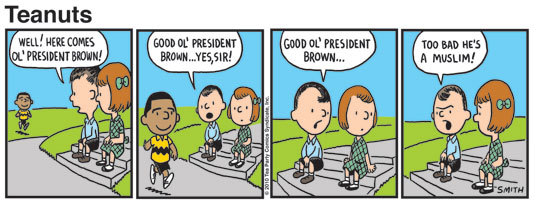
False reports that President Obama is a Muslim

Americans question the President's religion — and always have.

Originally posted to Helium Network on Aug. 22, 2010. Including updates.

The U.S. President Barack Obama is a Christian. His spokesman said in 2010 that he prays daily, and Obama said the same at a February 2011 National Prayer Breakfast. At an Easter Prayer breakfast in 2012, Obama referred to Jesus as "Son of God," in keeping with Christian beliefs. Increasingly, however, since his election, Americans hold the false belief that their President is a Muslim.

Polls conducted by the Pew Form on Religion & Public Life during the first two years of Obama's presidency consistently found that half of respondents correctly identified that the President is a Christian, while a third claimed not to know, and just over a tenth believed he is Muslim. (The last observation was also reported by the Economist in April 2009: "Meanwhile, roughly one American in ten still believes, incorrectly, that Mr Obama is a Muslim.") An August 2010 survey found these numbers suddenly dramatically changed: only a third correctly identified him as a Christian, nearly half claimed not to know, and a greater percentage than ever believed him to be Muslim: 18 percent. A September 2015 survey by CNN/Opinion Research Corporation found it had increased to 29 percent.

The Pew Forum's associate research director Alan Cooperman mused: "You would think the longer the person is in the White House, the more the 'don't knows' would decline. But the 'don't knows' are higher now than when he came to office."

The facts about Obama's background are widely available. His mother came from a Christian family in Kansas; she was an anthropologist who respected all religions as part of human experience. Obama's half-sister in Kenya has stated that their father, Barack Hussein Obama, Sr., "was never a Muslim although he was born into a Muslim family with a Muslim name." Obama has said that his step-father, too, was only nominally Muslim. "When my mother remarried, it was to an Indonesian with an equally skeptical bent, a man who saw religion as not particularly useful," he wrote in his book The Audacity of Hope. "Like many Indonesians, [my stepfather] Lolo followed a brand of Islam that could make room for the remnants of more ancient animist and Hindu faiths," he added in Dreams from my Father. Obama spent part of his childhood in Indonesia where he attended a secular public school. "Madrasa" is simply the Arabic word for "school"; when English speakers use the word, they often intend to connote a Muslim religious school, but this does not describe the school that Obama attended.

J. J. Goldberg, editorial director of the Jewish newspaper The Forward, was quoted in 2008 as speculating that Obama's "decision to keep his middle name, Hussein, raises symbolic fears among some of these [older and conservative Jewish] voters, and reports about his record – including his early flirtation with black identity politics and his long association with Reverend Wright – strengthen these fears."

For a number of American Christians, calling someone a Muslim may be a vague, indirect way of expressing disapproval. The Pew Forum data from 2010 show that those who disapprove of Obama's performance as President and/or identify as Republican are three times more likely as supporters and Democrats to make an incorrect assertion about his religion. When ideological qualifiers are added, such that specifically "conservative" Republicans are compared to specifically "liberal" Democrats, the gap widens so that the former group is five or six times more likely to make the incorrect statement. Similar surveys in 2012 by the Pew Forum and Gallup show these numbers holding steady on a national level, while Public Policy Polling found that more than half of likely Republican voters in the state of Alabama made the incorrect statement.

Although one might assume that knowledge of the President's religion is unrelated to approval of his performance, this has not been the case historically. George Washington's Masonic loyalties were questioned, Abraham Lincoln's critics suspected him of being Catholic, FDR was believed to be Jewish, and JFK (who was indeed Catholic) was feared to be taking orders from the Vatican.

Bruce Feiler wrote that there is nothing new about such an attack: "It's the nature of how we conflate political frustration, economic anxiety, and concern about the changing fabric of our identity. In a country where our national character has been tied up with God since our founding, it's hardly surprising that we tar our political opponents with worshiping a different god than we do."

Particularly because Obama inherited wars in two Arab countries and because Democrats are often perceived as "softer" on security than Republicans, some people were concerned that Obama would mismanage these wars or discontinue efforts to keep the United States safe from terrorism. The allegation that he is a Muslim was, in this context, meant to be understood as an allegation of disloyalty toward his country. Obama actually strengthened forces in Afghanistan and carefully drew down forces in Iraq until the last troops left in December 2011.

In a Newsweek poll in July 2008, 12 percent of voters asserted that "Obama was sworn in as a United States senator on a Qur'an, while 26 percent believe the Democratic candidate was raised as a Muslim and 39 percent believe he attended an Islamic school as a child growing up in Indonesia. None of these things is true." (When I blogged about this for JVoices the same month, I noted that I had been unable to locate a breakdown by religion for the people who held these false beliefs.) For that matter, a February 2010 poll by CBS News/New York Times found that 88 percent of Americans didn't know that the Obama administration has lowered taxes for most Americans. Accusing the president of raising taxes (even if he hasn't) is another traditional American way of expressing disapproval.

Considering the Muslim rumor in 2008, two authors in the New York Times shrugged it off by pointing out that "[f]alse beliefs are everywhere. Eighteen percent of Americans think the sun revolves around the earth, one poll has found." (Note: This has increased to 26 percent as of 2014, the National Science Foundation uncovered.) The New York Times added that, in their opinion, the rumor about Obama "seems slightly less egregious" than the incorrect belief about the Earth's orbit. But one should not jump to the conclusion that false beliefs about the President are harmless. "According to a Harris interactive poll," Newsweek reported in April 2010, "two thirds of Republicans believe Obama is a socialist, while 57 percent believe he is a Muslim, and almost one in four suspect he's the Antichrist."

[For more about false beliefs, see the Dead Men Blogging post on "Avoiding and correcting false beliefs."] Polls have suggested that people with some college education are more – not less – likely to be wrong on this question. John Chait, quoted in Eli Pariser's book The Filter Bubble, addressed this seemingly strange observation. "People with more education are more likely to follow political news," he said, and political news in the United States is highly partisan. "Therefore, people with more education can actually become mis-educated." A 2014 poll found that Muslims were more likely to approve of Obama's performance than Catholics, Protestants or Mormons.

One sound bite that helped fuel the rumor came from Obama's appearance on ABC's "This Week" news program in September 2008. During the conversation, interviewer George Stephanopoulos said "You mentioned your Christian faith" and then challenged Obama as to why he "took after the Republicans for suggesting you have Muslim connections...McCain's campaign manager said they've never done that." After some back-and-forth, Obama tried to clarify: "You're absolutely right that John McCain has not talked about my Muslim faith..." Stephanopoulos interrupted and corrected him: "Your Christian faith." Obama finally made his point: "What I think is fair to say is that coming out of the Republican camp, there have been efforts to suggest that perhaps I'm not who I say I am when it comes to my faith, something which I find deeply offensive, and that has been going on for a pretty long time." The part of the video where Obama used the phrase "my Muslim faith" was taken out of context and went viral on the Internet.

Another example occurred when, writing for Israel Today in April 2010, Aviel Schneider quoted Egypt's foreign minister Ahmed Aboul-Gheit as having said on Nile TV: "The American President told me in confidence that he is a Muslim." The alleged conversation could have taken place when the minister was in Washington, D.C. for Mideast peace talks in early January 2010. Additional details of this story were recounted by Dennis (Avi) Lipkin on Gary Stearman's "Prophecy in the News" TV show:

"On January 19 of 2010, just a few months ago, my wife picked up a broadcast from Nile TV from Egypt...it was called a Round Table discussion... [Aboul-Gheit] said very calmly that he had had a one-on-one meeting with President Obama, and President Obama swore to him that he's a Moslem...that he went to the mosque, that he went to the madrasa until age 11, and he said...'You Moslems will see what I will do for Islam regarding Israel.' This was on Egyptian TV. Two months later, there was an article in the Okaz of the Emirates newspaper in which the envoy of President Obama to the Arab League – his name is Rashad Hasan – said, 'As a Moslem' – I'm quoting now – 'As a Moslem, President Obama understands the significance of Jerusalem for the Islamic world...'" (see 12:00-13:10 of the video)

Lipkin made many statements during the half-hour interview that call his credibility into question. He said that Islam's god is the Devil, that this god commands Muslims to tell lies to hide their religious identities, that the religion (not just fanaticism) presents a global threat, and that the United States is in danger from its own growing Muslim population. He also said that "atheists came into power...so there's no freedom to be Christian anymore" (despite the fact that there is only one openly atheist person in the 535-member Congress). Even if Aboul-Gheit translated and interpreted Obama's words correctly and spoke honestly and without deliberate embellishment, and even if Lipkin's wife had reported the minister's words faithfully and accurately to her husband, Lipkin is demonstrably not the best person to repeat and represent those words. Where rational discussion with such an ideologue seems unlikely, some people simply resort to lampooning and satirizing these fringe beliefs.

Viewed in 2010, the president's official website, BarackObama.com, had a lengthy page dating back to the 2008 presidential campaign devoted to debunking this rumor. The page denied that he ever prayed in a mosque; instead, it recalled his memory of feeling God's presence in a church in Chicago. At the top of the page, he was quoted as saying during the campaign: "I have been victimized by these lies. Fortunately, the American people are, I think, smarter than folks give them credit for." (The original page no longer exists during the 2012 campaign, but the quote still appears in many places.)

Victoria Jackson, formerly a comedian with Saturday Night Live, posted a video to YouTube on Feb. 3, 2015: "There's a Muslim Living in the White House". It is a musical ditty interspersed with supposed evidence that Obama is a Muslim. She begins by saying: “He released terrorists from Gitmo that our sons and daughters died to capture!...His cabinet is made up of Muslim Brotherhood people!...His name is Muslim, and he was raised in a Muslim country, and the application for his school says Barry Sotero and then it says ‘Religion: Islam’.” Naturally, a form filled out by an adult (whether a relative or not) about a child's religion does not necessarily represent what the child actually believes and certainly does not establish that child's religion for the duration of their lives.

One can only hope that Obama's faith in the American people's collective intelligence will be shown to be justified.

In case you missed it

Have you seen inside the book 'To Climates Unknown'?

The alternate history novel To Climates Unknown by Arturo Serrano was released on November 25, the 400th anniversary of the mythical First ...