Monday, March 14, 2022

The Muckrake podcast explains the implications of 'Don't Say Gay'

"'Don't Say Gay' Is Here to Stay"
The Muckrake Political Podcast
March 11, 2022
Nick Hauselman and Jared Yates Sexton

[This is a segment of a larger episode that is available on Patreon for subscribers.]

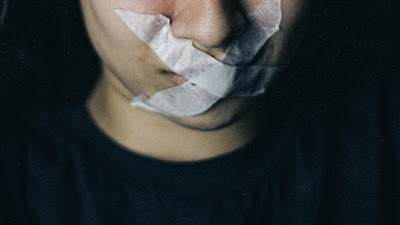
A person whose mouth is taped.
Image by educadormarcossv on Pixabay

Here's my paraphrase of what's available here:

The governor of Florida is promoting a bill, known as "Don't Say Gay," to exclude and demonize LGBTQ people. He's banning something that is a made-up problem that isn't even affecting kids' lives.

So many ways it is bad:

On an individual level. The goal is to prevent LGBTQ kids or kids from LGBTQ families from talking about themselves and their families; to teach straight, cis kids that LGBTQ kids are weird and wrong; and to penalize teachers from explicitly supporting those kids. Consider, too, political histories of kids being taken away from their families: "This is just a precursor to a lot of really bad stuff."

On the level of demographic shift. Another possibility is that, because Texas and Florida are on the precipice of having majorities of Democratic voters, the right-wing is trying to push progressive individuals out of the state.

On the level of irrationality. Rather than say Christians and queer people need to get along, the right wing is turning to QAnon-esque conspiracy theories to say that queer people are inherently evil.

On the level of education. Another part of the goal is to undermine public education as an institution. Education helps people participate in public life. The current right-wing turn away from public education is a turn toward authoritarianism. People who aren't going to participate in democracy don't need to be educated in history, political science, economics, sociology, or in how anything works at a macro level. The authoritarians, as they stand to benefit from a capitalist system, also want children to be allowed to work.

On the level of a broader system of laws. The more authoritarian laws we have, the less our democracy is viable.

See also

and even if someone thinks "well I don't like/look at porn so why should it be a priority for me?" it's important to remember that when christofascists say "porn" they also mean age-appropriate comprehensive sex education, media with queer/trans people in it, and picture books about gay penguins.

[image or embed]

— Scott (@smadin.net) Jun 29, 2024 at 4:23 PM

To read more on this topic, please see "What Does Tucker Carlson Say About LGBT People?" It's a 12-minute read on Medium. Or try "How Trump scored himself 36 points on LGBTQ rights — and why that’s a failing grade." It's a 9-minute read on Medium. Consider a paid membership on the platform.

Sunday, March 6, 2022

Overcoming biases takes time

cartoon of two people thinking, one with question marks and one with lightbulbs

If your audience already knows your topic well, you can say a few words and activate their existing knowledge base, complete with all their unchallenged assumptions.

But if your audience does not know your topic well, and especially if they have certain assumptions, biases, and prejudices that prevent them from understanding what you are saying, you need to help them deconstruct those existing frameworks before you can begin to make your point.

This is part of the reason why education takes time. It isn't just a knowledge transfer of a few key phrases. It's teaching people how to think, which includes a large body of facts plus the ability to reason and emote their way through those facts.

Some people are good at presenting information quickly and clearly. That's one useful skill (among many others) for teachers to have, but it isn't necessarily what makes someone an expert in their subject matter. Students, too, may be experts-in-training. They become experts by spending a long time listening — and realizing that they must never cease to learn. Expertise is an ongoing investment of time.

Image by nugroho dwi hartawan from Pixabay

Saturday, March 5, 2022

Cliff Simak: Folklore has fact as a starting point

“Then there was Smith, who had traveled the barren world for years jotting down the windblown stories whispered by the little degenerating things about an ancient greatness and a golden past. Myths, most of them, of course, but some place, somewhere lay the answer to the origin of the myths. Folklore does not leap full-blown from the mind; it starts with a fact and that fact is added to and the two facts are distorted and you have a myth. But at the bottom, back of all of it, is the starting point of fact.”
— Cliff Simak, “Mirage” (1950; first published in Amazing Stories as “Seven Came Back”)

Flower field image by 愚木混株 Cdd20 from Pixabay

Friday, March 4, 2022

The reason for the huge Ukrainian protests in 2014

In 2014, Ukrainians wanted to align themselves with the European Union, not with Russia. To this end, they favored the leader Yulia Tymoshenko over Viktor Yanukovych. People all over the world saw footage of politically motivated violence on the streets of Ukraine's capital city, Kiev.

Why did Ukrainians protest?

Protests erupted in Ukraine in late 2013 because President Viktor Yanukovych, caught between European and Russian trade interests, sided with Russia.

Ukraine had been part of the Soviet Union until its breakup in 1991; today it is its own sovereign nation. The Ukrainian language is encouraged there today, although many people also speak Russian, in part as a result of the former Soviet Union's "Russification" campaigns. Ukrainians have a range of opinions and feelings about their geographic and political position between Europe and Russia.

Yanukovych had been expected to sign the "Eastern Partnership" trade agreement with the European Union, but he suspended talks with the EU on Nov. 21, 2013. Had he continued talking to the EU, he would have faced trade sanctions from Russia, and the EU would have demanded that he free his political opponent, Yulia Tymoshenko, from prison.

The Tymoshenko-Yanukovych rivalry

Yulia Tymoshenko had a leading role in a 2004 revolution that quashed election results that favored Yanukovych. Tymoshenko served as prime minister from 2007–2010, then lost the 2010 election to Yanukovych. The next year, she began serving a prison term for abuse of authority stemming from an international business deal. The EU and US considered her a political prisoner.

Protests intensified in February 2014

Yanukovych made a deal with Russian president Vladimir Putin to cut gas prices in Ukraine, then passed an anti-protest law, but this did not satisfy protestors. People occupied Kiev City Hall until February 16, 2014, during which time their demands grew to include restoring the 2004 constitution and limiting the president's powers.

These protests coincided with the Winter Olympics held in Sochi, Russia, which brought worldwide media attention to the region. Kiev is about a thousand kilometers northwest of Sochi.

Days after the protestors left City Hall, there were deadly, fiery clashes in Kiev's Independence Square. Protestors made fire bombs, and police showed up in riot gear. The AP published a photo of a gray-haired person running while covering their face in their hands, as the shoulders of their sweater billowed with orange flame.

Dramatically, as medics took a 21-year-old woman to the hospital for a bullet wound to the neck, she used her phone to post to her Vkontakte social media account: "I am dying." She survived, but over a hundred others did not.

With hopes of stabilizing the situation, Ukraine's embattled president met with foreign ministers from Germany, France and Poland. British Prime Minister David Cameron and U.S. Vice President Joe Biden also spoke with him by phone. On February 20, Yanukovych signed a peace deal with the opposition protestors.

The next day, however, a different internal political resolution in Ukraine was manifested. Ukraine's parliament voted to oust Yanukovych, reinstate the 2004 constitution and free Yulia Tymoshenko from prison.

Yanukovych fled his residence. Tymoshenko appeared in Independence Square in Kiev on February 22 and told the cheering crowd that Yanukovych was a "terrible dictator." She has a back injury and sat in a wheelchair while speaking. "We've eliminated this cancer, this tumour," she said. Making clear the protestors' preference for working with the EU over working with Russia, she said: "Everyone has a right to take part in building a European, independent state."

Yanukovych was later discovered to have gone into exile in Russia. Parliament said in 2015 that he was no longer president, and a court convicted him in 2019 of treason and sentenced him to prison, though these were formalities since he remained in Russia.

The above is based on an article that I posted to another website on 27 February 2014. That website went offline later that year. I had read "The Day We Pretended to Care About Ukraine," published 20 February 2014 in Politico, in which Sarah Kendzior chastised American web surfers for succumbing to the allure of "disaster porn" without having a good understanding of the political issues. That concern is perpetually valid, so I am reposting my article to my own blog now.

2016 – 2020: The Trump administration

U.S. President Donald Trump was impeached in 2019 for trying to shake down Ukrainian President Volodymyr Zelensky. (Trump failed.) I wrote some articles about that, and when you search this blog for the Ukraine tag, you will find them.

2022: Can You Donate to Help Ukrainians?

Following Russia's invasion of Ukraine, the New York Times posted a donation guide for "How You Can Help Ukraine."

They recommend Direct Relief which "has supplied Ukraine with $26 million in medical aid over the past six months" and Save the Children which "has been engaged in Ukraine since the Russian annexation of Crimea in 2014," as well as Mercy Corps and International Medical Corps.

TGEU (Transgender Europe e.V.) has a list of organizations in Ukraine and in neighboring countries that are helping transgender Ukrainians with emergency needs during this time.

Donations made through CNN Worldwide and Public Good will be distributed among 39 organizations. (Information current as of March 15, 2022.)

Do you use PayPal? They also listed a dozen organizations for Ukraine relief. You may see different organizations depending on the country from which you access this page.

In December 2023, U.S. aid to Ukraine has been delayed, and this may impact other countries' willingness to give aid too. Without this finance, Ukraine is expected to lose the war.
See: "Western officials warn Ukraine is ‘certain to fail’ against Russia if US doesn’t provide more aid," Jim Sciutto, CNN, December 15, 2023

I also wrote

How Putin Played Donald Trump and the USA

War May Change How We Rely on Big Oil: Energy companies' reactions to Russia’s war on Ukraine


Photo: Yulia Tymoshenko, 2010, in Aachen. © GNU Free Documentation License, Version 1.2 or any later version Wikimedia Commons.
Thursday, March 3, 2022

Swan Lake, and TV Rain is gone

A few minutes ago, the Washington Post published "Russia’s last independent news station suspends broadcasts". TV Rain, the last remaining independent TV/radio news in Russia, has gone dark. Lateshia Beachum explains: "Russia blocked access to the station and declared it and fellow news station, Radio Echo, as foreign agents for their coverage of the war with Ukraine in which they used the terms “war” and “invasion,” usage of which the Kremlin has banned, the New Yorker reported." The reporters have fled. The story continues: "The last seconds of TV Rain’s broadcast, where one of its journalists walked off reportedly saying “no war,” was of a black-and-white broadcast of Swan Lake. The last time the station aired the performance was in 1991 when the Soviet Union was on the edge of collapsing, according to NBC News."

Image of the swan by Peter H from Pixabay

www.nytimes.com/2024/12/20/w... Very sad. Her stories were so important.

[image or embed]

— Cathryn Thurston (@drthurston.bsky.social) December 20, 2024 at 8:51 AM

Wednesday, February 9, 2022

Over 3 months, on average, to confirm a Biden nominee

It is taking longer than ever to confirm the U.S. president's nominee for a position.

As The Times reported last month, hundreds of Biden nominees remain stuck in the Senate “because of partisan dysfunction or personal pique.” During his first year in office, only 41 percent of Mr. Biden’s nominees cleared the Senate, according to an analysis by the nonpartisan Partnership for Public Service. This compares with 57 percent of Mr. Trump’s first-year nominees, 69 percent of President Barack Obama’s and 75 percent of George W. Bush’s. The average time for confirmation of Mr. Biden’s picks was 103 days — longer than any of the previous six administrations.

“You’re seeing a broken system breaking down even further,” the partnership’s chief executive, Max Stier, told The Times. “We need a political Geneva Convention, to distinguish between legitimate partisan differences and the destruction of our core government infrastructure.”

Note: The reference to "any of the previous six administrations" doesn't suggest that things were much worse in the Carter administration. Rather, it is that the Partnership for Public Service apparently only surveyed data going back to Reagan so, here, we aren't given any information about what happened earlier.

Source: "When Did Republicans Turn Into a Bunch of Snowflakes?", Michelle Cottle, New York Times, Feb. 8, 2022. (Incidentally, the article does not directly address the question that the headline-writer gave it. The part that I quoted more accurately represents the article's theme.)

Image source: "aitoff" on Pixabay.

In case you missed it

Have you seen inside the book 'To Climates Unknown'?

The alternate history novel To Climates Unknown by Arturo Serrano was released on November 25, the 400th anniversary of the mythical First ...