Saturday, June 13, 2015

Quotes on the power of naming

What goes into naming? Steven Pinker:
"...naming an object involves recognizing it, looking up its entry in the mental dictionary, accessing its pronunciation, articulating it, and perhaps also monitoring the output for errors by listening to it."
This is a major locus of humans' sense of power. Kathleen Dean Moore:

"Children bring their dolls to life by giving them names. Names transform animals into family members. In some religions, nobody can have eternal life – not even tiny babies – until they have been baptized, given a name. In a single word – ilira – the Inuit people bring to tangible life the awe and fear that possess them when they see a polar bear approaching across the ice; in another word – kappia – they name the apprehension that seizes them when they cross thin sea ice. In Genesis, all the parts of the universe are drawn out of fluid chaos by their names. “God called the dry land Earth, and the waters that were gathered together he called Seas.” To be is to be named.

Yet no one is allowed to know God’s name. He is called yhwh, a word without vowels, an obvious fake, a name that does not name. It is an issue, clearly, of disproportionate power. The power to name is the power to create, and the power to destroy."

Indeed, until you call out a word like ilira or kappia to name the fear, or bear or ice or lightning to name the thing that inspires it, the waters of the mind may remain untroubled. Erich Maria Remarque:

I turn around. The man of faith and the man of science are sitting in the full brilliance of the ceiling light. For them the world is not a vague, quivering unrest, it is not a muttering from the depths or a lightning flash in the icy spaces of the void – they are men of faith and of science, they have sounding lines and plummets and scales and measures, each of them a different set but that does not matter, they are sure, they have names to put on everything like labels, they sleep well, they have a goal that contents them, and even horror, the black curtain in front of suicide, has a well-recognized place in their existence, it has a name, it has been classified and thereby rendered harmless. Only what is nameless or has burst its name is deadly.

"There's lightning," I say.

The doctor looks up. "Really?"

There is a difference between naming tangible things (ice, bear, lightning) and intangible things (fear). The intangible thing is already an abstraction. To name it is to bring it into awareness, but simultaneously to separate oneself from it further by pointing to it or representing it rather than feeling or knowing it directly. Joseph Chilton Pearce:
"...a name can be given something not immediately present to the senses. Naming is then a 'symbol-for-a-symbol,' a double-substitution."
Jonathan Lear called it a "systematic mistaking":

”What we do not understand, to put Wittgenstein's [language acquisition] insight in psychoanalytic terms, is that we are being persuaded, not by obvious truth, but by the force of our own projective identifications. We are creatures who cannot help but create mythic accounts of how our mind works, of how we hook onto the world, of what reality is really like. We project this imaginative activity onto the world and then mistake it for "the way things really are." In this way, we systematically mistake a bit of ourselves, our imaginative activity, for the world.

This systematic mistaking we tend to call "philosophy." So, for example, we begin with what we might call this core myth of meaning – that individual words are names – a myth only implicit in Augustine, made explicit by Wittgenstein; a fantasy so seemingly innocuous that we are unaware that from it flows a theory of mind, meaning, and world. For if words are names, and if names stand for a meaning, then for me to be speaking meaningfully must be for me to have ideas in my mind, the meanings, with which words are correlated. And thus we form a picture of the mind as a container of ideas which gives my words the meaning they have. It is as though the idea could exist independently of the word – just as the word without the idea would be a meaningless sound – and we form the picture of words naming objects in the world by being animated by ideas in the mind. Here is a picture of language hovering between mind and world. It is as though we were separated from the world, trying to talk about it. And from this picture, to give just one example, skeptical questions – "Are we getting the world right? How do we really know?" – become inevitable. And we take this inevitability to reflect the human condition: that it is our fate to live in separation from how things really are. Wittgenstein brings to conscious awareness that it is not so much our fate to live in separation as our fate to be tempted to create and be seduced by myths of separation. These are illusions we can work through and ultimately live without. In this way, proper philosophical activity is the working-through and undoing of "philosophy." In Freudian terms, remembering comes to replace repeating.”

The double-substitution or the step back might indeed be a systematic mistaking, but it is not necessarily a bad thing. It is part of what enables us to have a shared reality, not just a privately experienced reality. Fernando Pessoa:
”Civilization consists in giving an inappropriate name to something and then dreaming what results from that. And in fact the false name and the true dream do create a new reality. The object really does become other, because we have made it so. We manufacture realities. We use the raw materials we always used but the form lent it by art effectively prevents it from remaining the same. A table made out of pinewood is a pinetree but it is also a table. We sit down at the table not at the pinetree. Although love is a sexual instinct, we do not love with that instinct, rather we presuppose the existence of another feeling, and that presupposition is, effectively, another feeling.”
But the limits of human language can constrain our thinking unnecessarily. David Darling:
”In the West, we are very keen and adept at making maps – scientific maps of the reality in which we find ourselves. Boundaries, names, and labels have assumed with us enormous power. So we find ourselves inhabiting a world of bits and pieces, a world of apparently irreconcilable differences. And one of our principal misunderstandings stems from our use of the words "you" and "I". For what we fail to recognize, or have forgotten, is that "you" and "I" are purely constructs of our language, and of our linguistic interactions with others. "You" come about because we happen to be speaking English (or some similar tongue) and are therefore conforming to the rule that a verb must have a subject, and that processes are mysteriously initiated by pronouns. The syntax of Western language demands a clear indication of the subject-object relation. Therefore, every time we speak we reinforce our belief that every situation can be analyzed into a subject-predicate-object form. Our language forces us to be compulsive analyzers, to break down our experience of the world into composite elements. The fact that there might be entirely different modes of thinking usually escapes our attention. And yet such modes do exist.”
People may deliberately refrain from naming beings who they believe will die or who they prefer to block from their awareness. Kenzaburo Oe:

"At present the baby is registered simply as your first-born son, it would be a big help if we could have a name for our records."

A name! thought Bird. Now, as in his wife's hospital room, the idea was profoundly disturbing. Provide the monster with a name and from that instant it would seem more human, probably it would begin asserting itself in a human way. The difference between death while the monster was nameless and death after Bird had given it a name would mean a difference to Bird in the nature of the creature's very existence.

"Even a temporary name you're not certain about will do," the girl said pleasantly, though her voice betrayed her stubbornness.

"It can't hurt to name him, Bird," Himiko broke in impatiently.

Sometimes people do not want to name things that they perceive as monstrously distorted, perhaps because the naming confers legitimacy and helps establish a new concept. The newly named thing has increased power and could threaten the existing order. Felix Gilman:

It was also not strictly speaking a rose, though of all things of the made world, it most closely resembled a flower, and of all the flowers Liv knew, it most closely resembled a rose. It was more like the sketch of a rose, perpetrated by a person who'd never seen one; or, more precisely, it was like the product of processes that would, in the made world, have resulted inevitably in a rose, but out here were not so narrowly constrained.
* * *
The thing was hideous. It was ridiculous. It was beautiful. All those things at once, and none of them. It was not meant for her, and her opinions of it were beside the point. It would have been both futile and insulting to classify it; it was neither a rose nor a relative of the rose. It was perhaps in part the potentiality of a rose, or an alternative to the rose, or more likely something with no meaning at all....
* * *
"Name nothing," Creedmoor had warned her. "It's poor form out here to name things."

Jesse Sheidlower:

"Is a hotdog a sandwich? Yes! And no! Unfortunately that's the way it is.

When you're looking at broad classes of nouns like this, you're focused on what you'd call "typicity". For example, soup could be defined as 'liquid food'; this definition would include 100% of things that might even possibly be called "soup", but it would also include a lot of not-really-soup-y things—like cereal or martinis.

* * *

The general thing to know about dictionaries is that you're usually not trying to capture the complete and exact description of something; you're trying to get a general picture of what something means. This is hard enough for concrete nouns that we more or less know, like "horse" or "sandwich"; it's impossible with abstract nouns like "freedom" or "beauty".

* * *

...when you try to be exact—you get something useless.

So most dictionaries, that are written for native speakers and that assume a good-faith effort to understand the definition, give a reasonably broad definition, that will include most things that should be included and exclude most things that should be excluded.

* * *

...people sometimes put a lot of faith in dictionary definitions. In particular, courts use old dictionaries to try to determine what words meant at a time when laws were written. But that is very much not how dictionaries should be used. If it's this hard to determine what a "sandwich" is, what are we supposed to do about words like genocide, or to bear arms? Or woman in reference to a trans woman? People literally die because dictionaries are misused. There are ways to attempt to answer these questions—corpus linguistics, sociolinguistic interviews—but thinking that a dictionary is an exact map of reality is not a correct one of these."

Others will name to assert their own power and to prevent others from naming. Mary Daly:
Women have had the power of naming stolen from us. We have not been free to use our own power to name ourselves, the world, or God. ... To exist humanly is to name the self, the world, and God. The 'method' of the evolving spiritual consciousness of women is nothing less than this beginning to speak humanly – a reclaiming of the right to name. The liberation of language is rooted in the liberation of ourselves.

Or they will name an enemy to gain power over the unknown and the hostile. Carol K. Mack and Dinah Mack:
"In all cases, 'naming' the demon seems to reduce and dis-empower it. Modern explanations of the phenomena resulted in new names. The Id and the Shadow, included here with their methods of depossession, are redefined demonic species. The Buddhist Mara represents the demon both as an interior obstacle and potential teacher. A transformative approach to the Tibetan Buddhist Yama (Death) illustrates a radically different approach to the field."
Denise Lardner Carmody and John Tully Carmody:
"In many ancient cultures, to possess the name of something was to control it, to imprison it even in a ritual guaranteed, magically, to make it one's servant."
Starhawk:
"Name a thing and you invoke it. If we call the world nonliving, we will surely kill her. But when we name the world alive, we begin to bring her back to life.
Marge Piercy:
"I remember that I spoke to her about the power of naming. What we cannot name, I said, we cannot talk about. When we give a name to something in our lives, we may empower that something, as when we call an itch love, or when we call our envy righteousness; or we may empower ourselves because now we can think about and talk about what is hurting us, we may come together with others who have felt his same pain, and thus we can begin to try to do something about it."
Yet some things remain nameless because they can never be objects to us – the air we breathe, the water we fill ourselves with, the bodystuff that holds the water in. José Saramago:
”Human vocabulary is still not capable, and probably never will be, of knowing, recognizing, and communicating everything that can be humanly experienced and felt. Some say that the main cause of this very serious difficulty lies in the fact that human beings are basically made of clay, which, as the encyclopedias helpfully explain, is a detrital sedimentary rock made up of tiny mineral fragments measuring one two hundred and fifty-sixths of a millimeter. Until now, despite long linguistic study, no one has managed to come up with a name for this.”

Sources

Steven Pinker. The Language Instinct: How the Mind Creates Language. (1994) New York: HarperPerennial, 1995. p. 316.

Kathleen Dean Moore, Riverwalking: Reflections on Moving Water. New York: Harvest, 1995. pp. 62-63.

Erich Maria Remarque. The Black Obelisk (1957). USA: Crest, 1958. pp. 79-80.

Joseph Chilton Pearce. Exploring the Crack in the Cosmic Egg: Split Minds & Meta-Realities. New York: Washington Square Press, 1974. p. 45.

Jonathan Lear. Open Minded: Working Out the Logic of the Soul. Cambridge, Mass.: Harvard University Press, 1998. pp. 12-13.

Fernando Pessoa. The Book of Disquiet. Edited by Maria Jose de Lancastre. Translated by Margaret Jull Costa. London: Serpent's Tail, 1991 (a collection of writings that were unorganized upon Pessoa's death in 1935). p. 53.

David Darling, Zen Physics: The Science of Death, The Logic of Reincarnation. New York: Harper Collins, 1996. p 142.

Kenzaburo Oe. A Personal Matter. (1964) Translated from the Japanese by John Nathan. New York: Grove Press, 1969. p. 146.

Felix Gilman. The Half-Made World. New York: Tom Doherty Associates, 2010.

Mary Daly, Beyond God the Father: Toward a Philosophy of Women's Liberation. Boston: Beacon Press, 1973. p 5-6.

Carol K. Mack and Dinah Mack. A Field Guide to Demons, Vampires, Fallen Angels and Other Subversive Spirits. (1998) Arcade, 2011.

Denise Lardner Carmody and John Tully Carmody. Mysticism: Holiness East and West. New York: Oxford University Press, 1996. p. 112.

Starhawk. Truth or Dare: Encounters with Power, Authority, and Mystery. New York: Harper Collins, 1987. p 8.

Marge Piercy. He, She, and It. New York: Fawcett Crest, 1991. p. 66.

José Saramago. The Cave. (A Caverna, 2000). Translated from the Portuguese by Margaret Jull Costa. USA: Harcourt, 2003. p. 264.

Jesse Sheidlower, Lexicographer, Columbia University; Former Editor-at-Large, The Oxford English Dictionary, quoted in Notable Sandwiches #89: Hot Dog, Talia Lavin, The Sword and the Sandwich, March 15, 2024

Quotes on the sanctity of trees

Thomas Moore:

"Trees provide a rudimentary lesson in enchantment: We need not cling anxiously to our own subjectivity, will, and desire; instead we can place trust in the beings around us who demonstrate many alternative ways to be a contributing, outstanding individual. A tree tells us what gives us pleasure, and it is so good at offering us benefits beyond measure that we have no reason not to surrender ourselves to it. We can sit on a tree's limb, rest against its trunk, enjoy its fruits and nuts, sit under its shade, and watch it dance in the wind. The lessons we can learn from a tree are infinite, and its pleasures indescribable. There are moments in anyone's life when to be like a tree – tall, straight, fertile, rooted, branching, expressive, and solid – would be the most effective therapy."

Christine Valters Paintner:

"Perhaps this is why we feel so drawn to trees. Groves of redwoods and beeches are often compared to the naves of great cathedrals: the silence; the green, filtered, numinous light. A single banyan, each with its multitude of trunks, is like a temple or mosque – a living colonnade. But the metaphor should be the other way around. The cathedrals and mosques emulate the trees. The trees are innately holy."

See also: Maui’s 150-year-old banyan tree is growing leaves after being charred by the wildfires. It’s just the beginning of a long recovery, Kara Nelson, CNN, Sept 24, 2023

And follow-up: Missed communications and blocked evacuation routes: New report details problems and heroism from Maui’s disastrous wildfires Holly Yan, CNN, April 17, 2024

Mohammed Amara:

"We (Muslims) do not kill clerics, we do not kill women, we do not kill children, we do not kill trees. [emphasis added] This is what the prophet taught us. The U.S. and Britain are committing atrocities against our people everywhere but we shouldn't respond to a crime with a crime."

William Ian Miller:

"Did not the Talmudic sages 1,800 years ago require that no trees be grown within twenty-five cubits of a town, and that carob and sycamore trees were to be banished to fifty cubits' distance, along with carcasses and tanneries: 'To preserve the beauty of the town, every tree that is found nearer to the town than that must be cut down'?"

Sacred trees

See: "Teen arrested after felling of famous Sycamore Gap tree on Hadrian’s Wall." Police said that a deliberate act of vandalism may have brought down what is perhaps England’s most-photographed tree, which drew visitors from afar and appeared in the 1991 film “Robin Hood: Prince of Thieves.” Sammy Westfall, Washington Post, September 28, 2023
Felling the tree damaged Hadrian's Wall. Two men in their 30s were convicted and sentenced in 2025.

Trees that are 350 million years old

"Five tree fossils buried alive by an earthquake 350 million years ago were found in a quarry in the Canadian province of New Brunswick, according to a study published Friday in the journal Current Biology." — CNN, Feb 2, 2024

"Over 100 million mangroves — a group of trees and shrubs that live mainly in coastal waters, where they are able to support entire ecosystems — would be planted as part of the project. That’s enough to absorb over 1.2 million metric tons of CO2 per year, according to URB, the sustainable city developer behind the initiative — the equivalent of removing 260,000 gas-powered vehicles from the road."
Plans for ‘world’s largest coastal regeneration project’ revealed in Dubai, Jacopo Prisco, CNN, May 14, 2024

"The giant trees, swollen of trunk and stubby of canopy, are unmistakable. Baobabs can live for more than 1,000 years, acting as the keystone species in dry forest environments in Madagascar, a swathe of continental Africa, and northwest Australia. Known as “mother of the forest” and “the tree of life,” nearly every part of the tree can be used by humans and animals, meaning they’re of enormous value to each ecosystem they inhabit."
Finally, an answer to a mystery surrounding these 1,000-year-old trees, Tom Page, CNN, June 24, 2024

See also: "Saying goodbye to Stumpy, the tree that changed my life," Opinion and photographs by Carol Guzy, CNN, July 8, 2024

See also: "Restaurant chain faces outrage after carving up 500-year-old oak tree," Olivia Kemp, CNN, April 17, 2025

Sources

Thomas Moore. The Re-Enchantment of Everyday Life. New York: HarperCollins, 1996. p. 23.

Christine Valters Paintner. Water, Wind, Earth & Fire: The Christian Practice of Praying with the Elements. Notre Dame, Ind.: Sorin Books, 2010. p. 110.

Mohammed Amara, of Cairo, on the Arabic-language TV network Al Jazeera, following the subway bombing in London in July 2005. Quoted in "Arab view: 'Enough, enough': Some Muslims fear backlash after UK bombs" by Octavia Nasr, CNN Senior Editor for Arab Affairs. www.cnn.com July 8, 2005.

William Ian Miller. Faking It. New York: Cambridge University Press, 2003. p 155. Citation: Maimonides, Book of Acquisition, "Laws Concerning Neighbors," 12.iii.10.I.

Photo of tree at Küçük Çamlıca, Istanbul, by Nevit Dilmen. Creative Commons 3.0. Wikimedia Commons.

Tuesday, June 9, 2015

Young people joining a violent group in a search for meaning

Data from the Centers for Disease Control and Prevention – as described by Emily Esfahani Smith in 2013 – shows that forty percent of Americans "either do not think their lives have a clear sense of purpose or are neutral about whether their lives have purpose." The government agency knows that a sense of purpose contributes to mental and physical welfare. Indeed, as Smith notes, in Holocaust survivor Viktor Frankl's 1946 book Man's Search for Meaning, Frankl said that a sense of meaning in one's life enabled many to survive. In a forthcoming study by Roy Baumeister in the Journal of Positive Psychology, Smith said, "participants reported deriving meaning from giving a part of themselves away to others and making a sacrifice on behalf of the overall group." Furthermore, while happiness was found in the present moment, meaning was found in thinking about the past and the future. Thus, meaning is about transcendence, both of "the self" and "the present moment".

Paul Brandeis Raushenbush, reading analyses of the ISIS cult phenomenon such as that by Prof. John Esposito ("The Challenges of Defeating ISIS"), noted "the continued use of the word 'meaning,' and how a lack of a sense of meaning and purpose in life, coupled with the experience of alienation within one's society, has led to many young (mostly) men, to turn towards such deadly violence." He said that the long-term solution to violent religious movements is that everyone to be

"invested in reaching out to young people. We have to be available to listen to their concerns, empathize with their sense of alienation, and help them find constructive ways to engage societal injustice. It is all of our responsibility to empower this generation with the knowledge and support they need to find a meaningful life and a positive identity that they can embrace and be proud of.

ISIS and other radical groups are deadly serious about reaching out to young people with their skewed version of meaning that leads to death and destruction. Are we just as serious in reaching out to offer meaning that results in affirming life and creating a better world?"

It's not just boys, Lee Smith wrote, in an article that began:

"Teenage girls are the West’s center of gravity: Virtually all of Western pop culture, the key to our soft power, is tailored to the tastes of teenage girls....Indeed, Western civilization is a success largely insofar as it has made the world a safe place for teenage girls—to go to school, get a job, and decide who and when to marry, or if they want to marry. When teenage girls turn away from One Direction and embrace ISIS, it means the West is losing."

He cited a recently released Washington Institute for Near East Policy poll showing that Middle Easterners (e.g. Egyptians, Saudis, Lebanese) tended to have negative opinions of the Islamic State, whereas opinions were more favorable in the U.K. and in France, especially among people of college age. "Thousands of young European Muslims have already left the continent for the Middle East," he wrote, "to help the organization’s leader, Abu Bakr al-Baghdadi, build an authentic Islamic caliphate. Doubtless thousands more are on their way, to kill and die for an idea they believe in." Despite the Islamic State's ideals and practices being "exceedingly stupid and vicious," for these foreign fighters, "the idea of a caliphate, ripped from the pages of Muslim history, resonates with a kind of existential authenticity missing from the vast and drab European suburbs warehousing Muslim youth."

Furthermore, "many hundreds" of European women "have gone to Syria and Iraq to marry Islamic State fighters," because, in his analysis, "the West seems weak and unmanly and they pine for real men who are willing to kill and die for what they believe in." Europe has social and commercial prowess yet, he says, "has become incapable of endowing the lives of its citizens, Muslim or not, with meaning" and "is devoid of values worth living – or dying – for." In particular, he says, Europe and the United States behave in embarrassing ways when confronting Middle Eastern powers, sometimes appearing to "roll over and take it," suggesting that "we don’t really believe there’s anything worth fighting for."

For similar reasons, Robert Zaretsky and David Mikics criticized the Western use of the term "nihilist" to describe the Islamic State.
“'Nihilist' is almost precisely the wrong way to describe groups like ISIS. Not only does it fail to define the group’s worldview, but from their perspective, no word better defines the world of Western, enlightened, and liberal values – in a word, our world – than does 'nihilist.'”

The idea of nihilism – and the proper "just and considered" nonviolent response to it – was originally developed in the West, where it has been engaged by philosophers "for the past century and a half."

Nihilism was understood as "the conviction that no conviction – religious, metaphysical, or moral – was possible" and that the absence of religious guarantees means that we should focus on taking responsibility for our actions. Still, the human tendency is to "tend to cling to traditional beliefs for the comfort they offer" even though modernity has discredited many religious arguments and even though "existential religious thinkers like Soren Kierkegaard and Karl Barth have argued that any faith worthy of the name must co-exist with doubt and disillusion." The task is "to feel discomfited by and not indifferent to this abyss," the awareness that "that knowledge is elusive and truth nonexistent." It should spur us to action. We must recognize "that human nature and human knowledge are imperfect: We cannot win the war against injustice, but only achieve provisional victories."

By contrast, Zaretsky and Mikics explain, ISIS offers a "thrilling new belief system" that "recoils from such an encounter with doubt." For them, violence is an acceptable means to an idealistic end. So, it is inaccurate to label ISIS fighters as nihilists and to imply that the West should be in a philosophical war against nihilism.

"Nihilism is not the enemy – this is not a war of meaning versus meaninglessness – but, instead, it is a description of the human condition. Our real enemies are those who, afraid of this prospect, seize on brutality as a means to religious or ideological ends; our real friends are those who, recognizing this possibility, are willing to work together toward human solidarity and dignity on our shared earth."

Sources

"What is a good life?" Emily Esfahani Smith. First published in The Atlantic Magazine. Reprinted in The Week, Feb. 22, 2013. pp. 40-41.

“ISIS and the Crisis of Meaning.” Paul Brandeis Raushenbush. The Huffington Post. 8/28/2014.

"Why the Teenage Girls of Europe Are Joining ISIS: Because they want the same things that teenage boys want: a strong sense of meaning and purpose." Lee Smith. Tablet Magazine. October 22, 2014.

Is ISIS an army of nihilists? Just the opposite: How politicians’ favorite word for the jihadist group obscures what’s really at stake." Robert Zaretsky and David Mikics. Boston Globe, Aug. 31, 2014.

Image: "Tree of Knowledge of Good and Evil" by Lidia Kozenitzky, available from http://commons.wikimedia.org/wiki/User:Effib

Saturday, June 6, 2015

Dr. Josephine Jackson on the perils of homosexuality (1937)

Guiding Your Life, a 1937 sexual education book by Dr. Josephine Jackson, claims that homosexuality is a "deadly perversion" and a "sickening futility." Homosexuals are doomed to unhappiness because, even if they try heterosexual mating, they are unable to appreciate "the great mission of reproduction." Homosexual apologists are just "following the law of compensation" when they tout their own virtues and talents; their sexual identity "clothes itself in the guise of artistry, calls itself the badge of genius, makes claim for freedom of action but leads finally to utter hopelessness and frustration."

Parents should watch for signs of homosexuality just as they'd watch for signs of measles, for, while no one is immune to these diseases, infection can be effectively guarded against. The symptoms of homosexuality are "devotion" to a same-sex friend, where the devotion is of "unwarranted degree, persistence, and exclusiveness." Children may pass through "an attack of the disease of mild and relatively harmless degree." An adolescent's same-sex crush will yield only humiliation unless the crush is himself a pervert, in which case a boy is lured to his "utter undoing" and a girl has a relationship that "degrades and defiles," because deep same-sex crushes "spoil the vine of love." A lesbian is "losing out on the structure of true femininity" because men and women are like chemical elements that need to combine to be each other's psychological and physical complements.

How can parents prevent their children from becoming homosexuals? "[Boys] should cultivate the companionship of girls; a liking will soon come. Then logic, intuition and a sense of humor will carry them out of the morass..."

The worst occurs when the homosexual tries to convert a "normally endowed" person.

None of her claims are backed up logically or empirically.

Josephine A. Jackson, M.D. Guiding Your Life: With Psychology As Key. New York, NY: D. Appleton-Century Company, Inc. 1937. Page 91, 150-158.

(I read this book and took these notes c. 1999.)

Should we be 'happy'?

The Monks of New Skete wrote: "It's totally unreasonable to believe that God would make any intelligent being except for its happiness. Only a theologian could think up such a thing. No, happiness is ours for the taking. And we have to take it.
"

But what is meant by happiness? There are surely different kinds, and different people would report that different things make them "happy."

Joseph Epstein said, "The good life has a great deal to do with contentment and satisfaction – and nothing whatsoever to do with that fool’s gold called happiness." But what is contentment and satisfaction? Where do they come from? An article in The Week in 2013 referred to research that suggests that they come from helping others:

Human beings appear to be genetically engineered to be happiest and healthiest when we spend a lot of time selflessly helping others – and unhealthy when we're mostly devoted to self-gratification. That's the eye-opening conclusion of University of North Carolina researchers, based on a study of 80 volunteers. The study subjects were asked how often they felt hedonic pleasure – the kind of happiness brought about by enjoying a tasty meal or buying themselves something. They were also asked how often they contributed something important to society that gave them a deeper sense of purpose. The researchers then drew the subjects' blood, and found that the genes of the volunteers whose lives contained lots of pleasure but little meaning were priming cells to express high levels of inflammation – which is linked to cancer, diabetes, and cardiovascular disease – and a weaker anti-viral response to infections. 'Their daily activities provide short-term happiness yet result in negative physical consequences long-term,' psychophysiologist Barbara Frederickson tells ScienceDaily.com. People who emphasize service to others and a connection to community, on the other hand, showed a pattern of gene expression linked to less inflammation and stronger immunity. There are two distinct kinds of happiness, says study co-author Steven Cole, and 'our genes can tell the difference.'

It is also possible to find value even in things that do not make anyone "happy" by any common definition. Thomas Mann: "Is not life in itself a thing of goodness, irrespective of whether the course it takes for us can be called a 'happy' one?"

Sources

The Monks of New Skete. In the Spirit of Happiness. New York: Little, Brown, and Co. 1999. p 309.

Essayist Joseph Epstein, quoted in The Wall Street Journal. The Week, May 2, 2014. p. 15.

"A genetic guide to true happiness." The Week, Sept. 13, 2013. p. 24.

Author Thomas Mann, quoted in the Wall Street Journal, quoted in The Week, Sept. 13, 2013. p. 21.

Must excessive wealth change who one is?

Some studies have shown that power or perceived power – including excess wealth – changes the way people think and make decisions, especially in the ethical realm.

Guy Kawasaki said that being a mensch (a good person) is an important part of developing business skills, and yet: "This doesn’t mean that a mensch has to be wealthy. In fact, money usually renders a person unmenschionable. (If you ever want to understand what God thinks of money, look at who He gives it to.)"

In David Vann's novel Aquarium, a character says: "I’ve never believed the rich are unhappy. I think they close their doors on us and then can’t stop laughing."

Apart from how people behave when they are rich, some perceive it as immodest to be significantly richer than others. R. H. Tawney, who taught at the London School of Economics, wrote in 1920: “The manager of a great enterprise who is paid $400,000 a year, might similarly be described as a hundred-family man, since he receives the income of a hundred families....the truth is that these hundred-family salaries are ungentlemanly.”

But others argue that none of these things need be the case. Money is a thing convenient to have, and as long as it does not warp our values and priorities, it can be a force for good. Self-improvement guru Anthony Robbins said: "When I first started to make money, I started to catch hell for it. My friends disowned me. They said, 'You're into money. What's your problem?' I said, 'I'm not into money. I just have some.'"

Sources

Guy Kawasaki, The Art of the Start: The Time-Tested, Battle-Hardened Guide for Anyone Starting Anything. New York: Penguin, 2004. p. 213.

R. H. Tawney. The Acquisitive Society. New York: Harcourt, Brace and Company, 1920.

Anthony Robbins. Unlimited Power. New York: Fawcett Columbine, 1986. p. 377.

Tuesday, June 2, 2015

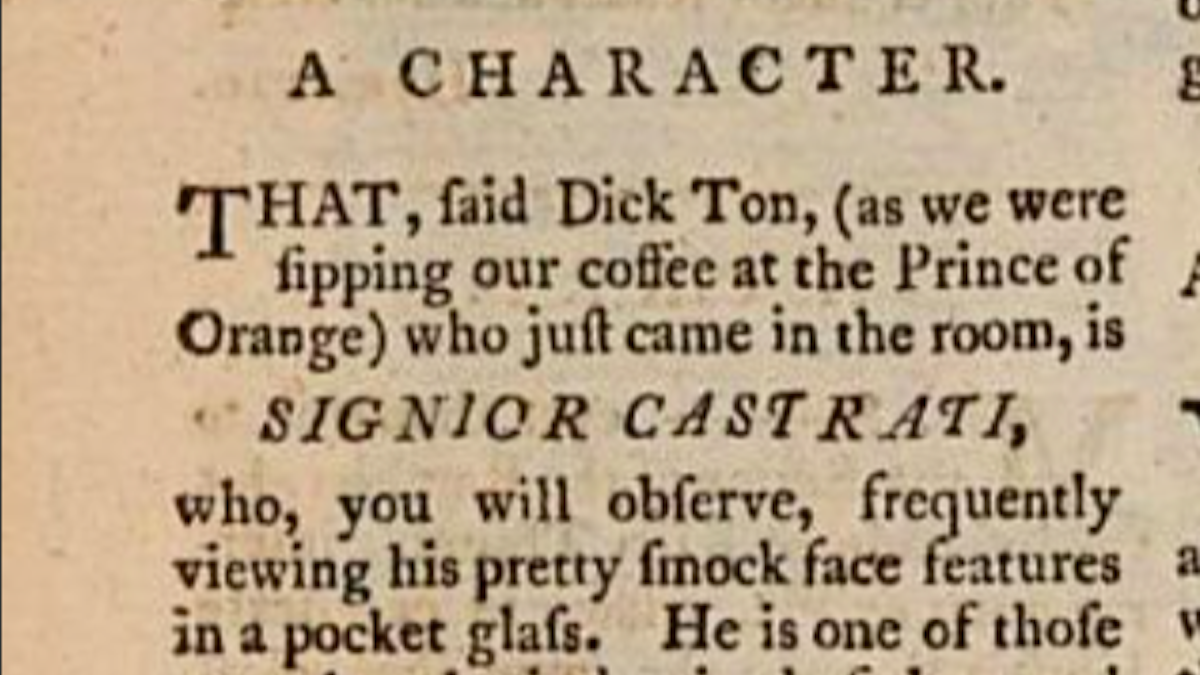
A stereotype of a castrato (London, 1784)

The following passage in an 18th-century magazine of prurient interest shows how castrati were perceived in England. The universalized "Signior Castrati" is portrayed as vain, "frequently viewing" himself in a mirror. He is "deprived of the grand essence of manhood" and is an "apology for a man," yet, as a singer, he is "almost deified" by his women admirers. Furthermore, as a sexless "piece of neutrality," he appeals sexually to both men and women, the latter especially because he cannot cause them to fall pregnant.

That, said Dick Ton, (as we were sipping our coffee at the Prince of Orange) who just came in the room, is Signior Castrati, who, you will observe, frequently viewing his pretty smock face features in a pocket glass. He is one of those mortals, who is deprived of the grand essence of manhood, in order to qualify him for the amusement of the delicate and polite part of mankind in the vocal way. He is descended from obscure parents in Italy; being bred to music, the chief study and pursuit of the inhabitants of that part of the world, he came over to England to try his talents, where having succeeded to his utmost wishes, he cuts what may be called a fine figure. He has made the tour of Great Britain and Ireland, and such is the depravity of the reigning taste, that this apology for a man, through the charm of sound, has as many admirers, as the first actors; and particularly among the female world, by which he has been almost deified.

You may wonder, as you please, at his universal reception among the ladies, as his excellency in one point, cannot make up for his deficiency in another; but you will wonder more when I inform you, that this piece of neutrality, neither male nor female, has charmed into the married state a very fine woman with a considerable fortune. These mutilated fellows are objects of choice to some wanton lascivious persons, because they are adapted to gratify the inordinate craving of those rank beldams, as they can keep the field in one regular series, and never decline the encounter ‘till they have the word of command. They are also extremely convenient for those precise ladies, of such extraordinary mock modesty, who are mightily concerned for their virtuous reputation, as they can indulge their little wanton sallies, without running the danger of any disagreeable consequence.

The above is the entire text of the article “A Character.” The Rambler's Magazine (London), February 1784, p. 74. Available to read for free on Google Play.

The first sentence of A Character in the original typesetting. That, said Dick Ton, (as we were sipping our coffee at the Prince of Orange) who just came in the room, is Signior Castrati, who, you will observe, frequently viewing his pretty smock face features in a pocket glass.

In case you missed it

Have you seen inside the book 'To Climates Unknown'?

The alternate history novel To Climates Unknown by Arturo Serrano was released on November 25, the 400th anniversary of the mythical First ...