Showing posts with label novels about eunuchs. Show all posts

Thursday, October 13, 2016

Eunuchs in the 'Percheron Saga' by Fiona McIntosh

Fiona McIntosh's trilogy The Percheron Saga contains the novels Odalisque, Emissary, and Goddess.

I used to have an article here that discussed the character of Salmeo in the Percheron Saga. I incorporated that material in my book Painting Dragons (2018), and so I have taken down the article here. Please check out Painting Dragons (paperback and Kindle eBook).

Thursday, March 10, 2016

Atto Melani in 'Imprimatur'

Imprimatur by Rita Monaldi and Francesco Sorti (2002) and translated from Italian into English by Peter Burnett (2008) features Atto Melani, a castrato singer and abbot who is a friend of the narrator's on a 17th-century Da Vinci Code-esque adventure. He was a real person – "a castrato opera singer, also employed as a diplomat and a spy," according to his Wikipedia entry – who appears in this novel as a fictional character.

The narrator knows early on that Atto is a eunuch. “I realized at that point that I had not asked the abbot whether he was a composer, an organist or a choirmaster. Fortunately, I withheld that question. His almost hairless face, unusually gentle and womanish movements, and above all his very clear voice, almost like that of a small boy who had unexpectedly attained maturity, revealed that I was in the presence of an emasculated singer.” (pp. 22-23) At one juncture, Atto sings “non ti chiedo mercé” [I ask you no mercy] and “Lascia ch’io mi disperi” [Let me despair]. (p. 253)

He knows Nicolas Fouquet, who is described as “a mere bell-ringer’s son who, from his beginnings as a poor castrato, had so risen as to dispense counsel to the Sun King.” (p. 80) This does not entail that he always acts with decorum nor that he always receives respect. Atto prods Dulcibeni: “You should thank Huygens and that slobbering old Feroni if they did her the honor of ripping open her maidenhead before they threw her into the sea.” To which Dulcibeni responds: “Silence, castrato, shame of God, you who can only get your arse ripped open...That you liked plunging your cock in the shit, that I knew; but that you head was full of it too...” (p. 461)

Overall he has a strong attitude:

“Very well,” conceded Atto, reaching forward with his lantern to show the way. “It is always up to me to resolve everything.” (p. 84)

The posse includes a sidekick Ugonio who speaks like this: “To obtain more benefice than malefice, and to be more padre than parricide, I abominate the artefactor of this revolting, merdiloquent and shiteful spectacule. He is a disghastly felonable!” (p. 391) They are fixated on medications to ward off plague, such as this recipe: “four drachms of Armenian bole, terra sigillata, zedoary, camphor, tormentil, burning bush and hepatic aloes, with a scruple of saffron and cloves, and one of diagrydium, juice of savoy cabbage and cooked honey.” (p. 54)

Rita Monaldi and Francesco Sorti. Imprimatur. (2002) Translated from Italian to English by Peter Burnett (2008). Edinburgh: Polygon, 2008.

The sequel is Secretum:

Friday, March 13, 2015

The pathological characters in 'The Last Castrato' novels by Hill and Sanchez (with spoilers)

John Spencer Hill, in 1995, wrote a novel The Last Castrato with a pathological eunuch character. Eleven years later, J. Wolf Sanchez published a novel by the same title with an identical premise. In this article, I compare the two novels: first Hill's, then Sanchez's.

Here there be spoilers.

John Spencer Hill's novel

In the novel The Last Castrato by John Spencer Hill, a crazed eunuch is on the loose in twentieth-century Florence. The stage was set three decades earlier when five self-appointed "Camerati dell’arte" tried to bring back Renaissance music per the original Camerata:

They found a boy, Francesco Pistocchi, about ten years old who "sang like an angel," and they paid his parents "a few hundred lire" to allow them to take the boy to Florence. "They were simple folk and I suppose they thought Marchesi was a singing coach or something of the sort," one of the perpetrators recalled. They performed the castration at midnight in the candelit chapel of Santa Maria Novella. Intending to do things the way they were done in the Renaissance, they gave the boy “a posset spiked with laudanum,” stripped him, and put him in a bathtub. “‘The idea was to have the scrotum fully distended so that we could find the right tubes. Anyway, after half an hour we took him out and Cafferelli muttered a few words in Latin over him, then we stretched him out on the altar and snipped his vas deferens.’ He added, as if to justify the act: ‘It was quite painless and we employed sterile procedures. The lad was never in any danger.’” (p. 176) Years later, the victim recalled how the cardinal crossed his forehead with bathwater and said, “This is a new beginning. From this day I christen you Farinelli, the last and best of the castrati — in the name of the father, the son, and the holy ghost." (pp. 245-246)

When police heard the story decades later, they noted that the castration itself was "a felony under Italian law," and that the kidnapping and unlawful confinement were also illegal. (p. 177) This awareness accounts for why the young castrato was never able to sing. No one wanted to be associated with the castration. “The lad was simply not a marketable commodity,” the perpetrator said. (p. 179) What they had instead was a "monster". One of the Camerati realizes "he’d allowed Marchesi to talk him into creating a monster — a time-bomb fused to blow up in their faces thirty years later." (p. 112)

They had become rich and famous and none of them had given a thought to Pistocchi for years — though Pistocchi, it seemed, had certainly been thinking about them. ... Who waited thirty years to get even? Strozzi couldn’t have restrained himself for more than half a day. The only possible explanation was that something in Pistocchi’s mind had finally snapped. After bottling up the black poison of his hatred for three decades, he must have been crazier than a shithouse rat and then one day boom! all the fuses in his brain had blown at once. (p. 112)
* * *
Pistocchi’s actions, of course, could hardly be condoned; but it was easy (almost too easy) to sympathize with the desire for revenge that drove him. The men who had castrated and then abandoned him had done so for gain and with an eye only to their own profit. He had been an object to them — a thing — never a human being. They had mutilated and cheated him out of manhood, had inspired his trust and then betrayed it — all without a qualm or a quiver of conscience. Their interest in him, as Strozzi had made plain that day in Arbati’s office, was as a marketable commodity. ... He would be caught and held to account for them [his crimes]. But the guilt for his deeds would have to be shared, before the bar of eternal justice, by the five Camerati who three decades earlier had mutilated him into the avenging angel of their own destruction. They had made a monster, a nemesis, and it had returned to destroy them. (p. 211)

The monstrous split personality

Because of the trauma of his castration and his anger at his abusers, the boy Pistocchi grows to have a split personality. One is Farinelli, quiet, genteel, reflective:

He had a pleasant face lit by frank, intelligent eyes that seemed to weigh all they met with a slightly bemused detachment and that also seemed to miss nothing. He was a big man, well-proportioned and (she thought) probably very strong, who had perhaps once been an athlete, although it was difficult to judge the physique that lay under the folds of his jacket and loose, open-necked cotton shirt. But what attracted her to him in particular was his voice. It had a wistful, melancholy quality that made her think of a wind sighing in the pine trees. It was a sound she knew all to well from nights lying alone, until finally sleep came, in the loft of the cottage on Lake Michigan where her father escaped to write his books in the summer. In her mind it was a sound indelibly associated with loneliness and isolation. She wondered if Signor Farinelli had endured, like her, a lonely childhood deprived of love and motherly tenderness. (p. 37)
* * *
It was as if he had come to interpret his mutilation as the symbol of a universal truth of the human condition — as if he’d understood and been able to accept that, in a way, we’re all castrati cut off from truth and absolute knowing by the impotence of our relativity. We see parts, never the whole. We know in part, never in whole. And yet, for all our unknowing, we know that our partness is part of a greater wholeness — and we have faith that, one day, we will come face to face with it. (p. 268)

The book's main female character, Cordelia, feels that she can identify with his frustration to some extent: "She had endured the tyranny of a husband who had consumed her and spat her out. She knew about betrayal and disempowerment. In a way, she [Cordelia] understood what he had suffered — his castration, his loss of selfhood. But she had broken free and started again. For him, there could be no new beginning." (p. 246) She also sympathizes with the wife of Signor di Banco, who she perceives as embodying “that sorry paradigm of marital conditioning – the eunuch helpmate, sapless appendage of her mate. Cordelia felt her presence in the company as an embarrassment and an affront – an all-too-acute reminder of what women were content to endure from men, of what she herself had suffered in her five-year union with Charles Passmore.” (p. 39) These two examples show a layered interpretation of what it means to be castrated or to be a "eunuch." It is about being consumed and betrayed so deeply that there is no way out, only "disempowerment," "loss of selfhood," in the way that a woman sometimes becomes an "appendage" to her husband and cannot grow or extricate herself.

But then, on the other hand, Pistocchi has a personality with a single-minded focus on revenge. “Debagged and dumped, that’s what I was,” he tells himself. (p. 263) Before the police identify the serial killer, they nickname him "Lo Squartatore."

"Francesco Pistocchi was an angry man, a man consumed by a burning and implacable hatred for those who had wronged him. He was also a simple man — in many ways, even a childish man. His emotions were blunt and visceral desires: not much more, in fact, than savage instincts. There were no grey tones in the palette of his emotional life. His response to events was confined to the primal imperatives of white and black — love and hate — and love was a feeling he had not experienced for many, many years. What he understood best was hatred — and in particular the deep psychological satisfaction of revenge. The wonderful reality about revenge, as he knew from experience, was that it worked. Unlike most other solutions, it actually did make you feel better." (p. 60)

He cuts the vocal chords of the former members of the Camerati, and for the one who actually held the knife, he plans a special punishment of stuffing his genitals down his throat. When approaching his intended final victim, the one who had actually held the knife to castrate him decades earlier: “His eyes burned like coals in their sockets, and a maniacal grin distorted the curve of his jaw into a twisted, demonic parody of joy.” (p. 205)

The image of a Native American is invoked, drawing up cultural stereotypes of stealth and monstrosity:

With the fluid grace of a cat, he crossed the trembling length of his observatory and swung onto a ladder that was bolted to the wall behind a bank of silent, hanging valances. He made his descent swiftly, his crepe-soled shoes silent on the metal rungs. (p. 145)
* * *
He would make the last two hundred yards on foot, moving stealthily – like an Apache. He liked the idea (learned from American westerns) of the feathered underdog, his knife clenched in his teeth, making a surreptitious attack on the well-guarded fort and then melting without a sound, undetected, into the embalming cover of darkness. Only in the cruel light of morning did the stunned and marveling cavalry-troopers find the scalpless corpse of their colonel in his blood-soaked bed, where he had died without a peep or whisper. A feral smile curled at the corners of Pistocchi’s lips. The image appealed to his quixotic sense of the proper romance of revenge. He liked to have a little fiction woven into the weft of his reality. (p. 202)

The moral for others

The moral of this novel is not ultimately focused on redemption for Pistocchi or about eunuchs in general. It pivots from Pistocchi's tragic unraveling to about what men and women can learn from the eunuch's more well-adjusted personality of Farinelli.

For Cordelia, Farinelli is a kind of poetic inspiration as she moves from feeling like an unappreciated wife to being a free agent in the world.

For Cordelia's new male love interest, the balance between gender polarities is of personal interest. He claims to be working on "a poem called Androgyne, about the paradox of masculine and feminine attributes in human personality. I’ve been wrestling with it for weeks and, to tell the truth, I don’t know any more which of us will end up winning – the heroic poet or the poem that’s fighting tooth-and-nail not to be born.” (p. 194) Cordelia later explains the poem to someone else as being “about the reconciliation of male and female characteristics in human personality. His argument is that we all have both – masculine and feminine traits, that is – and that they’re balanced, though in different proportions, in each individual. Personality is the subtle tension of the two held in a creative equilibrium and working together in unison.” (p. 215)

In this book, however, such redemption is not available to the queer character, who suffered a permanent schizoid break in the personality, committed multiple murders, and eventually slew himself. It is only the heterosexual, normatively gendered characters who have the power to interpret gender as gentle reflections on creativity and freedom and to live out this wisdom.


J. Wolf Sanchez's novel

At the beginning of this story, in Florence in 1877, we are told that the talented multilingual singer Giaochinno Vespucci is in an asylum due to “neurosis and mania,” having killed his fiancée with a dagger. He said his fraternal twin Vincenzo made him do it.

Background

One of the doctors in 1877 comments that "our Signor Vespucci is probably the last of his kind. The world has no need of the castrato anymore.” It is unclear why the doctor is unaware of Alessandro Moreschi, who lived 1858-1922 and is known today by the sobriquet "The Last Castrato," and who goes unmentioned in this story by that title.

A little historical information is given on castration in Italy. In other places, throughout history, slaves were castrated to make them "more docile, less sexual," and thus Italy adapted this practice to serve theatrical needs.

“The church had forbidden women to perform in church, or participate in theatre, or in the public stage for that matter. However, by the late 1500’s, as music began to be more complex and works for all kinds of entertainment were booming, a mad rush to find men who could play women’s roles became apparent. ... In the late 1700’s, one Englishman observed that all the castrati in the churches in Italy were made up of the refuse of opera houses."

The author adds: “Since the deliberate process of mutilation was illegal (despite the Church’s employment of eunuchs in their choirs), all kinds of reasons were used to justify the existence of a particular castrato, such as disease of the testes or accidental injury — being gored by a wild boar was a common reason. It became, sociologically speaking, an inside joke.”

Story

Giaochinno and Vincenzo were born in 1805 as fraternal twins. When they are about ten years old, their parents sell them to a man who promises them better singing opportunities. The Conte Gaspari has them castrated to preserve their voices. The castration scene is shown in the novel. Instead of an opium anaesthetic, the cutter (a barber) pressed the jugular so they would fall into unconsciousness. He claims this strangulation is safer, but the real reason for his choice is that he has no opium. The man who brings the boys to the barber hasn't bothered to soak them in a warm bath, either. The boys are tied up suddenly and roughly. On page 16, it says Giaocchino woke up in the middle of his own castration and saw that his brother had already had his completed. This contradicts page 100 which says that Giaochinno had not yet been forced into unconsciousness at all (he was simply gagged to stop him from yelling) and that he watched the cutting of his brother from the start.

After that, Giaochinno and Vincenzo never speak of their castrations, that is, until 1829 when Giaochinno takes an interest in a woman and Vincenzo begins cruelly taunting him. Vincenzo says that he knows Gio masturbates, but what will happen when his girlfriend notices his mutilation? “They all laugh about the half man. The man without a prick!," Vincenzo says. "They were talking about how small your manhood must be.” He calls Gio's girlfriend a "tramp" and warns him: “She said you were probably a homosexual. Most eunuchs are, you know.”

The novel then reveals that one of the boys takes revenge for their castration. First, their father is killed in his own house with his own knife: “The man was beaten to a pulp, his eyes gouged out, his nipples and genitals sliced off.” It was a knife that Vincenzo had secretly taken with him when he departed his father's house after having been sold. Next, the dying Conte Gaspari is suffocated with a pillow.

It seems that Vincenzo would have been the one to commit these murders. After all, at this point in their lives, Giaochinno is described as a sweet, sensitive soul, and Vincenzo is described as cruel.

The monstrous split personality

But then, there is a third murder. This one is a crime of passion. When he hears Vincenzo taunting him about his fiancée Abriana, Giaochinno stabs her repeatedly. He then threatens to kill Vincenzo, too, but another woman, Serpina, disarms him. Giaochinno then “saw Vincenzo wave goodbye.”

An asylum doctor reveals at the end: “Vincenzo died during the castration process.” Of the surviving twin Giaochinno: “He and his psychic twin who lived within him felt abandoned.” This sounds a bit like Hitchcock's Psycho, but, more importantly, it clearly resembles John Spencer Hill's novel of the same title. The moral of the story is: “I think the real illness here is that when Vincenzo died, a part of his [Giaochinno's] soul died with him....The real illness here was hoping against hopelessness.”


Books

John Spencer Hill. The Last Castrato. New York: St. Martin’s Press, 1995.

J. Wolf Sanchez. The Last Castrato. Suchamedia. 2006

Monday, March 9, 2015

The character of Vasilios Eleni in 'Like Fire Through Bone'

The 2013 novel Like Fire Through Bone by E. E. Ottoman is told from the perspective of Vasilios Eleni, a eunuch who serves Panagiotis Xarchakos in a household that includes Panagiotis' wife Eudoxia and her own eunuch servants. The setting seems to be Byzantine, but the level of historical accuracy is unclear. It may be considered a fantasy world.

Vasilios' history

When Vasilios was 14 years old, he was conscripted into an army along with his father and brother on their tiny island home where they fought with swords against the Empire. However, at age 15, he was captured and castrated, was no longer "considered a man," swore he'd rather die, and refused food, "determined to die with honor or whatever his fifteen-year-old self had thought that was, thin and almost skeletal in shackles, still healing from where he'd been made a eunuch." But when Panagiotis bought him for ten solidus and gave him the choice – work to death in the iron mines, or learn to read and write and become his secretary – Vasilios chose the latter. The eldest eunuch in Panagiotis' household was cruel to him. Vasilios decided "that I would become the best eunuch I could be, that people would talk about me with envy and admiration." He had to submit to Panagiotis's sexual desires, and felt that he must "uphold his image as the calm and collected castratos."

Vasilios dresses up nicely in a "red, finely woven, lamb's-wool, ankle-length tunic with a gray woven trim, his best leather belt, and gray slippers." He has "smoke-dark skin, short-cropped dark hair, and dark eyes." On another occasion, walking near the Emperor's palace, Vasilios thinks he looks vulnerable "in his fine clothes and the headscarf that clearly marked him as a eunuch and, therefore, unarmed."

Autonomy

The household eunuchs have an ambiguous amount of autonomy. Eudoxia says: "I always prefer my servants to be able to think and make decisions for themselves when necessary. It is an admirable quality, especially in a eunuch." Panagiotis tells Vasilios that "your condition means you cannot be expected to perform a man's duties, but I trust you above all others, and you have never given me reason to regret that trust." But Vasilios warns a subordinate domestic eunuch who has transgressed that "most other masters would beat you every day for daring to even think beyond what you were ordered to do. We are eunuchs and that makes us more valuable than most servants, but never forget that we are still owned. ... You have disappointed not only the expectation of our master and mistress, but the very duties you were designed to do." Vasilios treats him relatively leniently, lashing him instead of mutilating him, but he regrets that the other household eunuchs are fearful of him after this incident. He reminds everyone: "A jewel [this book's word for a concubine who was castrated in boyhood] who refuses to serve his master in bed gets beaten with a switch, not merely less wine for a week."

When Panagiotis dies, the household eunuchs prepare his body, and Vasilios thinks "suddenly that he no longer belonged to Panagiotis. They were equals in some strange way, because in death Panagiotis no longer held the wealth and power he had in life, the ability to enrich or destroy Vasilios's life with a single word."

Gender

A six-year-old girl asks him: "Are you really a eunuch?" and her mother reprimands her: "That's not a polite thing to ask over a meal." When the girl persists, saying, "the others said you weren't really a man because you are a eunuch, but you look like a man to me," Vasilios finally answers, "In some ways, I am still a man, and in some ways, I am not. In many ways, I still think of myself as a man, but often, I and other eunuchs are grouped with women and girls, like at the public baths, for instance. Most of the time, though, I think eunuchs are a little bit of neither and a little bit of both."

All of the eunuchs in the story have a first male name and a second female name. The main character, Vasilios Eleni, meets two noble eunuchs, Ilkay Zoe and Xêgodis Aetia.

Role

"Ilkay Zoe was the most famous eunuch in the Empire, maybe the most famous eunuch who ever lived. A brilliant strategist and most trusted advisor to the previous Emperor, he'd been given his freedom when the late Emperor had been on his deathbed." He is portrayed as beautiful in palace art. Theofilos Yalim is his lover.

When Vasilios meets Ilkay, he has this dilemma:

Vasilios didn't know how to address Ilkay respectfully. Usually eunuchs referred to each other by their male names, but usually eunuchs weren't free or as well-thought-of as Ilkay. Should he use both his male and female names? Every eunuch was stripped of their male birth name and given a new male and female name when they were cut. The double name signified the fact that they were no longer male but not female either. To use both would be to show the greatest amount of respect yet even that seemed somehow not enough. Vasilios tried to remember if there was another even more formal title he should be using. He didn't know if Ilkay had a title anymore.

Xêgodis Aetia, despite being married to a woman, presents as a eunuch because he wears silver earrings. He's tall, gray-haired, wearing a "long ankle-length tunic in gray and dark blue," and "carried himself with the air of someone who was used to being obeyed instantly and without question". He seems to have a high voice that he forces down artificially when he speaks.

Another high-ranking figure who appears only briefly in the book is a "very dark-skinned" eunuch wearing "expensive lamb's wool, with the glint of silver in his ears and around each wrist as well." The eunuch bows to Vasilios. He is the servant of the Lady Adhira Rahimi.

"If you could do anything, what would you do?" - Nereida
"I don't know. I try not to think about what will never be. I am the eunuch of a well-placed household, good at what I do, and that is enough." - Vasilios
"Is it?" - Nereida

Crush

Panagiotis offers the sexual services of Vasilios, his property, to a man named Markos. Markos declines to use Vasilios sexually, but says he would like Vasilios to accompany him on an errand. When they are in private, Markos tells Vasilios that he would like to attempt to buy his freedom so that they can have consensual sex.

Vasilios is bewildered by Markos' expression of attraction. Usually, as far as Vasilios believes, men are attracted to eunuchs when they are castrated early in life and with care not to scar them excessively so that they can be "jewels" (concubines). This does not describe Vasilios' life story, and he is not even young anymore. Furthermore: "If Markos wanted a lover equal to himself, wouldn't he want one who still fully functioned as a man?" On his own body, "there was nothing left but a tiny puckered nub of scar tissue and another long, raised scar below it." Markos eventually tells him that he's impressed that Vasilios retains his own will: "You have held your own. Even while kneeling, even while following every rule and order, you are still your own person. And that is amazing."

When he finally has the chance to have a sexual relationship with Markos, Vasilios confides that he does not enjoy performing oral sex on men, and Markos confides that he does not enjoy anally penetrating eunuchs (even though, Vasilios assures him, "that according to the Church it is not immoral to take a eunuch that way.")

Demon hunting

Vasilios has the opportunity to hunt a demon named Gyllou. A woman named Arite says she can't open the door to cast it out, but she says that Vasilios is gifted with "the sight" to find the person who can open the door. Vasilios is reluctant to leave Panagiotis's funeral preparations. "I don't have a choice," he says. Arite says: "Maybe not now, not yet, but there will come a time when you will have a choice, and then you will need to choose between being the obedient eunuch or trusting in God and letting what happens, happen after that."

Vasilios and his posse go on a quest to the monastery of the Archangel Michael, believing that there is a chance that they can send the demon back to Hell, but at the same time fearing that "the punishment for a eunuch who ran was death." The monk says that women aren't allowed inside, but eunuchs are. Vasilios meets Brother Stavros who is half-man, half-snake, and who suggests that Vasilios might like to join the religious order. Vasilios replies: "Thank you, but I don't think I am cut out for such a life." Th author then implies that he is simply not religious: "...thinking of the faith of his childhood, the statues, offerings, and rules about what the Gods would or would not tolerate. He'd been young and known little about faith or belief, and then he'd been taken, cut, and sold. He shook his head." Elsewhere he says he is not superstitious about the color of cats' eyes: "I believe we make our own luck."

In a dream, Vasilios sees Malachi: "This figure was tall, with striking, strong features and wide shoulders. The figure was dressed in dark-blue silk, of a shade Vasilios had never seen before, with a scarf pulled over his head and tucked around his shoulders in the way eunuchs wore them. His skin was the color of fire-darkened copper." The figure shaves his head bald wears gold earrings, and carries a dark red snake. His "eyes were dark, but flecked through with gold."

Book

E. E. Ottoman, Like Fire Through Bone. Tallahassee, Fla.: Dreamspinner Press, 2013.

Sunday, December 28, 2014

Jack Sullivan in 'Jackfoolery' by Mark Johnson (with spoilers)

In Mark Johnson's short novel Jackfoolery, eccentric 52-year-old billionaire Jack Sullivan launches his politically independent presidential campaign in the American West during the Clinton years. He has a Purple Heart from the Vietnam War from which he returned as a young man of about 20 without his penis and scrotum, having been hit by a projectile. Jack thinks about “the track so chaotic that no god can decipher or compel a reason for it, like the mystery of a particle’s position, the unknown ‘why,’ the profound ‘why’ – the ‘why’ which first occurred to him the day the doctor had told him his balls were blown off.” He thinks about how, if he’d just been standing in a slightly different place, the outcome might have been different. He ruminates

“until his thinking became a scar slashed across his psyche, a cascading chorus of watch outs that would often raise its spectral head in the years to come and send him sliding down a path of paralysis, fearing the moment and its consequences. It was a weakness he’d never told anybody about, and at times it would parade him through a series of tasks like a prisoner shilling for his captor, a puppet of uncertainty dancing to a distorted causality, cowering before the great unknown.”

His wife Gail recalls “all the early years of his anguish, cajoling her to have sex with others, like it was the only reasonable approach, the only fair thing.” They never have a child, however. And Gail feels he did not really want this approach:

She is quite certain that in Jack, as in other men she’s known, the reaction to the possibility of unfaithfulness is physiological. She has seen the eyes on fire, the body drawn forward, fists clenched, the rock hard ends of clubs ready to beat the intruder, the interloper, into senselessness—cut off his testicles and raise them to the heavens in triumph: “I have cut off your testicles, you are no longer a man, your sperm will swim no more forever in the great river of life. Such is the way of things.”

Eventually, they achieve their new normal. When Gail is asked, “So what’s it like being the wife of the world’s most famous eunuch?”, she replies, “It’s exciting,” and then elaborates, “Well, Jack’s running for President, you know.”

Jack does not initially have a platform. He is opposed to lying, including obfuscations for the sake of social grace. He is ambivalent about adultery and whether it can be considered wrong in all situations. He is appalled by President Clinton's lie about his adultery – more because of the lie than by the subject of what was lied about. As the press continues to ask him what he believes in, he begins with estrogen-mimicking chemicals used in agriculture. “So if I was you,” he warns, “I’d make sure my wife and kids were as far away from my fields as possible, unless you want your boys running around with little teeny peckers not knowing where to put them.” He moves on to a stream-of-consciousness medley of other topics that temporarily grab his philosophical interest, some of which indeed have potential to be of some national interest, but none of which are addressed in a politically pragmatic or effective way.

In his initial public speech announcing his candidacy, Jack appoints Dr. Harvey Streem "to serve as my personal physician with the delicate task of tailoring my hormonal levels”. Jack’s truck is “followed by Doc Streem’s truck with its cross and syringe and ‘better government through hormones’ declared on the doors.” This seems rather like stars who travel with a personal stylist, except in this case, he has a “world famous endocrinologist”. Doc Streem gives him daily injections in the buttocks, and Jack gives him daily feedback about his sex drive. Doc Streem

"is worried about Jack, about the none-too-subtle requests for increases in his testosterone levels. He recalls having read about ‘phantom limb pain’ in Soviet medical literature and is wondering if Jack is experiencing something on this order…If he recalled correctly, the literature said that by conjuring up images of past sexual experience, often with the aid of hypnosis, over time the amputee could develop the ability to create a kind of virtual event that could bring his prosthesis to life."

He calls one of them “Love Potion #9,” which combines “testosterone and estrogen with a mild mood enhancer, highly recommended by the visualization people,” and he takes Jack’s blood pressure immediately after injecting it, whereafter Jack “visualizes himself whole.”

Streem also gives “a minimal dosage” of testosterone to one of the women in Jack’s entourage at her request: “just a little edge, a little fierceness enhancer,” she thinks. “So she had consented, and struck, and now she would never be the same. She had crossed the threshold, like the young boy who raises his fists against another and triumphs, who walks away with chest puffed out, conqueror, king of the jungle.”

Jack tells others: “Look at FDR, poor bastard couldn’t even walk. And me, I’ve got my artificial, and ol’ Doc Streem’s injections make me just about normal. And it’s kind of metaphorical, you know, after Vietnam. So I can empathize. I am Eunuch, you know, like what’s her name sings.” (This seems to be a reference to Helen Reddy’s song “I am Woman, Hear Me Roar.”) He then offers to drop trou to prove his status.

There are three extended references to Jack's ability to urinate, which he does gleefully on display for reporters. In the first case, he "disconnects the plastic tube running to the contoured plastic bag velcroed to his leg, dumps the contents into the john, scratches the emptiness between his legs and comes out singing, “Sixteen horses beating on their trumpets...ba ba...ba ba...ba ba bababa ba...and where are you tonight, Sweet Marie.” In the second case, standing next to a tree, he “extracts the end of a rather long hose that is attached to the Streem-designed catheter bag strapped to his leg. Then he flips the switch on the CO2 cartridge attached to the bag, unclamps the hose...” He explains that he was tired of having to “rely on gravity” and wanted the device to give him an arc. “You see, I think it’s important for a man to piss outside now and then. Unfortunately, there’s all too few opportunities for that now. So, I’m going to address that problem when I become President.” In the third case, it is stated that his catheter "doesn’t drain the bladder directly. His sphincter muscle still works, so the tube has been attached downstream from that so he can still piss, although all he’s holding in his hand is a length of plastic tubing with a stopcock on the end.”

When he considers a flaccid prothesis again for appearance's sake, using an adhesive to the skin, his wife Gail says she thinks it’s unnecessary. Jack says,

“Yeah, I guess I’m being silly. And anyway everybody would know it was fake, like a rug, or a bunch of those silly plugs stuck on top of your head. I suppose it’s just this middle age shit. You kind of think you’re immune from it, being a eunuch and all, but I guess it can even transcend that.”

Erect prostheses, on the other hand, are something of which he has many. They are replicas of both penis and testicles, carved entirely of wood and mounted on wooden base plates with leather straps. He keeps them in leather cases. One of them is hung from the headboard of a bed in an attic at a Yale sorority.

"Twice a year the room in the attic was opened—once at the end of pledge week to introduce it to new members, and then again the night before final exams began, at which time it was purported to acquire magical powers. If kissed it was said to assure success in final exams. Of course there were all kinds of rumors about its other magic powers..."

The press reports: “Rumors have been circulating all week that Sullivan intends to either drop his drawers to validate his war injury, or read a list of powerful people in the political world who have purchased his dildos."

He says on camera: “You see, as President, I think it is important that a man, or woman for that matter, has balls.”

RIP Jack, felled by Love Potion #9, the end of the road for him.

Wednesday, December 10, 2014

An omniscient narrator’s insight into Vicente Herrasti’s fictional eunuch

The eunuch character Akorna is vital to Vicente Herrasti's Spanish-language novel "The Death of the Philosopher."

Vicente Herrasti's novel "The Death of the Philosopher (Acarnia in the Distance)" - "La muerte del filosofo (Acarnia en lontananza)" - imagines events following the death of the fifth-century B.C.E. Greek philosopher Gorgias. Published in 2004, the Mexican author's book does not seem to have been translated from Spanish into English yet, except for the first chapter which was translated by Sylvia Sasson Shorris and can be read free online.

The main character is Akorna, a faithful servant of the aged philosopher during the last years of his life. When Gorgias finally dies, the soft, unsuspecting slave is cast to the whims of much harder men who are interested in the philosopher because they suspect he has died with a hidden fortune. 

The omniscient narrator knows - or at least claims to know - the thoughts of Gorgias, Akorna and all the other characters. The reader is therefore privy to their schemes and knows when they are lying to each other. Generally, the narrator does not seem to attempt to judge or mediate the characters' thoughts, although proverbs are frequently quoted from Gorgias' masterpiece "Exhortation to Obedience."

Missing 'source tags'

A phrase such as "Akorna thought..." might be referred to by cognitive scientists as a "source tag," according to Lisa Zunshine in "Why We Read Fiction", in the sense that it attributes the information that follows to a particular source, that is, a particular person. The narrator of "The Death of the Philosopher" often omits these source tags.

So, for example, while Akorna tends the dying Gorgias, the narrator tells us, "there's no room for doubt: the scent of laurelberry would cling to Akorna to the end of his days." Following the narrator's implicit claim to know Akorna's present or future thoughts, he adds: "No more fig compote, wild mulberries and honey; no more rations of clean water with bran..." Is this a simple statement of fact: There will be no more fig compote? Or is it another statement about Akorna's mind: Akorna imagines never bringing fig compote to Gorgias again and perhaps never eating it again, but he might be mistaken?

One of the characters is a captain who, in one instance, reflects about the uselessness of poetry immediately before great violence. It is difficult to tell whether the reader should trust that this is indeed the captain's sentiment or if there are layers of interpretation that should be credited to the narrator or the author. Of course, as this is a work of fiction, there are no facts about what anyone "actually" feels in the sense that none of the characters actually exist. It is historical fiction based loosely upon the life of Gorgias, who did really exist but about whom little is known. The omniscient narrator's voice has a way of flattening out the distinctions between different characters' minds, emphasizing that a story is being told, but resisting too much inquiry into how the narrator came to know who was thinking what.

The eunuch, 'el acarnio'

Akorna's master has always erroneously called him "el acarnio," a reference to a mountainous region in central Greece. This region as it is described in the comedy "The Acharnians" by Aristophanes, a contemporary of Gorgias, is usually translated as Acharnania, but translated into Spanish by Angel Maria Garibay it became "Acarnia," and this is what Herrasti chose to use, according to the book's glossary. Herrasti's term "el acarnio" is also wordplay on the lack of carnal drive, as Akorna is a eunuch. He never corrected his master during his ten years of service until finally he stood over his corpse and uttered his true name.

As an unassertive, uneducated slave, Akorna is picked on by other characters and further derided by the narrator for being a eunuch. "The eunuch's intellectual faculties weren't much better than those of his comrades in misfortune," the narrator says, meaning he's no brighter than the average eunuch, but qualifies it by adding that the philosopher had treated him as if he were educated. He is described as a "man without manhood" ("hombre sin hombria"), fat and unfeminine, having been castrated after puberty.

Frinico, a man who shows sympathy to Akorna, has never seen a eunuch before and wonders things like "Was the castrate's laugh a final fleshly caprice, his minute legacy?"

Akorna's devotion to his master

Frinico is aware that others are interested in ascertaining the location of Gorgias' fortune. Akorna, who cries even thinking about profaning his master's tomb, has no idea that his life is at risk until Frinico warns him, even though he has been treated poorly since Gorgias' death to the extent that men have wiped their hands on his hair, forced him to stand the longest in the extreme heat next to Gorgias' funeral pyre and chained him up. The slave has wished he were dead, but he does not contemplate suicide.

Before losing consciousness next to the funeral pyre, Akorna hallucinated that the pages of the "Exhortation to Obedience" were stored in his wounded area, under the skin where his glands used to be. This is an access to a very private mental detail about which the reader might imagine that even Akorna himself might not remember after reviving. This contrasts the book with Gustave Flaubert's historical novel "Salammbo", set in the third century B.C.E. in North Africa, in which the eunuch high priest Schahabarim is described almost entirely in terms of his outward behavior, and the reader knows very little about what that character privately thinks and feels.

A well developed eunuch character

It's hard to find books with well developed eunuch characters. Herrasti's short novel, with a rich Spanish vocabulary, is a worthwhile read.

Originally posted to Helium Network on June 17, 2012.

Image: Bonfire at the Feast of St Jean. © Creative Commons Attribution-Share Alike 2.0 Generic license Wikimedia Commons.

‘Glory in the task of it’: The life of a fictional eunuch in Iran

Like many other books that feature eunuch characters, "Equal of the Sun" opens with a description of the main character’s castration. The eunuch narrator in this instance recounts his story for a princess, upon her request.

Yet this story differs significantly from other books that employ the same gambit. Equal of the Sun, set in mid-sixteenth-century Iran by novelist Anita Amirrezvani and published in 2012, is one of the deepest and most complex treatments of a eunuch character in modern literature.

The story is narrated by a young man of noble birth. Distraught that his father has been fingered as a traitor and summarily executed, he promises himself that he will ferret out his father’s persecutor, but to do that, he needs access to the palace. So, at seventeen years of age, he voluntarily submits to castration and applies to the palace as a eunuch servant. He is accepted as the personal servant of the quick-witted Princess Pari, daughter of the Shah, who privately declares the eunuch to be her “chief of information.” He is taken under the wing of other high-ranking eunuchs who give him his palace name, Javaher, meaning “jewel.” His mentor is Balamani, who came from India as a child slave and who is second in command to the chief eunuch Anwar, who came from Africa.

Javaher feels a close bond with his princess, whom he often calls “the lieutenant of my life.” She tells him, “How curious it is that you were sent to me: I would never have expected to feel such kinship with a eunuch.” And he thinks to himself: “I began to feel, when we were alone, that we were not just princess and servant – we were hamrah, companions on the same road.” Smarter than her brothers, the princess wishes to rule alone and thinks of Javaher as her “acting vizier.” She even presents him with a religiously engraved, gilt steel dagger in a leather scabbard as a symbol of their pact.

She reflects on their bond: “My job is to mother my country, not bear children. Yours is the same.” In silent response, Javaher thinks: “How different we were from ordinary men and women!” Reconceiving his personal mission as the “grand and strange” goal of leading the country to a brighter future makes him feel hopeful.

Javaher is selected by the princess in part because he presents a well controlled demeanor at court. However, he is capable of passive aggression. While arguing with Balamani over how they will respond to news of a murder, his nonverbal language reveals his anger indirectly: “I lifted the blanket off my bedroll with so much force that it flew onto the floor.” He is not often molested, presenting himself as a force to be reckoned with.

Not all the eunuchs in the story are described in complimentary terms. Abteen the scribe is “sunken-chested” with “rounded shoulders,” humorless and bored by gifts. Fareed is a messenger who is never assigned to stay long because his botched castration causes him always to smell of urine. A nameless guard lolls in sleep outside the women’s chamber, enabling Javaher to sneak in. Seen in the eunuchs’ private bath, Anwar and his friend look like women with “pendulous breasts and flat pubic areas.”

Javaher, on the other hand, is described as more masculine in appearance because of the relatively late age at which he was castrated. He retains sexual interest in women and manages to have an active sex life (which is described explicitly) despite the complete loss of all of his male organs. At first, while relearning how to urinate, it seems that “the vertigo was so great I feared I would slip into the latrines. Was I male? Female? What was I?” Yet soon he comes to feel that “my freshly healed wound had reinvented my capacity for pleasure.”

Javaher has a strong sense of self. He knows himself “as a man, not just as a eunuch. I was, after all, more than a mutilation, in my own eyes.” He finds inspiration in other eunuchs, including the Chinese eunuch Cai Lun who was said to have invented paper and Alexander’s lover Bagoas who “led the ancient empire of Iran, crushing even mighty Egypt,” whose names he invokes prayerfully. He sympathizes with other eunuchs, as when he throws stones to anonymously wake a guard so he will not be punished for sleeping on the job.

He is ambivalent about his situation. He fears that women will leave him as they graduate to marriages. “Most women crave children, and that was the one thing I could not provide,” he acknowledges. “Yet I was still a man, wasn’t I?” In a nightmare, a woman asks him in bed: “What are you?” Yet he is able to recognize that “something deep within me wanted to sacrifice myself for my father, just as he had given his life for us,” and this sacrifice lends meaning to his life choice and its consequences. When his princess writes a poem celebrating him and his “third sex” nature, he glows: “My birth as a eunuch had finally been recognized and recorded with as much fanfare as the moment a male child enters the world.” Just as he recalls hearing a blind poet who puts great feeling into each word, he finds that “there was glory in being half, not whole, glory in the task of it.”

For Javaher, this mythic “task” is not so much to be physically whole but to live honestly. After separate altercations with two men, Javaher explains to Balamani:

“I may pay the price of my life for my words, but at least I said them. I don’t care that I made an enemy. I don’t care that I may lose my posting. For once, I did not feel as if what was true in my heart as as different from what was on my lips as day to night. I became like hot white light, pure and clean. I felt as if my testicles had grown to the size of mountains and I had earned the right to shout out, 'I am a complete man!'"

In many novels, eunuchs are villains or objects of pity or scorn. Where they are supporting characters, they often have nearly non-speaking roles and are typecast in terms of their job functions rather than being allowed to convey a sense of self and autonomy. Anita Amirrezvani has bucked the trend by depicting a eunuch who is indisputably a full human being. She reveals that she began writing the novel with "six alternating narrators" until, unsurprisingly, Javaher "emerged as the most compelling of the bunch."

Originally posted to Helium Network on May 1, 2013.

In Equal of the Sun, the princess deliberately breaks a bowl like this 12th-century Persian one. Marie-Lan Nguyen (2005) © Public domain. Metropolitan Museum of Art, Dept Ancient Near Eastern Art, online DB entry 140008703 Wikimedia Commons.

Tuesday, December 9, 2014

Beautiful but secretly imperfect: Li Chung, the lethal eunuch

"You didn't live a good part of your life with the cagey conniving eunuchs in the Forbidden City. I learned a lot there," admonishes Li Chung, the star of Beverley Jackson's The Beautiful Lady Was a Palace Eunuch. The novel, published in 2011, is set during the end of the Qing dynasty in early twentieth-century China.

Li's mother, desperate to keep her son from starving, brings him at the tender age of six to a hut outside the Forbidden City where he is castrated with only pepper-water as anesthetic. He is formally asked for his consent but is too young to know exactly what he is consenting to. The surgeons force him to walk for three hours and deprive him of water for three days. His mother is not allowed to stay with him, and he never sees her again.

Shortly after his recovery, Li's feet are bound, initiating a painful process that takes years. Foot-binding was a custom among Han Chinese women that involved gradually breaking the arch of the foot. A "dreadful old eunuch" tells the young Li about the procedure for the first time as he simultaneously performs it on the child "with absolutely no sensitivity or compassion."

Li undergoes this procedure because, as a eunuch, he will be trained to play women's roles in Chinese operas, such as the leading role in Spring Romance (Mou Tan T'ing). The author indicates that foot-binding was not customary within the Forbidden City, which was under Manchu, not Han, influence, and thus Li's feet will distinguish him within the palace even as they will help him pass as an ordinary poor woman outside the palace. Li sings, dances, plays a string instrument called the ching hu, and becomes skilled in martial arts – particularly a French art of kicking called Savate – despite the handicap of his bound feet.

There are over three thousand eunuchs in the Forbidden City when Li enters it in 1904. The high-ranking eunuchs are "splendidly dressed, their mustard color robes of silk adorned with embroidered clouds and Buddhist and Confucian symbols, and stripes of many colors representing the sea. Their sleeves hung well over their hands." However, while outwardly beautiful, the Forbidden City is full of "lonely unhappy people."

Word of seven-year-old Li's talents reach the Empress Dowager Ts'u Hsi, who rewards him with a luxurious private room apart from the other eunuch boys and one of her own Pekinese puppies accompanied by its own eunuch caretaker. "Happiness," Li addresses the dog by name, "you are mine, you are mine. I'm not alone anymore. And you are neutered just like me." For good reason, Li is particularly drawn to jewels that contain flaws: "beautiful, but secretly imperfect," like himself.

Following the Republican revolution, the Empress Dowager Longyu signs an abdication declaration in early 1912, ending the Qing dynasty. Among its Articles of Favorable Treatment is a statement ending the recruitment of palace eunuchs: "The services of all the persons of various grades hitherto employed in the Palace may be retained, but in future no eunuchs are to be added to the staff." Eunuchs react by looting the palace and exiting with lamentations. They go on to live "sad lives of poverty, [as] bad smelling unkempt old men with squeaky voices, generally looked upon with disdain."

Li vows to earn his own wealth legitimately through performance art. He has permission to come and go from the Forbidden City as he wishes. When he leaves, he always presents as the lady Lily Ying; no one outside the palace knows he is a eunuch.

The narrator announces that "Li had become a woman, the way he moved, talked, even the way he thought," followed by the oddly placed line, "He steered clear of everything political." It is not demonstrated how Li thinks as a woman, rather than as a man or a eunuch (whatever this would mean). The author always uses masculine pronouns for Li. There is almost no mention of how Li psychologically manages his dual-gendered life, except that he is in the habit of wearing gowns while bathing in the manner of European nuns, although this is less for modesty and more for the protection of his privacy against possible intruders. He also remains thoroughly chaste. That is not for lack of opportunity, but rather to maintain his dignity.

The most amusing part of the tale is that Li sets himself up as an early-twentieth-century Dexter: a hit man who targets only evil people. His three-and-one-half-inch bound feet in their silk lotus shoes are deadly when he feels inspired to kick someone in the head. He styles himself as a defender of vulnerable young eunuchs who have been brutally raped and of Chinese babies slaughtered by Japanese soldiers. He perpetrates his superhero antics in secret, of course, not wishing to appear to the world as a serial killer.

The narrative is rough in a few places. When his friend Kai has an emergency requiring financial support, Li pinches the six pearls entrusted to him by the costumers of his opera, and after some time, the pearls (or symbolic substitutes) are returned by Kai in the form of a necklace that Li wears every day. Why would Li flaunt pearls that he stole? Furthermore, when the two friends meet in a crowded banquet hall after a long separation, Li divulges the details of one of his killings, and the author doesn't suggest that Li so much as lowers his voice when revealing this sensitive information. This is a little disorienting for the reader and makes it difficult to infer the characters' serious thoughts and feelings.

Such hiccups aside, the story is entertaining. The author helpfully grounds the story for readers unfamiliar with Chinese history, using background information describing settings such as "the same ballroom of the Majestic Hotel where Mei-ling Soong and Chiang Kai-shek had been married on December 1, 1927." The story is framed by imperial characters who were also real people.

Li's story continues through an outbreak of war with Japan in 1937 when he attempts to evacuate the country by boat. This was a time of rapid change for China, seen in this book through the eyes of a fancifully creative fictional character.

Originally posted Aug. 27, 2012 to Helium Network.

Photo: Unknown. From the Smithsonian Institution Archives. © No known copyright restrictions. Flickr.

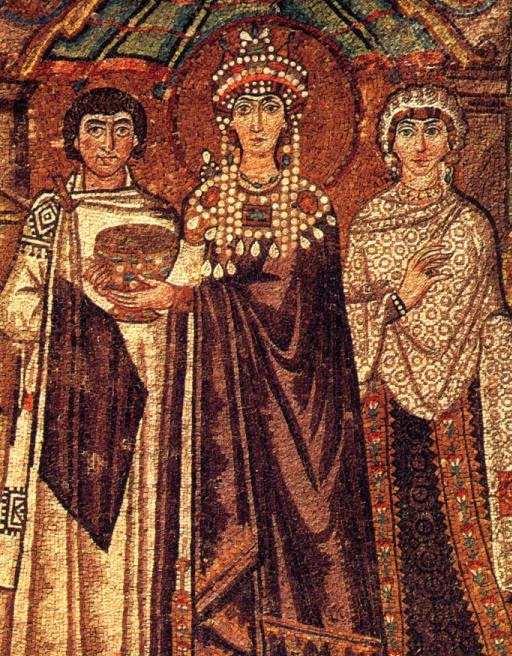
The character of Anastasius Zarides, Anne Perry’s fictional Byzantine eunuch

"The Sheen on the Silk" is a novel about intrigues in the Byzantine empire, centering around the main character of a woman posing as a eunuch. Written by Anne Perry and published in 2010, the story opens in late thirteenth-century Constantinople.

Anna Zarides, a widowed physician, travels a hundred miles from her home in Nicea to the city of Constantinople. She intends to learn more about the circumstances of the exile of her twin brother Justinian Lascaris so that she may rescue him. Realizing that she will need to speak with men as well as women, she poses as a eunuch called Anastasius upon her first arrival in Constantinople. This enables her to speak to men on professional pretenses, as a woman physician would not be allowed to treat male patients. It also relieves her of pressure to remarry.

This issue of personal concern happens against a backdrop of the Byzantine empire's decision whether to ally with Rome. The inhabitants of Constantinople have only recently returned to their city after being exiled for a half-century. (The reader knows from history that the two churches will not reconcile and Byzantium will suffer a series of defeats, ultimately falling to Mohammed II the Conqueror in the mid-fifteenth century.) The story explores the psychological concerns of individual characters who believe they stand to benefit or lose from an alliance with Rome.

Disguising herself as a eunuch

Although Anna consistently presents as a eunuch in public and indeed risks death if her deception were to be uncovered, she is referred to as "she" throughout the story.

Anna does not have much difficulty passing physically as a eunuch. Recalling that a woman named Marina once successfully posed as a eunuch in a monastery (this is a probable reference to a fifth-century Lebanese saint), she simply binds her breasts, pads her waist, cuts her hair at her jawline and leaves it unveiled and unadorned. There is no reason for her to expose her body to anyone else. When she sails to Jerusalem, "she insisted on privacy for bodily functions, but as a eunuch that was granted her, even if for quite mistaken reasons. No one wished to embarrass her for the organs they rightly assumed she did not have." She appreciates that traveling alone is generally safer for her when she is perceived as a eunuch compared to when she is perceived as a woman.

Deliberately behaving as a eunuch is more challenging for her. Her eunuch servant Leo, described as "tall, slender-shouldered, and round-faced, with hairless cheeks," accompanies her to Constantinople and she copies his movements so habitually that she even finds herself reaching for food that is distasteful to her. Sometimes she feels the need to "make some uniquely eunuch gesture," yet recognizes that any such attempt would appear "absurd." The deceptively simple solution is for her to behave more or less normally while taking care not to reveal herself as a woman. A eunuch tends to be socially "invisible, like a servant," which in Anna's situation is a benefit, because less affectation is needed if no one is watching anyway.

How eunuchs were perceived

Eunuchs as a category are not clearly defined or understood in this society. This is made apparent by the very title of the book which is a metaphor for the eunuch sex. "The character of eunuchs," Perry writes, "was like the sheen on the silk-fluid, unpredictable. A third gender, male and female, yet neither." Yet elsewhere a eunuch is described as "a womanish creature with a man's name and no gender at all." One might question whether there is a difference between being a "third gender" and "no gender."

The "sheen on the silk" metaphor appears more than once. In one instance, it emphasizes that the character of Anastasius seemed "almost as if there were nothing innate that defined him." Eunuchs are, nevertheless, considered to be their own category. Early in the story, one eunuch is expected to be "pleased to have another of his kind" and a eunuch's voice is said to convey "the strange, altered tone of his gender." The eunuch Bishop Constantine believes that members of his sex tend to have "patience, suppleness of mind and instinctive understanding of emotion." So part of the mysterious sheen on the silk is the question of whether eunuchs are a separate category and whether they have any innate qualities that distinguish them.

Anastasius - who, again, is Anna in eunuch garb - is described as "not a man, but not a woman, either, yet still a passionate and highly intelligent being. He was what she was pretending to be." Anna is unhappy, longing to solve the mystery of her brother's disappearance and lonely for more people who know her secret and who can see her as she really is. "She was incomplete, maybe as much as the eunuch she pretended to be," as Perry puts it.

Eunuchs are frequently misunderstood and ridiculed. One man observes that they are "without temptation of the flesh, and therefore without the possibility of true holiness. Is it not better for all that their species die out?" A powerful woman taunts, "What gives you pleasure, Anastasius?," adding, "Do eunuchs have pleasure?" A common response is to fear the unknown, as in this passage: "What an incomprehensible mixture of beauty, wisdom, and barbarity eunuchs were. Rome should fear them more than it did."

They can also be highly ranked and highly trusted. Posing as Anastasius, Anna was allowed to medically treat the bishop and the emperor. Furthermore, when she sent Nicephoras - who was, in this story, one of Emperor Michael's highest-ranking eunuch courtiers - to buy medication for the emperor, Nicephoras brought his personal poison taster with him, suggesting that he was important enough that he had to employ someone to worry about his safety.

Bishop Constantine faces special challenges because he is a eunuch

History leads Bishop Constantine to believe that Constantinople is more tolerant of his gender than Rome would be. He fears that Rome might disenfranchise standing eunuch officials. For that reason, among others, he opposes contemporary suggestions to ally the Orthodox Church with the Roman Church. "The days are gone when a eunuch could be everything except emperor," it is noted.

Emperor Michael Palaeologus, however, desires to unite with Rome. He appoints John Beccus, a "whole man" and a supporter of union, to be church patriarch. Constantine would have aspired to this position and he feels "doubly castrated" by this betrayal. "A whole man, an insult to Constantine's existence. As if organs made the soul!" he rails. "A man was his passions of the heart, his dreams, the things he longed for, the fears he had overcome, the wholeness of his sacrifice, not of his body." Logically, of course, if men are not to be judged by their bodies, a eunuch should not judge an uncastrated man on that basis either. The point is that Constantine believes that the emperor was making a comment slighting his manhood. In his rage, he fantasizes about castrating Beccus and seethes that this would make them "equal."

Constantine is an angry character overall. When he sees the murdered body of a formerly attractive lady, Perry writes that "his mutilation burned in his soul." In this sense, people's bodies - or at least their sense of their own bodies - can indeed impact their spirit and character.

Open questions about Anastasius

In Anna's case, it is difficult to pin down to what extent her character was determined by her female sex or by her eunuch behavior when she was disguised as Anastasius. So much of her gender presentation was a deliberate ruse, but it did become second nature over time, so one might question to what degree she began to privately feel that she was indeed a member of the eunuch gender.

A historical note

Lewis Coser wrote: “In Byzantium, where the institution of the harem did not exist, ‘no office, however high, in Church or State (with the single exception of the imperial dignity itself) was withheld from the eunuchs on principle, and many of the leading Byzantine statesmen and generals were eunuchs. Although eunuchism originated in the needs of harem masters,” rulers without harems also found uses for eunuchs.
"The Political Functions of Eunuchism." Lewis A. Coser. American Sociological Review, Vol. 29, No. 6 (Dec., 1964), pp. 880-885 (6 pages) https://doi.org/10.2307/2090872 https://www.jstor.org/stable/2090872 Quotation from p. 880–1.

Image: A mosaic from the Byzantine era. Basilica of San Vitale, Ravenna. © Public domain Wikimedia Commons.

The character of 'The Eunuch Neferu'

The Eunuch Neferu, originally self-published by Daniel Tegan Marsche in 2002, is an unusual novel about a young eunuch in Egypt in the first century BCE.

Admired for his beauty by a Roman general who was passing through the desert, Neferu was taken from his family of poor farmers and brought to the general's estate in the city of Alexandria to be a sexual servant. His drunkard father had willingly sold him to the general to pay for his gambling losses. Neferu was only eleven, had no sexual awareness, and did not understand the implications of the castration that would be required by the general. He only knew that he was duly impressed at being treated as a guest of honor at a residence that was to him unimaginably lavish. An older eunuch servant, Bo'am, briefly tutored him on sexual subjects so that he could express consent to be castrated.

Rather than undergoing the traditional Egyptian procedure which would have involved being buried in the hot desert sand for days, this boy had the good fortune to be brought to a surgeon who tied him to a chair and drugged him with dark brown opium powder mixed with honey. His mentor Bo'am told him he would feel no pain, but of course he did, despite the painkiller, when he awoke. He hazily dreamed of stepping onto a swimming crocodile's back and imagined himself delivered by a crowd of people who honored him with a new name. Later, recalling the agony of his recovery, he was nevertheless grateful he had not received the more primitive surgery with the higher mortality rate.

With respect to his initial innocence of sex, Neferu seems credible as an eleven-year-old, but in most other respects, including his poise, eloquence and understandings of the subtle machinations of adults, his first-person narrative seems to come from a psyche that is at least sixteen. He does seem to attain that chronological age, too, over the course of the book.

There are other oddities about this story. The very title is an anachronism. The name Neferu was given to the boy eunuch - originally known as Kebryn - by the general, halfway through the book, who says it means "the beauty of heaven." The idea is that it combines the Coptic word "nefer" meaning beauty and the Greek word "utopia" meaning heaven. Unfortunately, the word "utopia," literally meaning "nowhere," was actually coined by the English writer Thomas More over a millennium and a half after this story was supposed to have taken place. Other distracting anachronisms occasionally appear in the text such as the use of the Freudian phrase "anally retentive" and the unexplained use of Sanskrit terms for eunuch including primarily "hijras" and "vadhri" and also "prakrti," "pota," and "sandha." Sanskrit was spoken in India.

There is never an explanation of why the general required his sexual slave to be castrated, particularly as his previous lover had not been castrated and as he intended to leave his entire estate to the eunuch anyway. Nor is there an examination of how Neferu was affected by his castration. In the many homoerotic scenes, there is no mention of his castration negatively affecting his physical drive, pleasure or expectations, and instead there is one positive mention of his "ever so sensitive" scar. He never questions whether he would have liked to be able to father children. Conveniently for him, he is exclusively interested in men; there are no significant female characters in the book, anyway.

The author's biography on Amazon.com calls the story "a cathartic recounting of Marsche's personal, childhood journey of abuse re-wound to a place and time where his emotions could be expressed without contempt." Writing in the first person, he clarifies: "I was not a sexual being as a child, I was used as a sexual object; there is a huge difference." It is unclear why writing about an eleven-year-old whose sexuality is quickly awakened by a much older man was cathartic for Marsche. The eunuch in this story, despite his castration and domination by a Roman general, is extremely sexual. Marsche asserts in this same biography that "there is life after the abuse," an idea distinctly not suggested by the novel's abrupt, dark ending.

This review refers to the first edition published through iUniverse, but a fourth revision has been made available. The author is currently known as Daniel Malloy Smith according to GoodReads. His tale may have been inspired by Mary Renault's The Persian Boy (1972) or Wilbur Smith's River God (1993).

Buy the fourth edition of The Eunuch Neferu:

Neferu's status - slave or free? - is a subject of much contemplation. He seems to be fascinated by his condition of being technically able to leave the general but having no fathomable reason to do so. He wants to wear silk and gold and eat anachronistic foods; this he is able to do. His status with the general is gradually elevated until they are nearly peers. Bo'am consistently reminds him of his good fortune with purrs such as "I know many an indentured eunuch that would have glorified in the liberation to utter such words as your own."

Education is not a large motivator for him. He is told he must learn Latin and Greek in addition to his native Egyptian and Hebrew, but never mentions his studies, apart from how his dancing, which he seems to find somewhat tiresome, successfully impresses his lover.

Initially, Neferu prays to various Egyptian gods, but this habit seems to drop off the longer he lives in luxury. While Neferu is struck by temporary blindness, the Oracle of Bastet, addressing him as "Sightless Pilgrim," advises him to pick an Egyptian god and devote himself to it. Although this would seem to be an important warning, Neferu seemingly forgets this advice and the theme is never mentioned again.

As he is not motivated by ambition, education, religion, family (there is barely any passing mention of the parents he left), or general concern for others' welfare, he seems motivated primarily by appreciation for finery and sex and to some degree by the drive to maintain his honor. The insight he gains during his brief blindness represents a minute increase especially for a young man who should be growing psychologically in leaps and bounds. Finally, for all his apparent exploitation and tender age, he does not display the expected level of psychic vulnerability and therefore isn't even properly pitiable. Thus his fictional existence leaves a limited legacy.

Saturday, December 6, 2014

An abused boy is a tragic figure in M. A. McRae's novel 'Not a Man'

Shuki, a young eunuch, is repeatedly abused by men in the novel Not a Man. He and his fellow adolescents learn a good deal about sex as they grow up. Originally posted to Helium Network on May 13, 2014.

M. A. McRae's novel Not a Man is a sordid tale of a child sex slave. Written with a good amount of tenderness, the subject matter is nonetheless hard to take, especially with such a great quantity of words and repetitive anecdotes about abuse.

The premise

Not a Man is set in the modern world, probably in the mid-20th century, given the references to technology. The story opens in an Arab nation that is never named. Shuki, whose family is impoverished, is a 10-year-old sex slave to a wealthy man named Hassanel Daoud who is of English descent and was raised Arab according to his stepfather's culture. Hassanel often puts the boy in restraints and allows other men to have their way with him. The boy puts up with it because he knows his family needs the money and because he sees "Uncle Hass" as his caretaker.

Hassanel asks Shuki if he will consent to a "small operation" that he likens to a circumcision but does not explain any more fully; he bribes Shuki with the promise of gifts. Shuki is drugged and gagged as a doctor performs an illegal castration on a bed, cutting off his testicles and shortening his penis. Hassanel sentimentally retains the awful mementos of this procedure, and ever after, he takes pride in the idea that Shuki consented to this for him. Shuki, however, knows that he did not consent, and he privately determines to run away at his first available opportunity. Subsequent events are set in England.

The story makes clear that the practice of castrating "bed-boys" used to be fairly common in this culture, but that it became illegal and is now so uncommon that people no longer immediately recognize a eunuch as such when they meet him on the street. It is only when Shuki's nudity is revealed — which he assiduously avoids — that others understand that he was castrated. One man tosses Shuki out of a holy area, telling him that he is an "affront to Allah."

Unrealistic and creepy

Shuki is taken advantage of by many men throughout the story. Hassanel's sex-mad teenage son, Hasquitri, upon learning that Shuki is a eunuch, appropriates his father's boy toy for his own purposes. A wealthy businessman pays him for sex. His friend makes love to him. Even Shuki's teachers and a doctor to whom he turns for help have inexplicable stirrings for him as soon as they learn that he is a eunuch, and some act impulsively on that attraction. It happens so many times that Shuki believes he can obtain British citizenship by "offer[ing] myself to the Home Secretary in return for what I want."

This seems unrealistic in its thorough creepiness. It feels as though Shuki is surrounded by psychopathic molesters wherever he goes in his native land and also when he travels to stay in England. If this were a true story, it would be a horrid confessional.

The story is repetitive and excessively long, having roughly the same word count as "Harry Potter and the Goblet of Fire", except that, in this case, the golden egg can never be retrieved.

What redeems the book is that Shuki evinces an unstereotypical personality. He often plays along with the perception that eunuchs are biddable while really he is waiting for the right moment to ask for more money and gifts or to run away. He loves horseback riding, and he cares about training himself as a fighter as well as working on his literacy.

Some time after his castration, he tells one of his bed partners that

"it's only recently I've realized what I really lost that day...A man and a woman, together, in a relationship that will probably last until one dies...that sort of love is inevitably based on a sexual relationship. It's not sex that I miss, but what sex can lead to."

It is a mature thing for a young teen to say, but then, he's had plenty of opportunity to contemplate it.

For those who wish to read it

The e-book can be purchased cheaply on Smashwords, a self-publishing platform. Not a Man was released in 2011. The two subsequent books in the Shuki series are The King's Favourite and To Love and To Protect. The Australian author, M. A. McRae, keeps a blog.

The story drags on inexcusably and could have been told in a quarter of the number of pages. As it is, there is no subplot, but just an endless series of rapes and mishaps, with rather limited insight from the teenage characters into their situation. The book is nonetheless a useful reminder of a sort of life that does not exist only in fiction; sex slavery has been a reality for children, castrated or not, throughout history and even today in the underground economy.

Image: A photograph of the Boy Scouts Monument of Letran students in the Philippines, taken by Ramon F Velasquez. © Creative Commons Attribution-Share Alike 3.0 Unported license Wikimedia Commons.

Wednesday, November 12, 2014

The eunuch Ahausarus, a minor character in Steven Saylor's 'Roman Blood'

Ahausarus is a supporting character in Steven Saylor's mystery "Roman Blood." The story is set in 80 B.C.E. in Rome. Ahausarus is a servant of Caecilia Metella.

Originally published to Helium Network on Feb. 19, 2014.


Steven Saylor's novel "Roman Blood" is a murder mystery set in Rome in 80 B.C.E. The story is narrated in the first person by Gordianus the Finder, who is hired as a detective by the accused murderer's defense lawyer Cicero. Cicero wishes to find out who the real murderer is in advance of the trial. Cicero's slave boy Tiro, who is explicitly rendered as a non-eunuch, accompanies them. The novel does, nonetheless, have one eunuch as a supporting character.

The eunuch Ahausarus: A 'scatterbrained' servant


When Gordianus, Cicero and Tiro come to the house of Caecilia Metella, they encounter an unexpected situation. The eunuch Ahausarus is introduced as follows:
"The announcer arrived, obviously disappointed to find that it was Cicero and not some groveling client from whom he might extort a few denarii before allowing further admission to the house. From small signs – his high voice, the visible enlargement of his breasts – I realized he was a eunuch. While in the East they are an indispensable and ancient part of the social fabric, the unsexed remain a rarity in Rome and are looked on with great distaste. Cicero had said that Caecilia was a follower of Oriental cults, but to keep a eunuch in her household struck me as a truly bizarre affectation."
This comment – that Ahausarus's presence is a "bizarre affectation" on the part of Caecilia – immediately paints Ahausarus as a sort of Eastern relic, a stereotype, not as a unique person and certainly not one with autonomy. His presence is rather a comment on Caecilia's autonomy.

The trio are escorted into Caecilia's inner sanctum, heavy with the fragrance of burning sandalwood and myrrh, where she keeps an eight-foot-tall statue of a goddess. The statue's torso included representations of severed testicles, and the goddess held a bloodstained blade. Caecilia is extremely unhappy with the arrival of the three males into this particular room. Men are forbidden to pass beyond the curtain. "No, no!" she cries. "That stupid eunuch!...How could he have made such a stupid mistake?...I don't see how he could make the same mistake twice. Do you think he does it on purpose?...But Ahausarus is far too valuable to be gotten rid of, and too delicate to punish. If only he weren't so scatterbrained." Although Saylor does not explicitly state it, Caecilia likely finds Ahausarus useful insofar as, given his status as a eunuch, he is able to perform certain functions that are restricted to men, yet he is also able to join her in the sanctuary of the castrating goddess.

Ahausarus's normal duties


Cicero's client, the accused murderer Sextus Roscius, is staying in a different part of Caecilia's enormous house. Ahausarus appears multiple times in the story only within the context of his usual job function as a greeter and escort within the property. Gordianus narrates:
"The eunuch Ahausarus led us there through a network of increasingly narrow and less resplendent hallways...Ahausarus made a show of admitting us with a flourish through a final curtain. 'Sextus Roscius, the son of Sextus Roscius,' he said, bowing his head toward the figure who sat in the center of the room, 'a much-esteemed client of my mistress. I bring visitors,' he said, making a vaguely dismissive gesture in our direction. 'The young Messalla, and Cicero, the advocate, whom you have met before. And another called Gordianus.' [The slave] Tiro he ignored, of course, as he also ignored the woman who sat sewing cross-legged on the floor in one corner, and the two girls who knelt beneath the skylight playing some sort of game. Ahausarus withdrew."
Ahausarus is rarely called simply by his name, unless someone is addressing him directly. The narrator – who had been so surprised to see a eunuch in the first place – more commonly refers to him as "the eunuch Ahausarus," as in these sentences: "Caecilia, in fact, was unable to join us; the eunuch Ahausarus explained that the interview with Sextus Roscius had exhausted her." And: "Finally a slit opened and through it peered the calculating eyes of the eunuch Ahausarus."

The eunuch's officious personality, complete with arched eyebrows and rolled eyes, is revealed in this passage:
"Ahausarus refused to wake his mistress. Nor would he allow us to stay the night. ("Impossible," he sniffed haughtily, as if hosting Sextus Roscius and his family were taint enough on the household.)...After some hurried negotiations (mostly I begged while the eunuch arched his eyebrows and stared at the ceiling), Ahausarus was quite happy to see us off..."
His last task in the book is to clean up incriminating evidence, as ordered by his mistress Caecilia.

A typical eunuch character


Ahausarus is a typical example of the way that many eunuch characters are presented in fiction: silly, with an overinflated view of his role, yet able to be bribed. He is also a typical example of a slave stereotype, as he does whatever he is told but often makes goofy errors, and the reader doesn't get to learn his private thoughts and thus has no idea whether he errs on purpose as a form of rebellion.

About the image above: Diana of Ephesus and the Slaves was painted between 1895 and 1899 by Giulio Aristide Sartorio (1860-1932). Location: Galleria Nazionale d'Arte Moderna. © public domain. Wikimedia Commons.

Sunday, November 9, 2014

The character of Zeno of Tmutorokan in 'Memoirs of a Byzantine Eunuch' (with spoilers)

Christopher Harris’s work of historical fiction, Memoirs of a Byzantine Eunuch, is told from the viewpoint of the fictional eunuch Zeno, originally the son of Roman citizens living in Tmutorokan, northeast of Constantinople across the Black Sea, near the Jewish kingdom of Khazaria. Captured and castrated, he becomes a slave in Constantinople, and has the dubious honor of keeping close company with Emperor Michael III and the church patriarch. The novel provides rare insight into what it may have felt like to be a eunuch slave at this time.


In the year 837 C.E., as a seven-year-old boy, Zeno is captured by "Rus giants" – that is, Vikings. He is thrown in a sack over the back of a Rus man named Inger. As the Rus are sacrificing other unfortunate people, Zeno fears he'll be eaten, but instead he is made drunk on wine, his scrotum is tied off with a cord, he is castrated with a dagger and his testicles are thrown on the fire.

Eventually, the Norse-speaking Rus stop in a tavern on the Golden Horn, north of Constantinople, where they need Zeno to translate the Byzantine Greek language for them. He happens to hide under the skirt of the widow who ran the tavern. She protects him and orders out the Rus.

Inger stays behind at the tavern with his eunuch slave child and formally converts to Christianity to marry the widow. As Inger is often in a drunken slumber, the widow teaches Zeno to please her in bed. Zeno also helps to rear their daughter Eudocia.

When Zeno is fifteen, a scholar visiting the tavern is intrigued by his knowledge of the Rus. He brings Zeno to another scholar, Photius – a lifelong celibate who wears itchy underwear to bed – who sniffs that eunuchs are "nasty, hybrid, androgynous creatures, neither one thing nor the other. They violate logical categories, and break the laws of generation. A eunuch is an affront to nature, and to its Creator."

The pair nevertheless buy Zeno for ten gold pieces and attempt to make him a scholar, too. Zeno already knows how to read and write, and has the intellectual capacity but not the drive for book-learning, preferring to seek knowledge out in the world.

His luck begins to change in 847 when Bardas, the brother of the regent Theodora, visits the scholars. Bardas is upset that a eunuch, Ignatius, has just been made patriarch. Eunuchs, he observes, "always support their own kind." Photius avers, "I think removing their balls must remove their consciences."

Because he is feuding with eunuchs, Bardas acknowledges curiosity about whether they are more like men or women, and he uses Zeno as a test case. Zeno is brought to a man who hooks him up to improvised machines meant to measure tumescence while he watches prostitutes perform for days on end. The researcher finally declares that Zeno is definitely incapable of arousal yet has a male soul. Zeno recalls thinking, exhausted: "So I had a soul, and was male. That was something."

Zeno believes he has demonstrated that eunuchs are neither men nor women. His sense of otherness is compounded by his detachment from the social identity that other eunuchs seem to share as a collective. "I am not one of those gross swollen eunuchs, like Cyril, or one of the dried-up, wizened ones like Ignatius," he ruminates.

Of the painted eunuchs who cavort before the emperor, he says, "Those debased creatures had lost more than their balls. They had lost their self-respect." While Photius continues to stereotype eunuchs as "bitter at heart" and Bardas insists they are "a waste of money," Zeno proves to himself, at least, that they are wrong. Perhaps many eunuchs are like that, but Zeno knows he is different.

In his more melancholy moments, Zeno says things like: "Perhaps all eunuchs are the same. We lose our autonomy when we lose our balls. And that is not to be wondered at. Some ancient philosophers have defined life in a way that excludes eunuchs." He means this in the sense that some definitions of life included the ability to reproduce. One eunuch "had hinted as much when he compared eunuchs to bees. We work for others, not ourselves, with no hope of passing on any advantage we win."

Zeno also seems to resent his employment with Christian scholars who are fascinated by heresies. "Heresies are all the same to me," he yawns in private. He thinks religion, like food, can be used to excess. Secretly he believes that polytheism is the more likely explanation of "life's uncertainties and reverses."

In 854, Bardas sought to toughen up his sister's son, the fifteen-year-old Emperor Michael III. Zeno recommends the tavern where he grew up, chiefly so he can see his long-lost Eudocia whom he always thought of as a sister, a girl who "had not cared that I was a slave and a eunuch, had not even understood that I was inferior."

She is now fifteen and Zeno is surprised to find himself attracted to her, especially given that the researcher had "proved me sexless." The young emperor Michael also takes a fancy to Eudocia and Zeno has no choice but to facilitate their trysts. With Bardas's consent, Eudocia is set up in the palace where she lives in luxury but is confined to her quarters and must await Michael's pleasure.

Michael marries a different woman and discovers he prefers sex with men, particularly with the athlete Basil. He forces Basil to marry Eudocia so that he may more easily continue his affairs with both of them. Eudocia bears a son. (Although it is never clear who the father is, this child is the future Emperor Leo.) Michael eventually abandons Basil and takes a new primary male lover.

Meanwhile, Bardas kills the eunuch Theoctistus and deposes the skinny, tottering, lizardlike patriarch Ignatius, thought by all the characters to be ignorant, replacing him with Photius. This means that Zeno is now the servant of the leader of the Church.

Bardas subsequently has a nightmare of being harangued by saintly eunuchs in court robes – "Do you think I'd dream about naked eunuchs?" he asks indignantly – ringed with golden halos and carrying Christian ritual items. Although he calls them "horrible" and "unnatural," one of them is identified as Saint Peter by a dream interpreter.

The dream portends bad news, and indeed Bardas is soon slain by Basil who parades his genitals on a spear. "In death, Bardas became what he most despised, a eunuch," Zeno acknowledges, further reflecting that "I had no reason to think he liked me any more than the others of my kind."

As Zeno remains one of the closest associates of the Emperor Michael, he must suffer through the emperor's worsening debauchery. One of Michael's favorite party games is to stage mockeries of heretical Paulician Christian masses with sexual and scatological elements.

At the apex of the madness, Zeno unwittingly accompanies the emperor as he breaks into a church, orders his lover to axe-murder the elderly caretaker, and then uses the church's relic – the penis of Christ – in a sex game, for which Zeno is ordered to deliver an invocation. When Zeno seems surprised at the relic's existence, Michael sneers, "Did you imagine that He was a eunuch, like you?"

Zeno's dinners with other eunuchs are not much more pleasant, as the eunuch Cyril (whose body Zeno compares to "a heap of wet, slithering tripe") hosts an after-dinner orgy at which Zeno feels raped. Later, when Cyril tries to enlist Zeno to defend the palace eunuchs, he protests, "I am not one of your kind." Cyril's response is to threaten Zeno with being confined to a dungeon with circus freaks and people who have had their tongues cut out.

In Zeno's version of history, he plays an important role in the imperial succession. Basil slays Michael and takes the throne; he exiles Photius to a monastery for a time, but eventually reinstalls him as the patriarch. Zeno poisons Emperor Basil's son, and soon after, Basil himself is slain, clearing the way for Eudocia's son to be crowned as Leo VI.

Author Christopher Harris writes in his "Historical Note" that "the leading figures in this Golden Age were Bardas and Photius." The emperors in the story were also based on the real Byzantine emperors. The eunuch characters, meanwhile, are clearly the result of research into the way that castrated men were actually spoken about in antiquity.

Originally posted Nov. 2, 2011 to Helium Network.

In case you missed it

Have you seen inside the book 'To Climates Unknown'?

The alternate history novel To Climates Unknown by Arturo Serrano was released on November 25, the 400th anniversary of the mythical First ...