Showing posts with label social issues. Show all posts

Thursday, June 13, 2024

John DeVore: 'Compassion, kindness, and creativity...glows in the darkness like fireflies'

A compelling essay by John DeVore on attending the theater in London:

"Here’s what I remember: energy, life, fire, hundreds of humans gathering, talking and gesticulating, finding their seats, leafing through programs, and watching other people fill a space with words and tears and bones. I remember thinking, “Theatre is not dead.”

* * *

I sat in a theater and watched a play in London. I remember wanting to be there. I remember everyone wanting to be there, too.

* * *

The only way to save the theatre — and, in turn, the national soul because the stakes are high — is to reevaluate our cultural values. Oh yeah. Conservatives are going to hate it. We will need to take over all the baseball stadiums and megachurches to do this right. It has to be IRL. I propose not inviting the tech guys, but we should because every voice is blah blah blah. But this needs to happen in person, like Model UN, Galactus-sized.

* * *

What’s important to me? Family. Friends. Listening to and showing up for those who love and see me. Those who accept me for who I am. It’s important to eat, laugh, and tell each other everything will work out, even if it does not. It’s important to tell stories and to do the work, especially the work that never ends. The work will never be finished, and there is joy in that knowledge. The fight was fought before you were born, and it will continue. Patience and spine are important — compassion, kindness, and creativity, the kind that glows in the darkness like fireflies at midnight. All important. Those are my values. It’s important to step out onto the stage and open yourself up. It’s important to share dreams, even those that feel like memories."

A Few Thoughts On How To Save The Theatre, John DeVore, June 12, 2024

It somehow reminds me of this too:

"But today I’ll say, I don’t just tolerate fifth grade graduations. I’m not just relieved when they are tolerable simulacra of the Real Graduations. Fifth grade graduations are, at this moment in time, my absolute favorite graduations. Because these ceremonies, for once, aren’t about winning a race. They aren’t about passing a bar whose very existence implies that others didn’t get there with you. They’re about a group of friends who shared a space for far more than half of their lives look each other in the eyes and say that this was ours, together. Some of us were better athletes and some of us were better dancers and singers and some of us memorized more digits of Pi and read thicker books, but it would not have been the same if we were not all here. We were friends, in the most complicated, transcendent form of the word. And if we are lucky, that is what we will still be, years from now."

Actually, fifth grade graduations might be the best graduations: On celebrating in public, together, Garrett Bucks, June 12, 2024

old photo of drama lady in leopardskin cavewoman dress

Monday, January 8, 2024

California Constitution initiative: Allow parents to sue social media for $1 million

Mike Masnick, TechDirt, January 8, 2024 ("Leading ‘Save The Kids!’ Advocate Pushing Absolutely Dangerous ‘Protect The California’ Ballot Initiative That Will Do Real Harm To Children"):

"And now we’ve got Jim Steyer, who has more money and ignorance than sense, trying to quietly push a California ballot initiative that would adjust the California constitution in an unconstitutional (by the US Constitution) manner to falsely claim that social media is deliberately harmful to kids, and that people should be able to sue social media for a million dollars any time any kid anywhere is 'harmed' in a manner on social media that the social media company should have magically stopped."

Kind of like the opposite of Substack's claim that they cannot magically stop Nazis but only contain them which allegedly will somehow discourage them.

If you're in California, you can work out with your co-parent whether your kid uses social media.

See also the proposed Kids Online Safety Act (KOSA) at the federal level.

illustration of person watching TV

Saturday, January 8, 2022

Twitter users: Celebrate Jan. 8, the 1-year anniversary of no-Trump

On January 8, 2021, Twitter permanently suspended Donald Trump's account for violating its guidelines against the Glorification of Violence.

As a result of that decision, one year later, Twitter is a better platform.

Of course, many Trumpists are still active on the platform.

Good news: If you use Twitter, you can at least personally block them.

A stone wall covered with ivy.
Image by jeonsango on Pixabay

Blocking them means you won't see their tweets accidentally, which prevents them from ruining your morning, and it also removes the temptation for you to interact with them. (Interacting with them would benefit them by amplifying their message in the algorithm, and it would only encourage them to tweet more.) Blocking them also means they won't see your tweets accidentally, which gives you a little more privacy and safety from the GOP. You'll never know all the crap you're missing.

Go ahead. If you didn't already do so a year ago, take five minutes and Twitter-block the 43 Republican senators who voted to acquit Donald Trump of incitement to insurrection. You have permission. It will help you focus on building better relationships on Twitter.

Lindsey Graham
John Barrasso
Marsha Blackburn
Roy Blunt
John Boozman
Mike Braun
John Cornyn
Tom Cotton
Kevin Cramer
Michael D. Crapo
Ted Cruz
Steve Daines
Joni Ernst
Deb Fischer
Charles E. Grassley
Bill Hagerty
Josh Hawley
John Hoeven
Cindy Hyde-Smith
James M. Inhofe
Ron Johnson
John Kennedy
James Lankford
Mike Lee
Cynthia Lummis
Roger Marshall
Mitch McConnell
Shelley Moore Capito
Jerry Moran
Rand Paul
Rob Portman
Jim Risch
Mike Rounds
Marco Rubio
Rick Scott
Tim Scott
Richard C. Shelby
Dan Sullivan
John Thune
Thom Tillis
Tommy Tuberville
Roger Wicker
Todd Young

If you just blocked these people, say hi to me on Twitter!

Saturday, August 24, 2019

Hurt me 15 degrees less: On cruelty, fear, justice, order, and challenging the conservative white evangelical worldview

Yes, indeed, for white evangelicals in the US today, the catchphrase the cruelty is the point (as distilled by Adam Serwer in the Atlantic) is indeed the case, John Stoehr wrote in August 2019. They act this way simply because when they hurt "people deserving cruelty," it "feels good" to them, and they put effort into coming up with other rationalizations for their actions. (On this point, Stoehr cites Richard Rorty's Achieving Our Country.) And they are not so much afraid of their victims (making words such as "homophobia" misnomers) as they are afraid that they will go to Hell if they are more tolerant of others who they are told are going to Hell (i.e. others who are deserving of cruelty). This system makes them unwilling to listen to anyone who does not also subscribe to their evangelical group and concept of divine reward and punishment. This leaves them unable "to reason their way out of fear" and "is not a moral compass at all."

Daniel Schultz replied affirmatively to Stoehr, quoting the Atlantic's recent interview with conservative evangelical Ben Howe, in which Howe said:

"Trump became their hero, because he hated the establishment, and he beat up on the media, and he was fighting back against all these forces. The more he fights, the more they feel justified, like, He’s our hero because we needed someone to do this for us.

Trump’s appeal is not judges. It’s not policies. It’s that he’s a shit-talker and a fighter and tells it like it is. That’s what they like. They love the meanest parts of him."

Conservative white evangelicals, Schultz claims, believe in "justice and order." "Order" means that "God has ordained certain ways of being and doing in the world...Daddies are leaders, then mommies, then kids," and many also believe in a "racial hierarchy." (For many, "their whiteness outweighs their Christianness.") In this belief system, "God tells you not just the way you should be, but the way you actually are, and if you accept that, you will be blessed." "Justice" means that those who "violate or subvert" this social order are "threats to innocents" and "inherently deserving punishment." Someone who challenges a significant part of this system is basically suggesting that the conservative evangelical should "rewire their entire sense of reality," and indeed, "nobody really wants to give up on their world view. But the result of this stiff-necked epistemology is a tremendously brittle faith, one unable to tolerate the challenge of multiple perspectives." Schultz adds that "the refusal to be challenged also becomes perverse — a wrong choice for no good reason — because the social domination it protects is easily conflated with being the instrument of God’s righteous punishment. Sadists always have to justify themselves."

/ begin digression

On the topic of justice within evangelical thinking, I also found:

1. Owen Amos wrote for the BBC on 5 January 2018 that many evangelicals, including those who identify as "Premillenialists," believe there will be a great war (the "Tribulation" or "End Times") that will result in one thousand years of peace. Christopher Rollston, a professor at George Washington University, says: "Anything that's supportive of the modern state of Israel, for them is a good thing," because they believe that the Bible foretold the existence of the State of Israel. David Brog, executive director of Christians United for Israel, says that "they believe they are powerless to change the date of End Times" so it cannot be true that their support of Israel is motivated by a desire to hasten the End Times.

2. "There is no framework for restorative justice within evangelical thinking," Tori Williams Douglass wrote on May 8, 2018. Instead: "Punishment is a central theme in evangelical theology. They sincerely believe punishment works, and the data shows they are favorable to the harshest forms of punishment which are socially acceptable in any given situation." They tend to believe in spanking children "to punish them for any infraction, no matter how minor"; in penalizing poor people, which they prefer to frame as "teaching personal responsibility, employing the use of bootstraps, and encouraging hard work"; and in harsh punishment for crime, including the death penalty ("White evangelical protestants also have the highest group support of the death penalty, which is disproportionately used against people of color"). As someone employed in a neuroscience research lab, she says: "We know that hitting children doesn’t work, and we know what does work instead. We know that poverty and imprisoning people are traumatic events."

/ end digression

Returning to Schultz, who continues insightfully:

"Faith deployed in service of social hierarchy is also easily conflated with authoritarian power structures, even those led by [cough cough] corrupt awful human beings. Conservative white evangelicals respond to Trump not as a perfect or even good person, but as an imperfect instrument of God’s work to maintain the sacred order of the world. The cruelty is indeed the point because the cruelty manifests the justice that maintains the proper order."

Since a counterargument from "reason," "values," or "identity" won't succeed in this situation, it's probably more effective

"to point out the failures. How do you get a conservative evangelical to stop thinking the entire Queer community is evil? Show them not just a 'good' gay, but how anti-gay ideology has failed to protect them. How do you get them to turn against Trump? Show them how Trump has failed to carry out his promises. Not easy with a rabid culture warrior like Mike Pence in the #2 role. But probably the best evidence for somebody like this would be the ICE raids in Mississippi last week. Here’s Trump the authoritarian carrying out his promise to keep them safe — and the result is a terrorized, deflated community. People notice that kind of thing, especially when their church is called on to assist the victims."

I must personally note that such a line of argument may be emotionally difficult for someone to make. A gay person (me, for example) may note that anti-gay ideology has all kinds of negative social effects, but for me also to note that the social hierarchy hasn't worked out the way you hoped it would may be seen to imply that the way you hoped it would had any moral validity in the first place. If the (mysterious) way you hoped it would turn out was based on the idea that it feels good to you to hurt me because who you believe I inherently deserve to be hurt, that is alarming to me, and the fact that your bullying behavior toward me did not turn out to your own advantage is something I don't feel the need to help you with. I am not sure what magical beanie 'thinking cap' I'd need to don to be willing to have that head-spinner conversation.

On the other hand, it may be easier to have such a conversation based on a shared identity. A white American (me, for example) may note that anti-immigrant ideology has all kinds of negative social effects that hurt everyone-which-yes-includes-white-people. e.g. "However good you might feel hurting those other people and whatever you thought you were trying to accomplish, could you take a look at whether you've helped yourself and helped me? No? You have helped neither of us? Then could you please stop?" That is potentially a more coherent conversation if I am at least provisionally seen as belonging to the in-group and can make a request that at least appears to be on my own behalf. But if I'm seen as belonging to the out-group and if indeed the cruelty is the point, the conversation is a no-go.

I suppose maybe this is an example of pointing out a way in which Trump has failed. "We" wanted a negotiator; "we" didn't get that.

One right-wing organizer of Trump supporters, worrying about the "ugly, corrosive," violent "radicalization" of young men who "conclude there’s no space for them or their voice in the political process," commented anonymously to a writer: "the way to help these people is not to turn them 180 degrees, but to turn them 15 degrees.” This incrementalism may be the way the world really works. It may be the most effective strategy. But if we are observing the feelings of the hypothetical disaffected young men, we should also observe the feelings of their hypothetical shepherds who are put in a position of saying, "Could you please hurt me 15 degrees less?"

Sometimes trade-offs are made. New York City reversed its two-year-old ban on so-called "conversion therapy" (programs aiming to change sexual orientation) because it feared that it would lose a Supreme Court case over the matter which would cause permanent damage to LGBTQ rights. "The move is a gambit designed to neutralize a federal lawsuit filed against the city by a conservative Christian legal organization," the New York Times explained.

Loretta Ross wrote an August 2019 opinion in the New York Times about "call-out culture" which presents food for thought. (A "call-out" is a public criticism of someone's prejudice, often leading to a social media pile-on of thousands of negative comments. The prejudice in question is usually unexamined prior to the call-out, since, if the person already knew they were prejudiced and was being deliberately hurtful, there would be little point in "calling out" their behavior.) Ross acknowledges the importance of giving and receiving criticism. However, she suggests the reframe of a "call-in": "a call-out done with love." By this, she says, she doesn't mean that the critic should monitor their words for the purpose of "tone policing, protecting white fragility or covering up abuse." Rather, the critic should be attentive to whether their call-out will actually be effective. Complaints hurled as "personal therapy" are naturally ineffective. Complaints lodged by "self-appointed guardians of political purity" are also ineffective, she says, a point that may also be true, though it is a little harder to swallow. It gets at the difficult question, not only of how the critic knows that they're right (let's assume for the moment that the critic is indeed in the right), but how the critic knows what is a baseline level of righteousness that they can reasonably demand from others and what is an exacting level of purity that they'll never realistically achieve and that is counterproductive to request. In other words, to illustrate: What is the 15-degree turn in the preferred direction that the critic must demand, and what is the 180-degree turn that would be beautiful to see but which, unfortunately, if requested directly, will only result in a hostile 15-degree turn in the opposite direction. The general concept of negotiation and compromise is clear. It is just that it is difficult in any given situation, when we are dealing with words, feelings, and values (not numbers), to assess what's an appropriate level of "tough love" to dish out and which of our own words, feelings, and values we're prepared to compromise away.


A post-2020 election update: Monica Hesse's November 5 column for the Washington Post.

“Let’s make liberals cry again!” Donald Trump Jr., the saddest adult son, encouraged crowds at an election-eve rally in Wisconsin. His father, meanwhile, went on to a different Midwestern rally to fondly reminisce about the time in 2016 when liberal women wept at the announcement of his victory: “At the end of the evening when they’re all crying, and I remember they were crying,” he asked Grand Rapids, Mich. “Remember?”

A day later, as votes were counted, "25-year-old Republican Madison Cawthorn won a North Carolina district and, in his first public act as a future U.S. congressman, tweeted: 'Cry more, lib.'"

To point out that this is juvenile and mean and weird doesn’t get at the half of it. “Make liberals cry again” is the more synergistic, ball-cap-friendly version of “Own the libs.” A version of “Make America Great Again” that does away with the gauzy nostalgia and goes right for the bad sportsmanship. It is the version one uses when one wants to drop the pretense that this is about America at all and just acknowledge that it’s about reveling in someone else’s pain and perceived humiliation.

“Cry” is the most deliberate word in the phrase. It could have been subbed out for “pay.” Make liberals pay again. That phrase would imply that liberals had done something bad, requiring retribution. It could have been subbed out for “lose,” which would be a little gratuitous but still within the technical vocabulary of competition.

“Make them cry” turns the phrase specifically into a narrative of power.

For these Republicans, Hesse writes, the "game" isn't about any set of policies, and that allows the spirit of Trumpism to go on indefinitely. "When the goal is not victory but humiliation, there is no way to tell when the game is over." After all, "liberals can always be made to cry more, and longer. Long after Trump’s followers have forgotten why this was the goal, or what they gave up in order to achieve it, they can still make a liberal cry, again and again and again — a medicine for an ailment they will never cure."


In a November 7 New York Times article, reporter Ellen Barry quoted a Trump supporter as saying: “I’m just tired of all the arguing that people are doing. I wish sometimes Trump would just say — he doesn’t even have to mean it [emphasis mine] — that he would be the president for everybody. Just say those words.”

The cry against 'cancel culture' is an antipathy of being criticized

The way conservatives use "cancel culture," they refer to others' ability and right to criticize them.

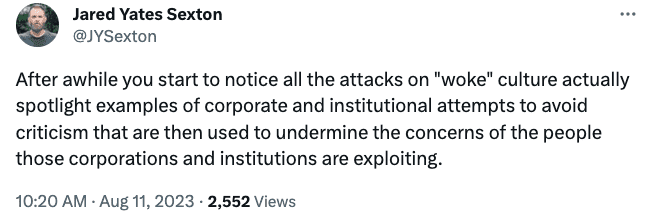
Jared Yates Sexton
tweets Aug 11, 2023: After awhile you start to notice all the attacks on 'woke' culture actually spotlight examples of corporate and institutional attempts to avoid criticism that are then used to undermine the concerns of the people those corporations and institutions are exploiting.
Jared Yates Sexton continues: And let's make it clear: there are no 'woke' corporations or institutions. There are wealthy and powerful people who either see an opportunity to profit or are concerned their exploitation will be laid bare. That's it. Period.

"...once you start pulling on the thread of conservative bad faith you inevitably notice that it makes its way through the entire national sweater." — A.R. Moxon, "One Must Imagine Charlie Brown Happy," The Reframe, Feb 18, 2024

"...a four-letter word...has, in some ways, come to stand in the place of traditional partisan orientations: care. Do you care or don't you?
* * *
Care is deeply political. ... To stand on the right side of history is to care. To be committed to social justice is to care. Self-care is imperative..."
— Hil Malatino (Trans Care, University of Minnesota Press, 2020)

Sunday, September 14, 2014

Did you ignore climate change today?

George Marshall, founder of the Climate Outreach and Information Network (COIN) based on Oxford, England, gave his first book talk on Sept. 3 at the Harvard Book Store in Cambridge, Mass. about his new book, Don’t Even Think About It: Why Our Brains are Wired to Ignore Climate Change.

The book is timely, with the massive demonstration called the People's Climate March scheduled for this Sunday, Sept. 21, 2014 in New York City, in advance of the international climate summit that will begin two days later.


Coming from an anthropological point of view, with experience as a communicator about climate change, Marshall's opening question is: "What explains our ability to separate what we know from what we believe, to put aside the things that seem too painful to accept? How is it possible, when presented with overwhelming evidence, even the evidence of our own eyes, that we can deliberately ignore something — while being entirely aware that this is what we are doing?" (p. 1) Climate change, he argues, is difficult for the human mind to understand and act upon. "If there are any grounds at all for regarding climate change as a ‘perfect’ cognitive challenge, it is not because of its specific qualities but because it is so multivalent — that is to say, it is so open to multiple meanings and interpretations." (p. 94)

He finds that many people are aware of the risks, but that, even when presented with information, they find ways to compartmentalize it or downplay it rather than to act on it. "Is there something innate in this issue that enables people to disregard it in this way? How else would it be possible for people to know that climate change is a threat but not feel that it is a threat?" (p. 45) To answer this question, he explores the separation between the "rational" and "emotional" brain.

Considering the work of Daniel Gilbert, Paul Slovic, Daniel Kahneman and others, he points out that climate:

- doesn’t have personal agency
- doesn’t trigger our moral sense of indecency or disgust
- doesn't change abruptly enough for humans to take notice or feel a sense of urgency
- introduces "dread risk" (risk that is catastrophic in scale) which may prompt us to emotionally shut down and try to rationalize or ignore the problem - introduces "unknown risk" (risk that is new and unpredictable) which means it is difficult for us to comprehend and prepare for
- reminds us of our mortality and provokes a "terror management" response by which we try to push away the uncomfortable knowledge
- is the subject of public debates, which, even if one side is educated and expert and the other side is laughable, creates the hard-to-shake impression that the jury is still out

Thus, climate change is, quoting Gilbert, “a threat that our evolved brains are uniquely unsuited to do a damned thing about.” (p. 46)

Yet another social reality is that, in general, people tend to avoid political controversy that will threaten their standing in their social group. This applies to scientists, too, who may otherwise be drawn to study climate change, but who, anticipating hostility and misunderstanding, may choose a different field.

Marshall says that information about climate change will be better received when it is communicated not only by professional campaigners, but by ordinary people. He also says it should not be exclusively framed as an "environmental" issue - portraying it as an issue about "gases" is particularly useless - but should be framed as being fundamentally about a large number of important issues.
"The visual and metaphorical language that surrounds climate change marks it, irredeemably, as an environmental issue. These images, constantly reinforced in every news story and media item, create a tightly interlinked schema by which climate change is detached from the other issues (employment, economy, crime, defense) that people care most about." (p. 131)
Climate change does, in general, increase the number of extreme weather events. These weather events cause significant property destruction and disruption to people's lives, and can also take a toll on ecosystems. When someone's house has been destroyed, they do not, however, want to talk about blind forces of nature and the probability, expressed in raw numbers, that the same thing will happen again to themselves or someone like them. Still less do they want to be told that they are contributing to the changing climate by driving their car to the hardware store to buy wood to rebuild their house. They just want to rebuild and to focus on the support they receive from their community.

With an issue this large, that affects every conceivable area of life, part of choosing the frame is deciding what to pay attention to and what to ignore.

On the one hand, people tend to employ an "optimism" bias by which they imagine that their lives and their local environments are better than average and that their futures and their children's futures will be comparatively rosy. On the other hand, when specific dangers associated with climate change are articulated to them, they may feel unable to prevent catastrophe and thus sink into agentic paralysis. Either way, no action is taken. The situation is either cast as someone else's problem or else as unavoidable and incurable.

Often, environmental campaigns proclaim a deadline by which the world must either be saved or lost, as in a phrase such as "we have ten years to save the planet". These slogans backfire, not only because it takes merely ten years to prove them to have been overstated and oversimplified, but because, when a fuller explanation of the meaning is given, "the campaign is immersed back into the tangle of probabilities, uncertainties, and cost-benefit analysis that it originally sought to avoid." (p. 62) In other words, there are facts behind the sound bites, but it is difficult to know when to invoke the complexity and when to chant the slogan.

People do not relish even slightly reducing their living standard today to avoid the mere possibility of a disaster in the future, even if it is rational (on paper) to do so. It is especially difficult when "the future" does not refer to one's own lifetime but to future generations. And it is nearly impossible when the beneficiaries are randomly selected, unknown people rather than one's own family and friends. It is one thing to bail out a flooded basement in one's own house or perhaps in the house of a relative or neighbor, and another thing to stop in one's travels to assist with a house that one has no personal connection to. There tends to be a "bystander effect"; even if a problem is recognized, without a clear plan of action, people tend to expect that "someone else" is in charge or has a plan to fix it. Thus, appealing to people to worry about the environments on distant islands fifty years in the future does not capture many people's imagination or attention, and adding more people at events, rallies, mailing lists, and so forth may only increase the bystander effect and thus the collective inaction. Marshall suggests changing the script: First, ask how much money it would take to pay you off to give you the right to cause damage to the climate that your own children will have to live in. Next, we need "to talk less about the costs of avoiding climate change and more about the lousy deal we are getting in return for a marginally higher living standard." (p. 71)

Historically, environmental campaigns have encouraged consumers to "go green" by making minor changes to their consumption. This backfires because the recommendations are easily construed as being based in personal criticism and blame. Among those who are predisposed to resist or contradict information about climate change, exhortations to "go green" stoke resentment and resistance (e.g. I am going to throw this recyclable bottle in the trash just to prove that I can and that it's my choice, and you can't make me put it in the recycling container), while among those who already care about climate change, reminders to reduce consumption often provoke exculpatory narratives to justify their behavior (e.g. I try to fly as little as possible, but I was so exhausted after studying the melting ice caps all year that I really needed to fly my whole family for a vacation).

Furthermore, a focus on personal consumption fails to strike at the root of the systems that drive production. As long as products and services are for sale, someone is going to buy them eventually. Encouraging people to buy them more slowly is not necessarily a radical change in favor of sustainability. Energy policy needs to change, and for that, social movement and political will - not just individual virtue - is needed.
"The focus on tailpipe gases and disregard for wellhead fuels has been the single most important factor in all government and policy framings. Radical environmentalists alone have attempted to connect two issues that, in the minds of most mainstream experts, operate in entirely independent realms. This does not, on its own, explain why we ignore the risk of climate change, but it does explain the fundamental disconnection that works through all narratives and policies on the issue." (p. 169)
Marshall's book explains very well why climate change in particular is so difficult for people to understand and to deal with rationally, and he proposes some reasonable, insightful, achievable steps to shift the discussion. As he said at Harvard Book Store (I am reconstructing the line from memory): "I spent twenty years as an activist trying to convince people to have the discussions that I wanted them to have. Now I want them to have the discussions that they want to have." But, he added, "If they happen to have the discussions that I want them to have, I'm happy."

Here's another one

Some emergencies are individual

Self-immolation of Wynn Bruce (April 2022)

Vacations are over

"Opinion: Vacations as we know it are over." Bill McGuire, CNN, July 27, 2023

See also:

"Why is Climate Change Such A Hard Problem?" Priya Aggarwal. Dialogue & Discourse. July 2, 2023.

In case you missed it

Have you seen inside the book 'To Climates Unknown'?

The alternate history novel To Climates Unknown by Arturo Serrano was released on November 25, the 400th anniversary of the mythical First ...