Showing posts with label interfaith dialogue. Show all posts

Wednesday, February 10, 2021

Quotes: Learning from people who are different

Without stealing or unfairly/inexpertly appropriating ideas from each other, we can learn from each other. Two reflections on this:

“The Jew can teach the Indian a lot about how to survive as a people and as a culture while being uprooted from one’s homeland, and against the odds of genocide and forceful proselytizing campaigns perpetrated by dominant religions and cultures. The Indian can teach the Jew a lot about what the Jew has lost at the expense of centuries of survival consciousness and uprootedness from connection to the land, information that is far more fresh in the ways of the Indians than it is in the ways of contemporary Jews.”
Gershon Winkler. Magic of the Ordinary: Recovering the Shamanic in Judaism. Berkeley, Calif.: North Atlantic Books, 2003. p. xx.

"Sufi mystics were renowned for their poetic testimonies to a paradigm of self-annihilation (fana) followed by a return to the glorious ‘subsistence’ (baqa) of everyday life. And similar notions, I believe, are to be found in Hindu teachings of the mystical heart-cave (quha) and Buddhist teachings on sacred emptiness (sunyata) and nothingness (nirvana)."
Richard Kearney. Anatheism: Returning to God After God. New York: Columbia University Press, 2010.

On how we can internalize the perspective of a parent (or anyone close to us), as we imagine they would express their perspective:

"What’s always funny, with me and Mom, is how the conversation can continue even when we’re not in the same room—how whenever I feel especially under pressure, I almost always start to hear my own internal version of her arguing with what I think might be her internal version of me, as though I’m rehearsing our next argument in my head, playing through things I’d never have the guts to say to her in person. Except . . . maybe it’s less “guts” than simple forbearance, a wistful wish to seem more reasonable than I often think I’m capable of being, plus the insight to know exactly how crazy most of the shit I long to spew at her would sound, if blurted out loud: how bitter, how scary. How essentially unnatural."
Gemma Files. Experimental Film. Toronto, Canada: ChiZine, 2015. P. 191.

A shared reality affects how we interpret our personal experiences:

"...two recognitions of human life that sound paradoxical but are actually complementary. First, people’s experiences are intensely personal; claims to the uniqueness of experience are true and deserve to be honored. Second, people’s ability to have experiences depends on shared cultural resources that provide words, meanings, and the boundaries that segment the flow of time into episodes. Experiences are very much our own, but we don’t make up these experiences by ourselves.”
Arthur W. Frank. The Wounded Storyteller: Body, Illness, and Ethics. (Originally published 1995.) Second edition. Chicago and London: The University of Chicago Press, 2013. Preface, 2013.

Saturday, August 24, 2019

Hurt me 15 degrees less: On cruelty, fear, justice, order, and challenging the conservative white evangelical worldview

Yes, indeed, for white evangelicals in the US today, the catchphrase the cruelty is the point (as distilled by Adam Serwer in the Atlantic) is indeed the case, John Stoehr wrote in August 2019. They act this way simply because when they hurt "people deserving cruelty," it "feels good" to them, and they put effort into coming up with other rationalizations for their actions. (On this point, Stoehr cites Richard Rorty's Achieving Our Country.) And they are not so much afraid of their victims (making words such as "homophobia" misnomers) as they are afraid that they will go to Hell if they are more tolerant of others who they are told are going to Hell (i.e. others who are deserving of cruelty). This system makes them unwilling to listen to anyone who does not also subscribe to their evangelical group and concept of divine reward and punishment. This leaves them unable "to reason their way out of fear" and "is not a moral compass at all."

Daniel Schultz replied affirmatively to Stoehr, quoting the Atlantic's recent interview with conservative evangelical Ben Howe, in which Howe said:

"Trump became their hero, because he hated the establishment, and he beat up on the media, and he was fighting back against all these forces. The more he fights, the more they feel justified, like, He’s our hero because we needed someone to do this for us.

Trump’s appeal is not judges. It’s not policies. It’s that he’s a shit-talker and a fighter and tells it like it is. That’s what they like. They love the meanest parts of him."

Conservative white evangelicals, Schultz claims, believe in "justice and order." "Order" means that "God has ordained certain ways of being and doing in the world...Daddies are leaders, then mommies, then kids," and many also believe in a "racial hierarchy." (For many, "their whiteness outweighs their Christianness.") In this belief system, "God tells you not just the way you should be, but the way you actually are, and if you accept that, you will be blessed." "Justice" means that those who "violate or subvert" this social order are "threats to innocents" and "inherently deserving punishment." Someone who challenges a significant part of this system is basically suggesting that the conservative evangelical should "rewire their entire sense of reality," and indeed, "nobody really wants to give up on their world view. But the result of this stiff-necked epistemology is a tremendously brittle faith, one unable to tolerate the challenge of multiple perspectives." Schultz adds that "the refusal to be challenged also becomes perverse — a wrong choice for no good reason — because the social domination it protects is easily conflated with being the instrument of God’s righteous punishment. Sadists always have to justify themselves."

/ begin digression

On the topic of justice within evangelical thinking, I also found:

1. Owen Amos wrote for the BBC on 5 January 2018 that many evangelicals, including those who identify as "Premillenialists," believe there will be a great war (the "Tribulation" or "End Times") that will result in one thousand years of peace. Christopher Rollston, a professor at George Washington University, says: "Anything that's supportive of the modern state of Israel, for them is a good thing," because they believe that the Bible foretold the existence of the State of Israel. David Brog, executive director of Christians United for Israel, says that "they believe they are powerless to change the date of End Times" so it cannot be true that their support of Israel is motivated by a desire to hasten the End Times.

2. "There is no framework for restorative justice within evangelical thinking," Tori Williams Douglass wrote on May 8, 2018. Instead: "Punishment is a central theme in evangelical theology. They sincerely believe punishment works, and the data shows they are favorable to the harshest forms of punishment which are socially acceptable in any given situation." They tend to believe in spanking children "to punish them for any infraction, no matter how minor"; in penalizing poor people, which they prefer to frame as "teaching personal responsibility, employing the use of bootstraps, and encouraging hard work"; and in harsh punishment for crime, including the death penalty ("White evangelical protestants also have the highest group support of the death penalty, which is disproportionately used against people of color"). As someone employed in a neuroscience research lab, she says: "We know that hitting children doesn’t work, and we know what does work instead. We know that poverty and imprisoning people are traumatic events."

/ end digression

Returning to Schultz, who continues insightfully:

"Faith deployed in service of social hierarchy is also easily conflated with authoritarian power structures, even those led by [cough cough] corrupt awful human beings. Conservative white evangelicals respond to Trump not as a perfect or even good person, but as an imperfect instrument of God’s work to maintain the sacred order of the world. The cruelty is indeed the point because the cruelty manifests the justice that maintains the proper order."

Since a counterargument from "reason," "values," or "identity" won't succeed in this situation, it's probably more effective

"to point out the failures. How do you get a conservative evangelical to stop thinking the entire Queer community is evil? Show them not just a 'good' gay, but how anti-gay ideology has failed to protect them. How do you get them to turn against Trump? Show them how Trump has failed to carry out his promises. Not easy with a rabid culture warrior like Mike Pence in the #2 role. But probably the best evidence for somebody like this would be the ICE raids in Mississippi last week. Here’s Trump the authoritarian carrying out his promise to keep them safe — and the result is a terrorized, deflated community. People notice that kind of thing, especially when their church is called on to assist the victims."

I must personally note that such a line of argument may be emotionally difficult for someone to make. A gay person (me, for example) may note that anti-gay ideology has all kinds of negative social effects, but for me also to note that the social hierarchy hasn't worked out the way you hoped it would may be seen to imply that the way you hoped it would had any moral validity in the first place. If the (mysterious) way you hoped it would turn out was based on the idea that it feels good to you to hurt me because who you believe I inherently deserve to be hurt, that is alarming to me, and the fact that your bullying behavior toward me did not turn out to your own advantage is something I don't feel the need to help you with. I am not sure what magical beanie 'thinking cap' I'd need to don to be willing to have that head-spinner conversation.

On the other hand, it may be easier to have such a conversation based on a shared identity. A white American (me, for example) may note that anti-immigrant ideology has all kinds of negative social effects that hurt everyone-which-yes-includes-white-people. e.g. "However good you might feel hurting those other people and whatever you thought you were trying to accomplish, could you take a look at whether you've helped yourself and helped me? No? You have helped neither of us? Then could you please stop?" That is potentially a more coherent conversation if I am at least provisionally seen as belonging to the in-group and can make a request that at least appears to be on my own behalf. But if I'm seen as belonging to the out-group and if indeed the cruelty is the point, the conversation is a no-go.

I suppose maybe this is an example of pointing out a way in which Trump has failed. "We" wanted a negotiator; "we" didn't get that.

One right-wing organizer of Trump supporters, worrying about the "ugly, corrosive," violent "radicalization" of young men who "conclude there’s no space for them or their voice in the political process," commented anonymously to a writer: "the way to help these people is not to turn them 180 degrees, but to turn them 15 degrees.” This incrementalism may be the way the world really works. It may be the most effective strategy. But if we are observing the feelings of the hypothetical disaffected young men, we should also observe the feelings of their hypothetical shepherds who are put in a position of saying, "Could you please hurt me 15 degrees less?"

Sometimes trade-offs are made. New York City reversed its two-year-old ban on so-called "conversion therapy" (programs aiming to change sexual orientation) because it feared that it would lose a Supreme Court case over the matter which would cause permanent damage to LGBTQ rights. "The move is a gambit designed to neutralize a federal lawsuit filed against the city by a conservative Christian legal organization," the New York Times explained.

Loretta Ross wrote an August 2019 opinion in the New York Times about "call-out culture" which presents food for thought. (A "call-out" is a public criticism of someone's prejudice, often leading to a social media pile-on of thousands of negative comments. The prejudice in question is usually unexamined prior to the call-out, since, if the person already knew they were prejudiced and was being deliberately hurtful, there would be little point in "calling out" their behavior.) Ross acknowledges the importance of giving and receiving criticism. However, she suggests the reframe of a "call-in": "a call-out done with love." By this, she says, she doesn't mean that the critic should monitor their words for the purpose of "tone policing, protecting white fragility or covering up abuse." Rather, the critic should be attentive to whether their call-out will actually be effective. Complaints hurled as "personal therapy" are naturally ineffective. Complaints lodged by "self-appointed guardians of political purity" are also ineffective, she says, a point that may also be true, though it is a little harder to swallow. It gets at the difficult question, not only of how the critic knows that they're right (let's assume for the moment that the critic is indeed in the right), but how the critic knows what is a baseline level of righteousness that they can reasonably demand from others and what is an exacting level of purity that they'll never realistically achieve and that is counterproductive to request. In other words, to illustrate: What is the 15-degree turn in the preferred direction that the critic must demand, and what is the 180-degree turn that would be beautiful to see but which, unfortunately, if requested directly, will only result in a hostile 15-degree turn in the opposite direction. The general concept of negotiation and compromise is clear. It is just that it is difficult in any given situation, when we are dealing with words, feelings, and values (not numbers), to assess what's an appropriate level of "tough love" to dish out and which of our own words, feelings, and values we're prepared to compromise away.


A post-2020 election update: Monica Hesse's November 5 column for the Washington Post.

“Let’s make liberals cry again!” Donald Trump Jr., the saddest adult son, encouraged crowds at an election-eve rally in Wisconsin. His father, meanwhile, went on to a different Midwestern rally to fondly reminisce about the time in 2016 when liberal women wept at the announcement of his victory: “At the end of the evening when they’re all crying, and I remember they were crying,” he asked Grand Rapids, Mich. “Remember?”

A day later, as votes were counted, "25-year-old Republican Madison Cawthorn won a North Carolina district and, in his first public act as a future U.S. congressman, tweeted: 'Cry more, lib.'"

To point out that this is juvenile and mean and weird doesn’t get at the half of it. “Make liberals cry again” is the more synergistic, ball-cap-friendly version of “Own the libs.” A version of “Make America Great Again” that does away with the gauzy nostalgia and goes right for the bad sportsmanship. It is the version one uses when one wants to drop the pretense that this is about America at all and just acknowledge that it’s about reveling in someone else’s pain and perceived humiliation.

“Cry” is the most deliberate word in the phrase. It could have been subbed out for “pay.” Make liberals pay again. That phrase would imply that liberals had done something bad, requiring retribution. It could have been subbed out for “lose,” which would be a little gratuitous but still within the technical vocabulary of competition.

“Make them cry” turns the phrase specifically into a narrative of power.

For these Republicans, Hesse writes, the "game" isn't about any set of policies, and that allows the spirit of Trumpism to go on indefinitely. "When the goal is not victory but humiliation, there is no way to tell when the game is over." After all, "liberals can always be made to cry more, and longer. Long after Trump’s followers have forgotten why this was the goal, or what they gave up in order to achieve it, they can still make a liberal cry, again and again and again — a medicine for an ailment they will never cure."


In a November 7 New York Times article, reporter Ellen Barry quoted a Trump supporter as saying: “I’m just tired of all the arguing that people are doing. I wish sometimes Trump would just say — he doesn’t even have to mean it [emphasis mine] — that he would be the president for everybody. Just say those words.”

The cry against 'cancel culture' is an antipathy of being criticized

The way conservatives use "cancel culture," they refer to others' ability and right to criticize them.

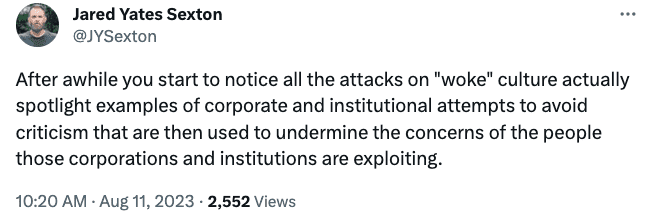
Jared Yates Sexton
tweets Aug 11, 2023: After awhile you start to notice all the attacks on 'woke' culture actually spotlight examples of corporate and institutional attempts to avoid criticism that are then used to undermine the concerns of the people those corporations and institutions are exploiting.
Jared Yates Sexton continues: And let's make it clear: there are no 'woke' corporations or institutions. There are wealthy and powerful people who either see an opportunity to profit or are concerned their exploitation will be laid bare. That's it. Period.

"...once you start pulling on the thread of conservative bad faith you inevitably notice that it makes its way through the entire national sweater." — A.R. Moxon, "One Must Imagine Charlie Brown Happy," The Reframe, Feb 18, 2024

"...a four-letter word...has, in some ways, come to stand in the place of traditional partisan orientations: care. Do you care or don't you?
* * *
Care is deeply political. ... To stand on the right side of history is to care. To be committed to social justice is to care. Self-care is imperative..."
— Hil Malatino (Trans Care, University of Minnesota Press, 2020)

Friday, June 21, 2019

Why do conservative American Christians feel discriminated against? A 2019 debate

See also:

David French vs. Sohrab Ahmari and the battle dividing conservatives, explained | Vox

GLAAD responds to New York Times hiring anti-LGBTQ attorney as opinion columnist | GLAAD


Last month, Sohrab Ahmari, a Catholic and the op-ed editor of the New York Post, published an alarming and revealing opinion, "Against David French-ism" (First Things, May 29, 2019).

Ahmari describes "what I call David French-ism, after the National Review writer and Never-Trump stalwart" as an expectation that Christian beliefs can be upheld politely and voluntarily on a cultural level rather than through legislative force. On this model, people would use their autonomy to live guided by Christian values rather than by some other kind of values. Ahmari derides it as "an idle wish that all men become moral." French-ism, he says, "is more a persuasion or a sensibility than a movement with clear tenets" that, beyond any individual, "pervade[s] a wider sphere of conservative Christian thinking and activism." It happens that French is Protestant.

When confronted with "the cultural civil war," Ahmari insists, "the only way is through," meaning that one must have "the aim of defeating the enemy and enjoying the spoils [my emphasis] in the form of a public square re-ordered to the common good and ultimately the Highest Good." The only other option is ceding the public square to "the libertine ways and paganized ideology of the other side." Social institutions aren't "neutral zones" that "accommodate" everyone. They are zero-sum: there is a winner and a loser.

Ahmari complains that the "libertines" wish to require Christians to "positively affirm our sexual choices, our transgression, our power to disfigure our natural bodies and redefine what it means to be human, lest your [Christian] disapprobation make us feel less than fully autonomous." Ahmari agrees that "Individual experiments in living—say, taking your kids to a drag reading hour at the public library—cannot be sustained without some level of moral approval by the community." The 2016 presidential election reflected an increasing Christian desire to once again begin privileging "order, continuity, and social cohesion" above mere individual "autonomy" which in practice empowering the government ("and not just the church, family, and individual") to "help protect the citizen from transnational forces beyond his control." (He attributes this belief to Trump. I disbelieve that Trump himself has any political philosophy, but of course I understand that many of his followers have political philosophies and perhaps they project them onto Trump.)

He concluded:

"Progressives understand that culture war means discrediting their opponents and weakening or destroying their institutions. Conservatives should approach the culture war with a similar realism. Civility and decency are secondary values. They regulate compliance with an established order and orthodoxy. We should seek to use these values to enforce our order and our orthodoxy, not pretend that they could ever be neutral. To recognize that enmity is real is its own kind of moral duty."

Ramona V. Tausz responded in "About Drag Queen Story Hour" (First Things, June 4, 2019)

She raised concerns that "videos of past story hours reveal pornographic adult entertainment: provocative outfits, sexual dancing, and twerking," while two of the drag queens "were later exposed as convicted sex offenders and pedophiles." Beyond such reasonable objections to the performers and content at specific events, however, Tausz also objects more generally to drag, quoting Anna Bohach as calling such performances "a sexist minstrel show.” Bohach opposes, as Tausz explains, "the inherent misogyny of drag queen culture, which reduces femininity to crude stereotypes."

Calling drag queens "demonic," she says, is "certainly not all that is needed — but it is a good start. The effort to ban Drag Queen Story Hour starts when we have the courage to clarify the moral stakes."


A note: These two articles in First Things make a couple assertions that lean toward non-fact territory. Ahmari says, without providing a source, that the accusation of Trump's collusion with Russia is "discredited," which it most certainly is not. Tausz quotes a sentence from the American College of Pediatricians, a group founded 17 years ago as an anti-LGBT advocacy group that has only a few hundred members, not to be confused with the American Academy of Pediatrics founded 89 years ago as a real professional organization that today has tens of thousands of members. The value of a statement from the former group is dubious and question-begging, because if they had pro-LGBT facts, they'd hide them, and if they had pro-LGBT beliefs, they'd dissolve. Tausz also mentions a recent paper by Lisa Littman that "suggest that gender dysphoria in adolescents spreads through social contagion." In that August 2018 paper, Littman defines the term "social contagion" as "the spread of affect or behaviors through a population" especially to refer to the influence of peers and she emphasizes that she does not intend "in any way to characterize the developmental process, outcome, or behavior as a disease or disease-like state, or to convey any value judgement." Littman only interviewed parents of transgender children, not the children themselves, about their perceptions about how their children's gender identity was forming and expressing; following controversy, the journal issued a correction in March 2019 so that the paper would meet the journal's publication criteria.

A couple tweets for a 2023 update on so-called Rapid-Onset Gender Dysphoria (ROGD):

An August 24, 2023 Scientific American tweet refers to 'a steadily growing body of scientific evidence' that ROGD and social contagion aren't reasons for the existence of trans people. Helen Staniland responds the next day: 'the very scientific community itself is captured'. John Seaborn comments satirically: 'TERFs: Science has fallen to the woke mind virus. I am not in a cult.'

"Conservatives Are Now Blaming Science For Low Trans Regret Rates": A new study was published showing that transgender people who opt for top surgery have very little regret. Conservatives are predictably outraged at the conclusion, going as far as to blame science. Erin Reed. August 14, 2023.

December 2023: Rapid-Onset Gender Dysphoria Is Not a Recognized Mental Health Diagnosis Jack L. Turban, M.D., M.H.S., Brett Dolotina, Thomas M. Freitag, M.P.P., Dana King, A.L.M., Alex S. Keuroghlian, M.D., M.P.H., Letter to the Editor, Vol. 73, Issue 6, P1163-1164, Dec 2023, DOI: https://doi.org/10.1016/j.jadohealth.2023.09.009

Speaking of which:

Michael Bailey tweets on June 15, 2023: It finally happened. Our article has been retracted.

See "A retraction long overdue," Pharyngula, June 16, 2023, which explains:

"For those unfamiliar with this slop, the assessment of the psychological state of young trans people was obtained by soliciting self-reports from their parents, parents recruited from web sites where people obsessed with trans issues gather. All their data was gathered from an anti-trans website! It’s as if someone looked up the parents of scientists by finding their posted comments on Answers in Genesis, and then came to the conclusion that all evilutionists were formed by resentment of their pastors and association with god-hating school clubs, and determined that scientists were all pathological basket-cases."

Brynn Tannehill, tweet: This study was retracted (ostensibly) for failing to get informed consent from the minors being written about. That's a HUGE ethical
Brynn Tannehill, tweet: Years ago, I wrote a humorous take on the ROGD study to illustrate why the research methodology and conclusions were awful. Still worth a read. But, the study by Bailey should never have been approved in the first place.

"An Easy Guide to Why Littman’s ROGD Research is Junk," Brynn Tannehill, December 11, 2018


Also, a May 2023 update:

"...the Surgeon General’s Office of Florida, which is supposed to make its decisions using rigorous scientific and medical standards, tapped leaders from the misleadingly named American College of Pediatricians (ACP), a conversion therapy organization designated as a hate group by the Southern Policy Law center, to consult on its production. ... Dr. Van Mol would go on to promote documents created by the ACP in order to get them enshrined into Florida’s medical literature. One such document was developed in January 2023 and was discovered due to a massive leak of documents by the organization. This document is quoted by Jones as being a '129-page file of references and sources for anti-trans arguments, attributed to Andre Van Mol and dated January 2, 2022' - you can find a full link to the first version of the document in Jones’ research. The slightly updated document was directly sent to the AHCA with a few additions in order to help develop their standards of care with the explicit goal to ban trans care and can be found in the court filings."


The June 20, 2019 episode of The New York Times' "The Argument" podcast responded to Ahmari's article. The episode is called, “Are we headed for war with Iran? And have conservatives given up on liberal democracy?” The first question is dealt with in the first half of the episode, while the second segment, beginning at 20:25, deals with the second question about the debate between conservatism and liberal democracy as exemplified in Ahmari's article.

David Leonhardt led a discussion between Michelle Goldberg and Ross Douthat. “To me," Goldberg began, "the fight seems to be about whether or not conservatives can continue to tolerate a society in which they don’t rule." She continued by saying that "there really are situations...in which there is a conflict between liberal notions of equality and religious exercise. But this [drag queen story hour] isn't one of them. This is just a community event that Ahmari is angry that he can't ban, and to me it kind of reveals that what they're demanding, once again, is primacy in public life that they feel like they deserve and have been denied, and, having been denied it, they're sort of ready to give up on the whole 'experiment' of American liberal democracy."

Whereas, Douthat's opening: "I think fundamentally what's going on are two things. One, you have a bunch of religious conservatives who made a lot of compromises in supporting Donald Trump or who didn't make those compromises and are now trying to decide whether to support him for reelection...and so they're thinking through justifications for essentially supporting a very unpleasant figure, and one of those justifications is this sense that political liberalism has become so hostile to conservative Christianity that you have to make deals with Donald Trump...that's a big part of the Ahmari vs. David French fight...so Trump looms over this." The second issue Douthat describes is "almost a power play" between libertarian "political conservatives" and Christian "social conservatives," in which Christians chafe at the observation that they are delivering votes to the Republican Party yet aren't seeing their social values reflected in the party's primarily fiscal agenda and successes.

Goldberg sought clarification about the suggestion that conservatives are not in charge. What haven't they gotten? What do they still want? Douthat responded: "Marco Rubio and Mike Lee and a few other people wanted the tax bill to be more pro-family and the rest of the Republican coalition wanted it to be more pro-business, and for the most part the pro-business side won." Goldberg challenged him by pointing out that Ahmari wasn't talking about anti-trust laws or taxes, but about a "culture war." Douthat suggested that Ahmari's language was just "chest-thumping" and that Ahmari would likely back off when questioned. He believes that Ahmari is "reacting to the sense that, in the new liberal culture, you get drag queen story hours, and if you're an evangelical florist who doesn't want to do flowers for a same-sex wedding, you get fined and driven out of business." Liberals, too, are unbending in their pursuit of the highest good; they "a corporate-sponsored Pride Week as the liturgy of our society."

Many Christians are still persuaded by the ideal of pluralism in which some people can live as openly gay and others can live out their own religious values. But, Douthat said, other Christians are alarmed at what they see as creeping restrictions on Catholic hospitals and adoption agencies that would compel these institutions to perform abortions or place children with same-sex couples. "A neutral public square," he said, "is a hard thing to sustain." That civic effort goes beyond "you don't have to marry a guy if you don't like gay marriage."

Goldberg reminded Douthat that her impression is that Christians are upset because they have less power than they used to have, and that Douthat seems to be providing alternative "reasons that they feel disenfranchised and victimized." But isn't that the same, she pushed him, as saying that they are upset "because they no longer rule?" She asked Douthat: "Is Catholicism or is orthodox Christianity oppressed if they are not allowed to discriminate?" Yes, Douthat said. Political pressure, even if "gentle," affects internal Christian tradition (as with the phase-out of Mormon polygamy). Goldberg challenged this, saying that she doesn't know any liberals who want to use the political sphere to influence what happens internally in churches. What happens in adoption agencies and whether they can discriminate against gays, Jews, and Muslims, is different. For some reason, Christians interpret those anti-discrimination efforts as discrimination against them.

Speaking from the Catholic perspective, Douthat said:

"The promise of American life in the 20th century was that, if Catholics made their peace with exactly this liberal pluralism that we're talking about and abandoned some of the 19th-century Catholic critiques of liberal democracy, then America would make a place for them and Catholicism would continue to thrive in the US...I think, since then, the turn that liberalism has taken, secular liberalism, around a whole range of issues starting with abortion and sort of moving through the debates around the sexual revolution, have essentially rewritten the bargain that Catholics made to become full Americans."

While this is not grounds for "tearing up the deal," it is unsurprising that "it provokes anxiety, uncertainty, and a lot of weird debates and experiments."


2023 update:


2025 update:

Like the NSDAP Volkskirche, the whole idea of Trumpist "Christian Nationalism" is to leave actual Christianity toothless and incapable of challenging a stream of morally depraved policies. Hard to believe that Ross Douthat is as stupid as he comes across in this piece.

[image or embed]

— Scott Horton (@robertscotthorton.bsky.social) December 6, 2025 at 11:22 AM

On October 2, 2020, Eric Trump went on North Dakota radio and said his father has "literally saved Christianity" as "there's a full-out war on faith in this country by the other side."


In a 2021 ABC News / Washington Post poll, as Jill Filipovic opined on CNN,

even a slim majority of Republicans and conservatives, and 75% percent of Americans generally, believe that abortion should be a private decision between a woman and her doctor. Just one in five Americans, a small minority, want to see the decision of whether or not to have an abortion regulated by law. Majorities support abortion rights across racial, gender, regional, and educational lines; almost half of white Evangelicals, the most conservative voting bloc in the country, say abortion should be between a woman and her doctor instead of regulated by law and 62% of Catholics favor upholding Roe v Wade. Only about a quarter of Americans strongly support state laws that make it more difficult for clinics to run.

In November 2022, all 50 Senate Democrats and 12 Senate Republicans voted to advance the Respect for Marriage Act, but 37 Senate Republicans voted no, "illustrating that, while polling has found that more than 70 percent of Americans — including a majority of Republicans — support same-sex marriage, the issue remains politically untouchable for many G.O.P. lawmakers....The bill would not require any state to allow same-sex couples to marry. But it would repeal the Defense of Marriage Act, which denied federal benefits to same-sex couples."

"Same-Sex Marriage Rights Bill Clears a Crucial Senate Hurdle" (unpaywalled): Democrats made the same-sex marriage bill one of their first major agenda items in the postelection session, moving quickly to enact it while their party still controls both chambers. New York Times, November 16, 2022.


Early context of the "culture wars":

Charles Murray launched The Bell Curve: Intelligence and Class Structure in American Life in 1994. (His co-author, Herrnstein, had died.) He claimed that Black people in the United States were poor because they weren't smart enough to earn high salaries. Annalee Newitz explains: "Pat Buchanan, a conservative adviser to Reagan who championed the idea of 'culture war' in a 1992 speech, had been arguing against affirmative action programs since the 1970s by citing Herrnstein's early research." The "not-so-hidden insinuation," Newitz says, is that you're unintelligent if you don't understand Murray and Herrnstein's logic. "False rationality often succeeds as an influence strategy because of this built-in defense against criticism. Anyone who disagrees is deemed too irrational or too stupid to understand..."

Newitz spoke to the author Ishmael Reed. As Newitz summed up:

"When I asked what he thought about The Bell Curve's influence today [in the 2020s], he joked that it's still about 'selling racism.' Current debates over cancel culture seemed to him just a continuation of the same rhetoric about Black people ruining America. Once again, white people were discussing what to do with Black people, and Black people's opinions were drowned out. 'You look at these people talking about cancel culture, like Bill Maher and David Brooks — they reach more people in one week than all the ethnic studies courses in the last twenty years,' he said. He described the situation as an asymmetric culture war, where Black critics like himself could occasionally land a great zinger in a national newspaper but rarely had the reach of a television pundit."

Newitz adds that "many white people bought into the book's lies," but Black people didn't. While the psyop was partly aimed at Black people, it had only been designed for the vulnerabilities of a racist white audience. "This is a classic failure mode in psyops: the propagandist's own biases cause him to underestimate or simply miss his target."

Modern versions of eugenicist arguments "are not truly based in science. They are, like all psyops, based on telling emotional stories and appealing to entrenched prejudices. Sometimes fighting them with fiction works better than fighting with facts."

Newitz quotes N. K. Jemisin's 2021 tweet: "White supremacy is a psyop."

(Annalee Newitz, Stories Are Weapons: Psychological Warfare and the American Mind. W. W. Norton, 2024. Chapter 4: Bad Brains.)

Trump pretty much copied Buchanan's message on economics.

"The Republican Party’s increasingly open embrace of aggressive nativism had been coming for a long time, of course. It’s what the self-described paleo-conservatives had been demanding for decades. In 1992, they came close to toppling the party establishment when their standard-bearer Pat Buchanan challenged President George H. W. Bush in the Republican primaries. A wave of white anger, resentment, and despair allowed these ethno-nationalist forces to advance significantly after the end of the Cold War – even if it wasn’t quite enough yet to take over the party. While the rightwing base was almost certainly with Buchanan on issues of national identity and immigration in the 90s, the conservative power centers and the Republican establishment were strong enough still to hold on. They never really denounced the openly anti-democratic forces in their midst, however, and instead decided they would try to harness the extremist, far-right popular energies on the base. As a result, the whole party kept being pulled to the right, with almost every election cycle bringing in a new cohort of people more radical than the last."
— Thomas Zimmer, "Why the Extremiests Took Over on the Right", Democracy Americana

On April 11, 2025, Bill Maher said on HBO's Real Time that he had recently had dinner at the White House with President Trump. He said: “Trump was gracious and measured. And why isn’t that in other settings, I don’t know, and I can’t answer and it’s not my place to answer. I’m just telling you what I saw, and I wasn’t high." (HuffPost)

It keeps going: Bill Maher Gets Into Fiery Spat With Reporter Who Questioned His Meeting With Trump. The Washington Post columnist accused Maher of having “fallen into the trap” by recently meeting with the president at the White House. Jazmin Tolliver, HuffPost, Apr 13, 2025

One of the many bleating air horns in the background of the immigration debate is the open demonstration that the right never actually opposed the logic of affirmative action, just the recipients. waiting with bated breath to see if this changes the op-ed sections of our favorite papers at all

[image or embed]

— Olúfẹ́mi O. Táíwò (@olufemiotaiwo.bsky.social) December 28, 2024 at 7:36 AM

McDonald's is the latest company to roll back diversity goals. The company rolled out a series of diversity initiatives in 2021 after a spate of sexual harrassment lawsuits and a lawsuit alleging discrimination by a group of Black former owners of McDonald’s franchises. Associated Press, NBC News, Jan. 6, 2025

"This is the permission structure that governs conservative politics: Anything is justified in defense against what they constantly play up as a radically “Un-American,” extremist “Left” that has supposedly taken over the Democratic Party. As crass or radical or outrageous as some on the Right might find him and his actions, nothing Trump has ever done has betrayed the accepted dogma of conservative politics: That only white conservatives – and the party that represents them – are entitled to rule in America, that Democratic governance is inherently illegitimate, that the “leftist” enemy within is the greatest danger to the nation. It’s a permission structure that doesn’t allow for lines that can’t be crossed. It has proven remarkably adaptable, fully capable of handling the most outlandish transgressions and crimes. It has allowed them to justify their actions within the long-established framework of conservative self-victimization – and to present their allegiance to Trump as a patriotic act."
"Power, Opportunism, and Ideology in Republican Politics," by Thomas Zimmer, Democracy Americana, July 26, 2026
Saturday, June 2, 2018

'The Good News Club': Evangelical Christianity in U.S. public schools

Katherine Stewart's The Good News Club: The Christian Right's Stealth Assault on America's Children is based on interviews with people involved in the deliberate intrusion of evangelical Christianity into public schools: those who are doing it, and those who are affected by it. Stewart writes: “In 2012, when this book was first published, America’s public elementary schools hosted 3,400 Good News Clubs — evangelical clubs that deceive children young as five into thinking that their public school endorses a certain fundamentalist brand of religion. As of this writing,” she wrote in the Preface to the 2017 Edition, "there are close to 6,000." The effects of the religious agenda are wide-ranging since the Religious Right fears that “the subjects of biology and history and more” are part of an effort to indoctrinate kids with a secularist agenda, and their abstinence-only sex education seems based, in Stewart's estimation, on "sectarian ideas about gender roles."

Whereas the Religious Right maintains a narrative that 1960s Supreme Court decisions against school prayer meant that “God was kicked out of the classroom,” Stewart found by traveling the country to research this book that there were many “religion-driven programs and initiatives inserting themselves into public school systems with unprecedented force and unexpected consequences.” Most of these programs are driven by “a very conservative, even fundamentalist” evangelical Christianity. She spoke with activists who are Biblical infallibilists who believe "they are engaged in a daily struggle with Satan. They also believe that most people who call themselves Christian...will not be among the saved.” Many of them also “believe that the United States has a special role to play in preparing for the imminent end of the world.” Child Evangelism Fellowship (CEF) has a creed that people are saved only through faith, not through good behavior. Rich Lang is quoted as calling CEF “a purity cult. It is intentionally exclusive” of those with different religious beliefs. A. Charles Ware, the president of Crossroads Bible College in Indianapolis and a man who is in an interracial marriage, said in a lecture she attended that he wished to redefine “interracial” to use it to disparage relationships between Christians and non-Christians.

Evangelical programs in public schools are harmful not only to people with minority identities but often to the majority of the school population, as the programs sometimes “enter the schools from outside the community together, and are at odds with it from the beginning.” Stewart quoted Jerry Falwell in 1979 as anticipating the day when “we don’t have public schools. The churches will have taken them over again and Christians will be running them.” Perhaps for this reason, Good News Club wants to operate inside the public schools, not in nearby churches. “Liberals tend to take for granted," Stewart writes, "the part of the right-wing narrative that suggests that religious activity in the public schools arises from a grassroots demand for it," but she contends that "it is the handiwork of well-tuned and very well connected conservative Christian legal groups, and is imposed upon rather than demanded by communities.”

One of their outreach tactics is plying small children with sweets. “Because the Good News Club seeks to reach children who in many cases are not old enough to read, a centerpiece of its program is the ‘wordless book,’ a simple picture book intended to convey religious doctrine....The CEF itself makes quite clear that the purpose of these exercises is not to educate, but to convert.” Stewart listened to some of the presentations to six-year-olds and said: “It’s like hearing a comedy routine for a second time...Everything is scripted...This is religion on an industrial scale, streamlined and codified into a tight set of procedures crafted by experts for maximum ease of use by middle-aged volunteers and maximum impact on the six-year-old mind.”

Older children have participated in events like “See You At the Pole” where they gather near a flagpole and nail pieces of paper containing names of non-Christian classmates to a cross. The first such event happened in 1990. Such so-called “peer-to-peer evangelism” enables “adults [to] use children to do what they’re not allowed to do on their own.”

Stewart spoke to one parent who, in 2009, emailed the other parents in his child’s first-grade class on a closed mailing list to let them know — in an "innocuous" manner, he thought— what CEF was and that it was present in the school. One parent challenged him with the question “How is this [Christian] group different from any other group?” while another said “I need to protect my kids from people like you.” The email spread off the list and he began receiving anonymous rants, one of which especially concerned him with its strident tone and its claim that “your school is harassing and persecuting christians”. Other parents also felt afraid and did not want to identify themselves to Stewart for the book because, as one put it: “When you get into these extreme forms of religion, it always brings out the crazies.”

Many supporters of the Religious Right have ordinary concerns about modernity: crime, declining educational standards, incivility, and the rate of technological change. What unites them into a movement is their attribution of social ills to a perceived loss of Christian power in the mainstream culture (as indicated by support for the belief in a nonexistent "War on Christmas," as Stewart mentioned once and as I have described in an article for Medium), and their solution is that others “are the problem because we are of the ‘wrong’ religion.” (Robert P. Jones concluded his 2016 book The End of White Christian America in favor of Christians adopting an attitude that ”accepts the death of White Christian America and encourages evangelicals to participate fully in a pluralistic society, but avoids the temptations toward domination and sectarianism, each of which is driven by nostalgia for a lost Christian America.”) Stewart doesn’t claim that Christian influence is dying. On the contrary, she fears: “We are witnessing the creation of an industrial-scale evangelical conversion machine.” History suggests it “will never succeed in changing the world in quite the way it imagines, but that it may very well change the world in ways that we would not wish to imagine.”

I was reminded of something in Asad Haider’s recent book Mistaken Identity by the following passage in Stewart’s conclusion, specifically her reference to “the language of liberalism":

“One reason why we haven’t seen what is happening right in front of us is that the leaders of the religious assault on public education have learned to cloak their agenda in the language of liberalism and relativism. We are all children of the civil rights era now. We all agree that discrimination is bad. We all want to respect one another’s worldview, and we all cherish the right to freedom of speech. We are so used to the idea that the First Amendment is for liberals, and that it is our bulwark against fascist movements, that we fail to notice when it has been turned around and used as a wedge instead.

The judicial strategists of the Christian Right claim that all they want is ‘equal access’ and ‘toleration.’ But that isn’t in fact all they want. They don’t want equality; they want control. They don’t want toleration; they want the opportunity to practice their intolerance. They don’t want their religion to be included in the schools; they want the schools to be absorbed within their religion.”

As I wrote in my review of Haider’s book, he argues that “the modern liberal state begins with ‘collectivities of people’ and inflicts its power upon them which somehow atomizes them into individual ‘political subjects — the basic political unit of liberalism, after all, is the individual.’ People are taught that they have rights as individuals so they must state that their personal identity has somehow been wronged if they are to get reparations from the state.” That’s how we end up with what we call “identity politics,” whether we like it or not. And, as Stewart implies, it's important to be able to tell the difference between a plea to address religious discrimination and a bid to assume control.

Book

Katherine Stewart. The Good News Club: The Christian Right's Stealth Assault on America's Children. (2017 Kindle edition). Hachette, 2012.

Book cover: The Good News Club

Update: A PRRI report found that, in 2006, white evangelical Protestants were 23% of the U.S. population. In 2020, they were only 14% of the U.S. population."

Update: Katherine Stewart wrote "Christian Nationalism Is One of Trump’s Most Powerful Weapons" for the New York Times in 2022:

   "A decade ago, the radical aims at the ideological core of the Christian nationalist movement were there to see for anybody who looked...[but] most Republican Party leaders at the time distanced themselves from theocratic extremists. They avoided the rhetoric of Seven Mountains dominionism, an ideology that calls explicitly for the domination of the seven “peaks” of modern civilization (including government and education) by Christians of the correct, supposedly biblical variety.

   What a difference a decade makes. National organizations like the Faith & Freedom Coalition and the Ziklag Group, which bring together prominent Republican leaders with donors and religious right activists, feature “Seven Mountains” workshops and panels at their gatherings. Nationalist leaders and their political dependents in the Republican Party now state quite openly what before they whispered to one another over their prayer breakfasts."

See also: Attempting to avoid LGBTQ+ issues, school districts are denying basic sexual health education Superintendents pointed to anti-LGBTQ+ culture wars and fear of repercussions as reasons why kids are not being taught sex-ed, SHELBY RAE WILLS/LOOKOUT, AZ Mirror, MAY 28, 2024

See also: The Religious Right Is Plotting How To Get Christianity Into Schools With Donald Trump’s re-election, reshaping the country’s education system is looking increasingly feasible. Nathalie Baptiste, December 6, 2024

Sunday, December 24, 2017

The forces behind political polarization

If you say, Disagreement is a social problem, your interlocutor is prompted to respond, I agree. Perhaps that's why, as Thomas Zimmer writes, "The least controversial thing one can do in American politics is to decry 'polarization.'"

Of course "polarization exists as an observable phenomenon in distinct areas and dimensions"; the problem, Zimmer says, is with "a narrative" that "dogmatically demands we put it at the center of our interpretation of the present and accept it as the key challenge the country is facing today." By tending to ignore counterexamples of non-polarization, it highlights "what historian Matthew Lassiter has rightfully criticized as an 'artificial red-blue binary.'"

First of all, many Americans share values, including across liberal and conservative identities. Placing the focus on ordinary American voters who supposedly have diametrically opposed viewpoints (maybe they do, maybe they don't, so what?) may simply serve to obscure the problem that "authoritarian reactionaries [are] taking over one of the major parties." Zimmer posits: "Every serious scholar and observer of American democracy, politics, and history agrees that a return of Donald Trump to the White House would constitute an acute threat to the future of democracy and constitutional government in this country. Would we really be better off if Democrats *didn’t* see him and the party that has elevated him as a major problem?" See here: "One party is dominated by a shrinking white reactionary minority that is rapidly radicalizing against democracy and will no longer accept the principle of majoritarian rule; the other thinks democracy and constitutional government should be upheld. That's not 'polarization.'"

Secondly, where among ordinary individuals the left-right gap is indeed "very wide, and has been widening," for example "on guns, pandemic response, the question of whether you should accept the results of an election your side doesn’t win or stage a violent coup," the blame doesn't lie on both sides; rather, "this has been almost entirely a function of conservatives moving sharply to the Right." So for example, on acknowledging climate change as an urgent problem, "Democrats aren’t moving to an 'extreme' position, certainly not by international comparison – they are getting in line with what is the position shared by nearly all serious experts in the world. Meanwhile, a sizable percentage of Republicans is drifting further away into fantasy land."


The excellent civil war history Battle Cry of Freedom meticulously accounts how the rise of a new technology (newspapers) empowered wealthy slavers to gin up race hatred + panic among poor whites so they would fight and die to protect the slaver’s wealth. I think of that maybe three times a day.

— Spencer Windes (like “winds a yo-yo”) (@spencerwindes.bsky.social) February 17, 2026 at 10:54 PM

Jonathan Haidt explains in a recent essay that we become politically polarized when centripetal or centrifugal forces are imbalanced. These are the forces that draw us together or pull us apart.

“Imagine three kids making a human chain with their arms, and one kid has his free hand wrapped around a pole. The kids start running around in a circle, around the pole, faster and faster. The centrifugal force increases. That’s the force pulling outward as the human centrifuge speeds up. But at the same time, the kids strengthen their grip. That’s the centripetal force, pulling them inward along the chain of their arms. Eventually the centrifugal force exceeds the centripetal force and their hands slip. The chain breaks.”

The “good kind of identity politics,” according to Haidt, is exemplified by MLK’s “I Have a Dream” speech that ”framed our greatest moral failing as an opportunity for centripetal redemption.” Identity becomes centrifugal “when you take young human beings, whose minds evolved for tribal warfare and us/them thinking, and you fill those minds full of binary dimensions” identifying which groups have power over which others and furthermore when you say that they must “fight their common enemy, the group that sits at the top of the pyramid of oppression: the straight, white, cis-gendered, able-bodied Christian or Jewish or possibly atheist male.” When students are told to examine everything “in terms of the bad people acting to preserve their power and privilege over the good people....This is induction into a cult, a fundamentalist religion, a paranoid worldview that separates people from each other and sends them down the road to alienation, anxiety, and intellectual impotence.”

Polarization is a problem insofar as it prevents people from working together to maintain a democracy. “Here," Haidt says, "is the fine-tuned liberal democracy hypothesis: as tribal primates, human beings are unsuited for life in large, diverse secular democracies, unless you get certain settings finely adjusted to make possible the development of stable political life.” Therefore the Founding Fathers of the United States designed a constitution as if it were “a clock that might run forever if they chose the right springs and gears.” They “built in safeguards against runaway factionalism, such as the division of powers among the three branches, and an elaborate series of checks and balances. But they also knew that they had to train future generations of clock mechanics. They were creating a new kind of republic, which would demand far more maturity from its citizens than was needed in nations ruled by a king or other Leviathan.” Today, however, “our government is divided into two all-consuming factions, which cut right down the middle of each of the three branches, uniting the three red half-branches against the three blue half-branches”.

Haidt referred to a previous essay in which he argued that polarization was caused by the following trends. In his words:

  1. The two parties purified themselves ideologically
  2. As politicians polarized, so did many Americans
  3. The urban-rural divide grew into a gulf, reflecting diverging interests and values
  4. Immigration was rising, leading to larger racial and ethnic divisions
  5. The net effect of all these trends is that partisans dislike one another more intensely
  6. Meanwhile, rule changes and culture changes in Congress made it harder to maintain cross-party friendships
  7. The media environment changed, making it easier for partisans to confirm their worst suspicions, and putting greater pressure on politicians to play to the extremes
  8. As the costs of campaigns increased, politicians have become increasingly afraid of offending their party’s donors
  9. When the Soviet Union collapsed, the United States lost a common enemy that had once unified the country
  10. The end of the Cold War coincided with the baton pass from the Greatest Generation to the baby boomers, who may be more prone to hyper-partisanship

Nina Khrushcheva has a more specific observation about clock mechanics. She applauded moments in U.S. history where politicians defended the procedural checks and balances even against other pressing moral demands, such as when "Secretary of State Daniel Webster supported the Compromise of 1850, despite his hatred of slavery, in order to save the union" and when "Robert Taft denounced the Nuremberg Trials, despite his hatred of the Nazis, to defend the fundamental US legal principle that a person could not be criminally charged on the basis of a retroactive statute." (Both of these examples were featured in President John F. Kennedy's Profiles in Courage.) She notes the current initiative in late 2017 "to pass a tax bill that would benefit America’s wealthiest households at the expense of saddling the country with more than $1 trillion in additional debt" and she implies that the process could have benefited from "thorough public committee hearings" and with less willingness on the part of politicians to "trade their honor for the approval of their tribe."

Adam Garfinkle gives seven reasons for the decline of trust in society. The first three or four overlap with Haidt's reasons for polarization.
  1. heterogeneous demographics driven by immigration
  2. the lack of a "common language to discuss good and evil" and the rise of "Christian neo-fundamentalism"
  3. less face-to-face interaction due to technology and class segregation
  4. institutional and bureaucratic failure
  5. media portrayals of the world as a mean place
  6. breakdown of family leading to emotional insecurity
  7. too much state intrusion

Being open to changing one's beliefs according to evidence

Various recent studies have found that American conservatives are more likely to share fake news, more prone to self-deception, and less likely to change their beliefs in response to evidence. They use simpler language and many of them are falling prone to authoritarianism. This is discussed in a July 2020 New York Times article.

Starting fights

Legal actions for political purposes can worsen polarization. In May 2018, Harvard Law School professor Laurence Tribe said: "It's important that we not exacerbate the dysfunction and the polarization in the society that helped Donald Trump rise to power in the first place." He explained that impeachment needs to be an action taken to rectify a specific abuse. "If we were to use the impeachment power simply as a substitute for buyer's remorse, saying 'We thought this guy was terrible, but he's even worse,' if we were going to use it against ambient badness, rather than clear abuse of power — we would really use the impeachment power to undermine, rather than save, our democracy."

Being guided by polarization

Leaf Van Boven and David Sherman conducted studies in 2014 and 2016 showing that Republicans and Democrats agree that climate change exist but they tend to support whatever policies are backed by their own party.

YouGov opinion polls in August 2018 found dramatic differences between Republicans and Democrats regarding opinions toward the n-word slur against black people. 90% of those who voted for Hillary Clinton, but only 53% of those who voted for Trump, agreed that white people should never use this word. Trump voters were even less likely to use the word "racist" to describe this behavior; while 86% of Clinton voters agreed that "it's racist for whites to use" that word, only 33% of Trump voters thought so. And while 86% of Clinton voters "wouldn't vote for [a] candidate who said it," only 26% of Trump voters held themselves to the same standard. The Washington Post story points out that, only twelve years previously, this gap barely existed; then, "55 percent of Democrats and 49 percent of Republicans said that the n-word was offensive."

The United States is polarizing faster than other countries

In early 2020, a National Bureau of Economic Research working paper by Jesse Shapiro, Levi Boxell and Matthew Gentzkow, showed research that (according to a news release from Brown University) "present[s] the first ever multi-nation evidence on long-term trends in 'affective polarization' — a phenomenon in which citizens feel more negatively toward other political parties than toward their own. They found that in the U.S., affective polarization has increased more dramatically since the late 1970s than in the eight other countries they examined — the U.K., Canada, Australia, New Zealand, Germany, Switzerland, Norway and Sweden." The study shows that "polarization had also risen in Canada, New Zealand and Switzerland in the last 40 years, but to a lesser extent. In the U.K., Australia, Germany, Norway and Sweden, polarization decreased."

The US is polarizing asymmetrically

"Another related challenge stems from what social scientists call “asymmetric polarization.” The Republican Party has moved further to the right than Democrats have to the left. And much of the extremism in the GOP has been tactical, where some party leaders have embraced a form of smashmouth partisanship with no guardrails as to what is permissible." (Julian Zelizer, CNN, Dec. 20, 2022)

Local journalism matters

Marc Ambinder wrote for MSNBC on Nov. 5, 2020:

there is a direct correspondence between the closing of newspapers and the polarization of people formerly served by those newspapers. If you live in a town with a thriving local news ecosystem, you are more likely to vote.

Reporting

Norm Eisen discussed journalistic norms, telling Chauncey DeVega for Salon in May 2022:

"That [old] norm deems that if you're going to provide one side of the story then you have to provide the other side of the story. If something happens, you need to report it neutrally. Editorializing is for the editorial page. The inferences, the interpretation, that doesn't go in the news. But if you have a norm-transgressing figure like Donald Trump, then those journalistic norms have to adapt to that circumstance. We can't be static. That is why journalism in this country is stuck."

At first glance, reporting both sides might seem to reduce polarization. But maybe it's the opposite, since it keeps people stuck in a "debate" that perhaps they don't need to be in. If one side is clearly better (however "better" is defined), then what needs to be done is accept the recommendation of the side, take some action, and move forward, while continuing to listen to objections (if made in good faith) and maintaining nuanced awareness of the situation.

Please see The Conspicuous Absence of White Identity from Yascha Mounk’s “Trap”, Dannagal Young, 3Streams, Oct 20, 2023. Young refers to a

"well-documented process of partisan 'social sorting' following the parties’ racial realignment, as Americans from distinct socio-demographic groups came to identify more with one of the two major political parties, leaving us with a Democratic party that is racially and ethnically diverse, suburban and urban, secular and agnostic, and culturally liberal, and a Republican party that is more homogeneously white, Christian, rural, and culturally conservative.

And while the sorting has certainly happened on 'both sides' its outcome has been decidedly asymmetrical, resulting in a Republican party whose homogenous identity alignment gives them exceptional 'group fit.' And when people 'fit' nicely into their social identity category (they look the way most of their team looks, worship the way most of their team worships, live where most of their team lives, and live how most of their team lives), their social identity becomes salient. When an identity is salient, it is easy to leverage, activate, and mobilize through identity threats."

Responding to an October 2023 profile in the New York Times, here's A.R. Moxon talking about the meaning of safety (No Beliefs, Just Intentions, The Reframe (Substack), Dec 17, 2023): One family in the New York Times profile "needed safety. They left their home state because they were being eliminated by their state government." The other "wanted to feel safe. They left their state because of insufficient elimination of unwanted and deliberately abandoned people, and came to a state where the people they would rather not see—people who are in the greatest danger—are nowhere to be seen, almost as if they had been pre-cleared away ahead of time..." Moxon continues: "And I’m told the problem is that both sides are polarized, and both sides actually want the same thing, even though they can’t get over their disagreements over silly politics."

Urban-rural divide?

"Over the past 30 years, the American political landscape has been characterized by a growing divide between rural and urban voters, almost as if they’re on two opposing teams, according to Suzanne Mettler, the John L. Senior Professor of American Institutions in the College of Arts and Sciences (A&S).

But the divide is confined largely to white Americans, Mettler and collaborators have found in an examination of the racial and ethnic facets of the trend.

When it comes to politics, Black and Latino residents of rural America differ far less, if at all, from their urban counterparts than do non-Hispanic white residents, the researchers report.

* * *

A Rural-Urban Political Divide Among Whom? Race, Ethnicity, and Political Behavior Across Place” published in Politics, Groups, and Identities on March 31, with a summary of the findings appearing in the United States Politics and Policy blog of the London School of Economics, June 7. Mettler is corresponding author, and co-authors are doctoral students Trevor E. Brown, Marissa Rivera and Gisela Pedroza Jauregui.

Growing rural-urban divide exists only among white Americans: Kate Blackwood, College of Arts and Sciences, Cornell Chronicle, June 20, 2024

There's gonna be a lot of discourse about Hispanic voters. In January I ran around the RGV trying to figure out how voters we're feeling about Trump and Republicans and they had a lot to say! www.rollingstone.com/politics/politics-features/hispanic-voters-swung-trump-south-texas-1235499072/

[image or embed]

— Nikki McCann Ramírez (@nikkimcr.bsky.social) March 4, 2026 at 10:00 AM

There are more surge voters than swing voters

Anat Shenker-Osorio says that the importance attached to "swing voters" is based on "median voter theory...a very old political science idea...[that] rests on the notion of the electorate as a fixed group of people. And so someone presumably occupies the ideological center of it."

In reality, though, "the composition of the electorate changes in every election," and the people in the ideological center (however exactly we may understand that) aren't the most important group to reach, if the question is how to win the election. There are always many people "who have never voted before, whether they've just aged into the electorate, never voted before because they just became naturalized, never voted before because they didn't feel like it, or are very unreliable voters." If they can be persuaded to vote, they're "surge voters" (new voters), and there are many more of them than there are "swing voters."

Five things Harris — and you — can do to close the deal Messaging guru Anat Shenker-Osorio on five dos (and don’ts) for the Harris-Walz campaign’s critical final sprint. The Ink. Oct 26, 2024

Sources

“The Age of Outrage: What the current political climate is doing to our country and our universities.” Jonathan Haidt. City Journal (Manhattan Institute). Dec. 17, 2017.

"Profiles in Cowardice." Nina L. Khrushcheva. Project Syndicate. Dec. 18, 2017.

"In Way Too Little We Trust." Adam Garfinkle. The American Interest. December 13, 2017.

lightning
Image by Oimheidi from Pixabay

I treat "both sides" and "down the middle" as a kind of mainia, a force that can take over the news mind, presenting new ways not to make sense. For reasons obscure, Amazon is doing a live election night program with Brian Williams as host. Here's @oliverdarcy.bsky.social on what might go wrong.

[image or embed]

— Jay Rosen (@jayrosen.bsky.social) October 30, 2024 at 8:46 AM

Scientists

I don't normally do this, but since I am very concerned about this Science letter www.science.org/doi/10.1126/... by the NAS president on the political polarization around science that is making the rounds. So let me say my 2c 1/

— Tobia Spampatti, PhD (@tspampatti.bsky.social) November 15, 2024 at 1:43 PM

September 2025

From a desktop screen: www.dcinbox.com enter search term & select "visualize"

Use of the word "evil" in official congressional e-newsletters, over time, by party

[image or embed]

— Lindsey Cormack (@dcinbox.bsky.social) September 15, 2025 at 7:52 AM

The "radical right" is responsible for two thirds of all deadly acts of "political violence" in the United States according to the right wing's very own Cato Institute.

[image or embed]

— Raider (@iwillnotbesilenced.bsky.social) September 14, 2025 at 6:16 PM

‘Polarization’ has become the master concept for diagnosing our current democratic crisis. But this is not polarization. It is the radicalization of the political right. By misdiagnosing it, we risk becoming complicit in the crisis. 🧵 Just out in Perspectives on Politics doi.org/10.1017/S153...

[image or embed]

— Petter Törnberg (@pettertornberg.com) July 7, 2026 at 6:14 AM

It’s Not Polarization; It’s the Radicalization of the Political Right Published online by Cambridge University Press: 07 July 2026, Petter Törnberg

My experience is that “polarization” diagnoses are often *designed* to do this. When someone talks about our present problem as “polarization,” I don’t automatically presume bad intentions, but I suspect them, and I proceed with caution.

[image or embed]

— A.R. Moxon (@juliusgoat.bsky.social) July 8, 2026 at 7:46 AM

Sunday, November 23, 2014

Holding meaningful discussions with people who have different beliefs about God

"Each of us has a basic view of reality and God that we act out every day," says Geneen Roth in Women Food and God (2010).  Who can deny that simple, foundational statement?  "Anyone who breathes and thinks and experiences," she wrote, "has beliefs about God."

Are religious beliefs, or the lack thereof, important? They surely are. Beliefs combine to craft the worldview that drives a person's most cherished values: their sense of self and society, their sensitivity to the world, their joy and sympathy.

James Calvin Davis provides this definition in his book In Defense of Civility (2010):  "A worldview is a moral reading of the universe. It is an interpretation of the events that surround us, the choices that confront us, and the responsibilities that obligate us – all in relation to a particular understanding of the 'meaning of life.'"

In Davis's opinion, it is a misguided secularism that attempts to shove all "religious ideas" out of public discourse.  Everyone has a worldview that informs their values. Some worldviews are religious, and therefore not everyone can easily separate their moral concepts from their religious concepts, nor should they be expected to do so as a prerequisite for dialogue. It is not necessary to shut down all dissimilar religious beliefs before commencing discussion.  In fact, a discussion can be held directly about the dissimilar religious beliefs as well as about what other beliefs might result from them.

Chris Stedman's book Faitheist (2012) makes a similar point:  "Religious and nonreligious identities are perhaps our most important social capital, for they signify our most central values, which inform how we act in the world."  He is careful to distinguish atheism as an "identification marker" rather than a "belief system."  Nevertheless, an atheist identity can suggest the inclusion of some belief systems and values and the exclusion of others, so it is a meaningful, important identity, just as religious identities, belief systems, and values are meaningful and important.

Written from an atheist perspective, Stedman's book strongly advocates for dialogue between people with "different metaphysical beliefs." Openness to exchanging stories about personal beliefs is part of "taking religious identities seriously." The point is not necessarily to attempt to convert the other to a different opinion, but to perceive and understand the other as one does in a relationship.

Atheists who primarily practice the art of monologue, as Stedman admits he once did, risk operating with "caricature and critique instead of humility, honesty, and open-mindedness" and "treating religion as a concept instead of talking to people who actually lived religious lives."

When two people investigate the possibility that they have some shared values despite some differing beliefs about God, it amounts to "the difference between mere diversity and engaged pluralism."  The result of this pluralistic work can be "a diverse community defined by shared values rather than shared identity." 

It is perhaps a side benefit that, whenever someone expresses willingness to discuss values, their very willingness is a public example that members of their identity group care about values, reminding everyone else of their humanity.  All this, even before a single specific word is spoken!

In her book Because I Say So: The Dangerous Appeal of Moral Authority (2010), Nikki Stern says:  "Ethics and morality don't eliminate the possibility of faith; they simply don't require it. It's hard to imagine being more tolerant than that."

To put it another way: expressing one's values in word or deed neither precludes nor requires a religious identity. Feeling secure of this fact will lead to tolerance of those with different identities. The next step can be a proactive, pluralistic approach.

A note on the image above: If an ostrich has the patience to read a newspaper, each of us can try to understand another person. Photo by Anefo / Noske, J.D., 17 Feb 1951. © No known copyright restrictions. Nationaal Archief of The Netherlands, No. 904-4385. Flickr.

This article was originally published to Helium Network on Nov. 10, 2012.

In case you missed it

Have you seen inside the book 'To Climates Unknown'?

The alternate history novel To Climates Unknown by Arturo Serrano was released on November 25, the 400th anniversary of the mythical First ...