Friday, September 13, 2019

Sharpiegate

The National Oceanic and Atmospheric Administration (NOAA) has not had a confirmed leader since Trump took office in January 2017. Trump nominated Barry Myers, whose conflict of interest is so blatant that the government has preferred to confirm no one at all for the job.

On May 1, 2019, a business columnist for the Los Angeles Times discussed the nomination of Barry Myers, the former CEO of AccuWeather and the brother of the current CEO, for head of NOAA. The conflict of interest is that "AccuWeather allegedly has tried to restrict [NOAA's public activities], largely because services provided by the National Weather Service, a NOAA agency, compete with AccuWeather’s business model of offering similar services for a price." In 2005, the Myers family asked Sen. Rick Santorum "to introduce legislation that would have barred the National Weather Service from issuing any weather forecasts that could be issued by private businesses. The Weather Service would be limited to forecasting extreme events such as hurricanes, tornadoes and tsunamis."

Myers is not even a scientist, as all but one previous heads of NOAA have been. Rather:

'Myers has built his business by taking NOAA data paid for by the taxpayers and turning it into products that AccuWeather sells,' observes Andrew Rosenberg, a former NOAA scientist and manager who is now director of the Center for Science and Democracy at the Union of Concerned Scientists. 'There’s nothing wrong with that, but he’s also pushed for the idea that the government shouldn’t compete with private business.'

While Myers had already resigned his position as CEO and divested his stock shares, nevertheless AccuWeather remains his family business, and "the overhanging suspicion of a revolving-door appointment can’t help but undermine the public’s faith that an appointee is acting exclusively in the public interest," the LA Times columnist Michael Hiltzik explained.

On September 1, 2019, as Hurricane Dorian made its devastating Category 5 landfall in the Bahamas, President Trump claimed that Alabama “would most likely be hit (much) harder than anticipated." There was no evidence for this. Hours later, NOAA sent a memo to the National Weather Service, saying that staff should not "provide any opinion" and "only stick with official National Hurricane Center forecasts if questions arise from some national level social media posts which hit the news this afternoon." In other words: Don't contradict the president.
A NOAA meteorologist who spoke on the condition of anonymity for fear of retribution said the note, understood internally to be referring to Trump, came after the National Weather Service office in Birmingham contradicted Trump by tweeting Alabama would 'NOT see any impacts from the hurricane.'

The same meteorologist said: “This is the first time I’ve felt pressure from above to not say what truly is the forecast."

David Titley, NOAA's COO during the Obama administration, tweeted that he didn't "know how they [NOAA leadership] will ever look their workforce in the eye again. Moral cowardice." Jane Lubchenco, who was a NOAA administrator during the Obama administration, said: "This looks like classic politically motivated obfuscation to justify inaccurate statements made by the boss." Michael Halpern, a deputy director at the Union of Concerned Scientists, asked, "If we’re politicizing the weather what is there left to politicize?"

After Trump tried on Sept. 1 to prove that he was correct by showing a hurricane map that had been crudely modified with a Sharpie to include Alabama in the hurricane's path, NOAA again "sent a similar message warning scientists and meteorologists not to speak out."

For six days — during which the weather in Alabama was "bone dry" according to the chief meteorologist at a CBS-affiliated news source in Huntsville — "Mr. Trump continued his relentless campaign to prove that he was right when he predicted that Hurricane Dorian could hit Alabama regardless of what the scientists said."

On Sept. 5, NOAA's deputy undersecretary for operations sent an internal email saying that Trump's doctored map was "crazy." (The email was released four months later as part of a Freedom of Information Act request.)

On Sept. 6, NOAA's Birmingham, Alabama office took a stand contrary to Trump's position, issuing a tweet stating that Alabama would not be affected. In response to the NOAA dissent, Commerce Secretary Wilbur Ross reportedly threatened to fire NOAA leadership. (The pressure reportedly came from Trump, through White House acting chief of staff Mick Mulvaney, to the Commerce Secretary. Ross denies having made those threats, and the Commerce Department opened an internal investigation into the matter.) NOAA then issued an unsigned statement that disavowed the tweet by the Birmingham office.

Update: In January 2025, Jim Acosta is leaving CNN. CNN, to placate Trump, offered to move him to a less prominent timeslot, which he turned down and said he'd rather quit.

"During Trump’s first term, the White House revoked the press credentials of CNN’s then-chief White House correspondent Jim Acosta following a contentious exchange with the president at a November 2018 press conference.
CNN sued, and a Trump-appointed federal judge temporarily restored Acosta’s press access, ruling that the White House had violated his due process.
The White House eventually reinstated Acosta’s credentials on a permanent basis, prompting CNN to drop its lawsuit."

Trump says he’s ‘banning’ CNN, MS NOW and Politico from the White House, Brian Stelter, CNN, September 18, 2026

On Sept. 7, NOAA's acting chief scientist Craig McLean emailed NOAA leadership: "For an agency founded upon and recognized for determining scientific truths, trusted by the public, and responsible in law to put forward important science information, I find it unconscionable that an anonymous voice inside of NOAA would be found to castigate a dutiful, correct, and loyal (National Weather Service) Forecaster who spoke the truth." (This email was also released four months later as part of the FOIA request.)

On Sept. 9, New York Times opinion columnist Paul Krugman wrote:

At first Sharpiegate, Donald Trump’s inability to admit that he misstated a weather projection by claiming that Alabama was at risk from Hurricane Dorian, was kind of funny, even though it was also scary — it’s not reassuring when the president of the United States can’t face reality. But it stopped being any kind of joke on Friday, when the National Oceanic and Atmospheric Administration issued a statement falsely backing up Trump’s claim that it had warned about an Alabama threat.

Why is this frightening? Because it shows that even the leadership of NOAA, which should be the most technical and apolitical of agencies, is now so subservient to Trump that it’s willing not just to overrule its own experts but to lie, simply to avoid a bit of presidential embarrassment.

Think about it: If even weather forecasters are expected to be apologists for Dear Leader, the corruption of our institutions is truly complete.

By January 2020, the White House was tweeting fake snowflakes in Washington DC, prompting journalists to waste time debunking yet another fake weather report.

Hurricane Helene

On September 30, 2024, Trump said of Hurricane Helene, which had just killed over 200 people: “It’s so extensive, nobody thought this would be happening, especially now it’s so late in the season for the hurricanes.”

HuffPost corrected the record: "It is currently slap-bang in the middle of hurricane season." The National Oceanic and Atmospheric Administration (NOAA) itself says: "The Atlantic hurricane season is June 1st to November 30th." Trump and his allies have big plans to dismantle NOAA.

"Asheville was supposed to be one of those places where people were safer from climate disasters." Climate advocate and Asheville resident, Melissa Hanson, describes the horror of Helene -- a very unnatural disaster www.scientificamerican.com/article/hurr...

[image or embed]

— Aimee Witteman (@aimeewitteman.bsky.social) October 4, 2024 at 1:02 PM

Marjorie Taylor Greene Says ‘They Can Control The Weather,’ Promoting Conspiracy About Hurricane Helene: Right-wingers have long promoted wild theories about weather control, and Greene, a Donald Trump ally, gave them a big boost. Christopher Mathias, HuffPost, Oct 4, 2024

The entirety of Greene's tweet was: "Yes they can control the weather. It’s ridiculous for anyone to lie and say it can’t be done." She didn't say who "they" are, which was surely intentional vagueness on her part. If someone really could control the weather, it would be important to say whom. Greene is happy to blur assumptions of "the Jews" and "the Democrats" and anyone else the right-wing is currently maligning.

The 2025 Atlantic Hurricane Season officially ends on November 30, but the outlook is very quiet out there, so it very likely ended on October 31 this year. Overall, it was a slightly above-average season with some strange characteristics.

[image or embed]

— Brian McNoldy (@bmcnoldy.bsky.social) November 14, 2025 at 11:58 AM

"As deadly tornadoes tore through the Midwest and Plains last weekend, state and local search-and-rescue crews rushed to the devastated areas to look for survivors. It wasn’t until the teams deployed that they realized they were operating without a critical tornado-tracking tool typically provided by FEMA.

That left responders with a less precise picture of where to search first, two sources familiar with the situation told CNN."

Exclusive: Search-and-rescue units respond without tornado-tracking tool after Noem’s team let contract lapse, Gabe Cohen, CNN, March 13, 2026

At least 10 people tied to sensitive US research have died or disappeared in recent years, sparking federal investigation, Natasha Chen, Alex Stambaugh, Chris Boyette, CNN, April 21, 2026

shitty weather forecasts? blame elon and his merry band of dipshits because they gutted NOAA on the basis of “lol who needs to measure climate anyway” everything bad these days seem to be his fault, trump’s fault, or both

[image or embed]

— Micah (@rincewind.run) June 30, 2026 at 9:36 PM

jfc it's true, if reality doesn't fit their bet - they bend the reality www.cnn.com/2026/04/23/e...

[image or embed]

— Comfortably Numb (@numb.comfortab.ly) July 18, 2026 at 8:37 PM

Monday, September 9, 2019

Quotes: What is the effect of television on culture and on self-understanding?

Rene Dubos, writing in 1974, observed that a person living in safety can spend a lot of time watching journalistic reports of catastrophes in faraway places, yet still feel that their own life is lacking. This is because television reports may not necessarily impart a sense of gratitude that nothing terrible is happening to them; rather, the time they have wasted in front of the television has prevented anything interesting from happening to them, and this lack of interestingness is what stirs within them. But is this simultaneous lack of interestingness and lack of gratitude a fault of the television, or is it a fault of the person watching the television?

Dubos wrote:

In 1973, a young female college student published a book in which she presented 'a chronicle of growing old in the sixties.' On her own account, the most significant influence in her life had been that before she was twenty she had spent more than 5,000 hours watching television. She had witnessed on the screen John F. Kennedy's assassination, civil rights marches, student riots, the Vietnam war, space shots, moon landings — in short, all the spectacular events of the present era. Television thus had made her knowledgeable about the contemporary world, but it had not given her a real feeling for what she had watched on the screen. Although she had grown up in a comfortable and safe environment, she felt that her childhood had been more 'traumatic' than that of most other people because of 'the eventlessness' of her life. Apparently television watching did not make her realize that misery in the American slums or the tragedies of Vietnam had been experiences incomparably more traumatic than the emotional emptiness of her own life. She had watched television as a voyeur, not as a person really involved in the human pathos of world events. Learning about the world through news reports, talk shows, television broadcasts gives the artificial thrill that comes from the illusion of proximity to events without the necessity of being involved in them; it does not elicit an organic interaction and therefore gives at best a trivial quality to the experience of the global village.

Many people do not experience it as a choice. When television is ubiquitous enough, it may seem that there is no other choice than to watch it and whatever is on it, as well as to go along for the ride with whatever else is happening in life. Some people do not experience life and culture as a choice. A novelist put it:

Most days the orderlies would just line the three of them [the severely brain-damaged patients] up in front of the TV. They'd shit their pants and piss on themselves. If they was lucky, somebody would turn the channel. In some ways it wasn't much different than how half the people in the fucking world lived. And whether they believed it or not, none of them, not Ben or the other two, or all the rest of the motherfuckers in the world, had a choice.

It is a rare eccentric who can compartmentalize and ignore television and claim that it is not part of the real world, not part of the immediate culture that surrounds them.

He [British physicist Peter Higgs] doesn't own a TV, but not because he lacks interest in the outside world. 'I don't regard television as the outside world,' he offers dryly. 'I regard it as an artifact.'

People used to gather, sing, and meditate, said Zen teacher Alan Watts, before there was television. Jon Kabat-Zinn in his classic Wherever You Go, There You Are (published in 1994), said that television (as well as newspapers) can destroy the silence and space in which to listen to the world and to ourselves, and thus impede our attentiveness and inner peace. Kabat-Zinn wrote:

We watch television at the end of the day, a pale electronic fire energy, and pale in comparison [to a fireplace]. We submit ourselves to constant bombardment by sounds and images that come from minds other than our own, that fill our heads with information and trivia, other people's adventures and excitement and desires. Watching television leaves even less room in the day for experiencing stillness. It soaks up time, space, and silence, a soporific, lulling us into mindless passivity. 'Bubble gum for the eyes,' Steve Allen called it. Newspapers do much the same. They are not bad in themselves, but we frequently conspire to use them to rob ourselves of many precious moments in which we might be living more fully.

From an early point in TV history — 1961 — even those working in the industry itself have felt that the broadcast content is a "wasteland".

Fifty years ago next month, I stood before the annual convention of the National Association of Broadcasters for my inaugural public address as President Kennedy's chairman of the Federal Communications Commission. My first objective in the job was to clean up the agency and the industry, which before I arrived had been embroiled in quiz-show, payola, and agency scandals. My second was to expand choice for viewers, by advancing new technologies in the belief that more choice would result in more and better content.

* * *

Television, I said, was too often a 'vast wasteland.'

I knew broadcasters would not be happy. My favorite response was from Hollywood producer Sherwood Schwartz, who named the sinking ship in Gilligan's Island after me. The 'vast wasteland' was a metaphor for a particular time in our nation's communications history, and to my surprise it became part of the American lexicon. It has come to identify me. My daughters threaten to engrave on my tombstone: ON TO A VASTER WASTELAND. But those were not the two words I intended to be remembered. The two words I wanted to endure were public interest.

Kurt Vonnegut called television an "eraser" because it replaces its viewers' ideas and images with material of its own.

It even eats the culture, as Ron Powers put it in 1990:

It was the Eighties in which American television peeled itself away from its remaining adherences to external norms, scales, and restraints, and asserted itself as a primary, generative force in the culture. In its brokering of three Presidential elections (not to mention countless other political campaigns); in its transformation of news and information; in its desanctifying of the Protestant liturgy; in its usurpation of text as the basis of education in many public schools; in its unrestrained celebration of majoritarian, corporatist values; in its merging with the technologies of data storage and of surveillance; in its radical destabilization of typographic culture; and in its invention of a pervasive, sui generis idiom — the decontextualized idiom of MTV — television in the Eighties finally fulfilled the worst nightmares of a half century: It devoured its host culture.

A technology that has potential to broaden cultural engagement and foster diversity instead is used to homogenize public opinion. Much of what television teaches is through its advertisements; it teaches the centrality of consumerism to society. Its materialistic values contribute to frustration and maybe even violence.

Amin Maalouf wrote:

Sometimes it's thought that with so many newspapers and radio and television channels likely to be available we shall have access to an infinite variety of opinions. Then the reverse seems to be true: the transmitters are so powerful that they merely amplify the currently prevailing opinion, drowning out any other point of view.

Jim Wallis:

The credo of modern consumerism screamed at me from the bumper sticker: 'I Shop, Therefore I Am.' This contemporary version of Descartes's old maxim, 'I think, therefore I am,' momentarily took my breath away, with its stark truthfulness about our materialistic age. The same week I saw the bumper sticker, another murder occurred in my neighborhood — this time over basketball shoes. * * * The portrayal of overconsumption as a deserved right has emptied human life of meaning and turned us into increasingly violent creatures. When people are told on their televisions that they deserve all the goods of American life and then are denied their attainment, more and more resort to just taking the stuff.

Jeremy Rifkin felt the 'pounding' and 'assault' of information even in 1985, before the Internet's impact on society; in that era, the information came largely from the television, which the average American watched for five hours a day. He wrote:

Today we are bombarded with information. Advertising, the mass media, our educational system are pounding on us with thousands and thousands of messages every day. from the time we get up in the morning until the moment we fall asleep at night, we are literally assaulted with bits of information. The advertising industry alone spent over $47 billion last year 'educating' the consumer. The average American is subject to the one-way flow of information from the television set for over five hours every day. Economic historians like Daniel Bell assert that our economy is now making the transition from an industrial to a postindustrial mode, where communication and information systems will dominate the economic activity of the nation.

Sources

Rene Dubos, Beast Or Angel?: Choices that Make Us Human. New York: Charles Scribner's Sons, 1974. p 86-7

James Frey. The Final Testament of the Holy Bible. Gagosian Gallery, 2011. [Kindle Edition.]

"The hermit physicist." The Week, Dec. 27, 2013. p. 8. Citing Decca Aitkenhead's article in The Guardian (U.K.)

Alan Watts. Still the Mind: An Introduction to Meditation. Novato, California: New World Library, 2000. p 68.

Jon Kabat-Zinn, Wherever You Go, There You Are, p 174

"A vaster wasteland." Newton N. Minow. The Atlantic, April 2011, pp. 50-51.

Kurt Vonnegut. Timequake. New York: Berkley Books, 1997. p 221.

Ron Powers, The Beast, The Eunuch, and the Glass-Eyed Child. New York: Anchor Books, 1990. p xiii.

Amin Maalouf. In the Name of Identity: Violence and the Need to Belong. (1996) Translated by Barbara Bray. (2000) New York: Penguin Books, 2003. p. 111.

Jim Wallis. The Soul of Politics: Beyond "Religious Right" and "Secular Left". New York: Harvest, 1995. pp. 151, 156.

Jeremy Rifkin (with Ted Howard). Entropy: A New World View. London: Paladin Books, 1985. p 184.

Friday, September 6, 2019

When the planet is "cognitively trapped" as "the environment"

In 2022, I moved this article to Medium: "Re-envisioning 'Environment'"

Wednesday, August 28, 2019

How the Trump administration plans to erect a border wall in 2020

As of mid-2019, the Trump administration has only managed to replace 60 miles of existing border fencing. Trump is suddenly demanding to build 500 miles of new fencing between now and the November 2020 election.

On August 27, 2019, Nick Miroff and Josh Dawsey wrote for the Washington Post:

"President Trump is so eager to complete hundreds of miles of border fence ahead of the 2020 presidential election that he has directed aides to fast-track billions of dollars’ worth of construction contracts, aggressively seize private land and disregard environmental rules, according to current and former officials involved with the project.

He also has told worried subordinates that he will pardon them of any potential wrongdoing should they have to break laws to get the barriers built quickly, those officials said."

U.S. Customs and Border Protection gave these construction orders to Army Corps engineers on a conference call in August. The story continued:

"Defense Secretary Mark T. Esper is expected to approve a White House request to divert $3.6 billion in Pentagon funds to the barrier project in coming weeks, money that Trump sought after lawmakers refused to allocate $5 billion. The funds will be pulled from Defense Department projects in 26 states, according to administration officials who, like others, spoke on the condition of anonymity to describe the matter."

And:

"The companies building the fencing and access roads have been taking heavy earth-moving equipment into environmentally sensitive border areas adjacent to U.S. national parks and wildlife preserves, but the administration has waived procedural safeguards and impact studies, citing national security concerns.

* * *

CBP has suggested no longer writing risk-assessment memos “related to the fact that we don’t have real estate rights and how this will impact construction,” the official said."

Furthermore, Trump insists that the fence be painted black (so that it is "hot to the touch, more slippery and therefore tougher to climb"), and "administration officials have stopped trying to talk him out of the demands," even though internal cost analysis says that it will be approximately $100 million to paint or coat 175 miles of fence — a hit to the construction budget that must reduce the total length of fence by about five miles. His other design demand is the removal of existing "the smooth metal plates that are used to thwart climbers" who reach the top of the fence because, even though these are functional, he finds them ugly; he wants the top part of the fence to be shaved to spikes instead. This, too, "is likely to reduce the overall length of the barrier by two to three miles, according to the administration’s cost assessments."

MTrump has also asked the Army Corps to award a contract to Fisher Industries, whose CEO has donated to Sen. Kevin Cramer, a Republican representing North Dakota.

That last part, Greg Sargent wrote in an opinion for the Washington Post the next day, reveals that Trump is "trying to hook up a politically connected crony while also perverting the governing process to stick to a political timetable — all to give his crowds something to chant about at his reelection rallies." Even Sen. Cramer, as Sargent pointed out, admits that Trump wants to award the contract to Fisher because the CEO has appeared on Fox News defending Trump's vision of the border wall.

Trump employs language used by White supremacists in rant against immigration, CNN, October 6, 2023

Trumpers, famous opponents of border walls

[image or embed]

— Aaron Rupar (@atrupar.com) September 18, 2026 at 1:43 PM

Saturday, August 24, 2019

Hurt me 15 degrees less: On cruelty, fear, justice, order, and challenging the conservative white evangelical worldview

Yes, indeed, for white evangelicals in the US today, the catchphrase the cruelty is the point (as distilled by Adam Serwer in the Atlantic) is indeed the case, John Stoehr wrote in August 2019. They act this way simply because when they hurt "people deserving cruelty," it "feels good" to them, and they put effort into coming up with other rationalizations for their actions. (On this point, Stoehr cites Richard Rorty's Achieving Our Country.) And they are not so much afraid of their victims (making words such as "homophobia" misnomers) as they are afraid that they will go to Hell if they are more tolerant of others who they are told are going to Hell (i.e. others who are deserving of cruelty). This system makes them unwilling to listen to anyone who does not also subscribe to their evangelical group and concept of divine reward and punishment. This leaves them unable "to reason their way out of fear" and "is not a moral compass at all."

Daniel Schultz replied affirmatively to Stoehr, quoting the Atlantic's recent interview with conservative evangelical Ben Howe, in which Howe said:

"Trump became their hero, because he hated the establishment, and he beat up on the media, and he was fighting back against all these forces. The more he fights, the more they feel justified, like, He’s our hero because we needed someone to do this for us.

Trump’s appeal is not judges. It’s not policies. It’s that he’s a shit-talker and a fighter and tells it like it is. That’s what they like. They love the meanest parts of him."

Conservative white evangelicals, Schultz claims, believe in "justice and order." "Order" means that "God has ordained certain ways of being and doing in the world...Daddies are leaders, then mommies, then kids," and many also believe in a "racial hierarchy." (For many, "their whiteness outweighs their Christianness.") In this belief system, "God tells you not just the way you should be, but the way you actually are, and if you accept that, you will be blessed." "Justice" means that those who "violate or subvert" this social order are "threats to innocents" and "inherently deserving punishment." Someone who challenges a significant part of this system is basically suggesting that the conservative evangelical should "rewire their entire sense of reality," and indeed, "nobody really wants to give up on their world view. But the result of this stiff-necked epistemology is a tremendously brittle faith, one unable to tolerate the challenge of multiple perspectives." Schultz adds that "the refusal to be challenged also becomes perverse — a wrong choice for no good reason — because the social domination it protects is easily conflated with being the instrument of God’s righteous punishment. Sadists always have to justify themselves."

/ begin digression

On the topic of justice within evangelical thinking, I also found:

1. Owen Amos wrote for the BBC on 5 January 2018 that many evangelicals, including those who identify as "Premillenialists," believe there will be a great war (the "Tribulation" or "End Times") that will result in one thousand years of peace. Christopher Rollston, a professor at George Washington University, says: "Anything that's supportive of the modern state of Israel, for them is a good thing," because they believe that the Bible foretold the existence of the State of Israel. David Brog, executive director of Christians United for Israel, says that "they believe they are powerless to change the date of End Times" so it cannot be true that their support of Israel is motivated by a desire to hasten the End Times.

2. "There is no framework for restorative justice within evangelical thinking," Tori Williams Douglass wrote on May 8, 2018. Instead: "Punishment is a central theme in evangelical theology. They sincerely believe punishment works, and the data shows they are favorable to the harshest forms of punishment which are socially acceptable in any given situation." They tend to believe in spanking children "to punish them for any infraction, no matter how minor"; in penalizing poor people, which they prefer to frame as "teaching personal responsibility, employing the use of bootstraps, and encouraging hard work"; and in harsh punishment for crime, including the death penalty ("White evangelical protestants also have the highest group support of the death penalty, which is disproportionately used against people of color"). As someone employed in a neuroscience research lab, she says: "We know that hitting children doesn’t work, and we know what does work instead. We know that poverty and imprisoning people are traumatic events."

/ end digression

Returning to Schultz, who continues insightfully:

"Faith deployed in service of social hierarchy is also easily conflated with authoritarian power structures, even those led by [cough cough] corrupt awful human beings. Conservative white evangelicals respond to Trump not as a perfect or even good person, but as an imperfect instrument of God’s work to maintain the sacred order of the world. The cruelty is indeed the point because the cruelty manifests the justice that maintains the proper order."

Since a counterargument from "reason," "values," or "identity" won't succeed in this situation, it's probably more effective

"to point out the failures. How do you get a conservative evangelical to stop thinking the entire Queer community is evil? Show them not just a 'good' gay, but how anti-gay ideology has failed to protect them. How do you get them to turn against Trump? Show them how Trump has failed to carry out his promises. Not easy with a rabid culture warrior like Mike Pence in the #2 role. But probably the best evidence for somebody like this would be the ICE raids in Mississippi last week. Here’s Trump the authoritarian carrying out his promise to keep them safe — and the result is a terrorized, deflated community. People notice that kind of thing, especially when their church is called on to assist the victims."

I must personally note that such a line of argument may be emotionally difficult for someone to make. A gay person (me, for example) may note that anti-gay ideology has all kinds of negative social effects, but for me also to note that the social hierarchy hasn't worked out the way you hoped it would may be seen to imply that the way you hoped it would had any moral validity in the first place. If the (mysterious) way you hoped it would turn out was based on the idea that it feels good to you to hurt me because who you believe I inherently deserve to be hurt, that is alarming to me, and the fact that your bullying behavior toward me did not turn out to your own advantage is something I don't feel the need to help you with. I am not sure what magical beanie 'thinking cap' I'd need to don to be willing to have that head-spinner conversation.

On the other hand, it may be easier to have such a conversation based on a shared identity. A white American (me, for example) may note that anti-immigrant ideology has all kinds of negative social effects that hurt everyone-which-yes-includes-white-people. e.g. "However good you might feel hurting those other people and whatever you thought you were trying to accomplish, could you take a look at whether you've helped yourself and helped me? No? You have helped neither of us? Then could you please stop?" That is potentially a more coherent conversation if I am at least provisionally seen as belonging to the in-group and can make a request that at least appears to be on my own behalf. But if I'm seen as belonging to the out-group and if indeed the cruelty is the point, the conversation is a no-go.

I suppose maybe this is an example of pointing out a way in which Trump has failed. "We" wanted a negotiator; "we" didn't get that.

One right-wing organizer of Trump supporters, worrying about the "ugly, corrosive," violent "radicalization" of young men who "conclude there’s no space for them or their voice in the political process," commented anonymously to a writer: "the way to help these people is not to turn them 180 degrees, but to turn them 15 degrees.” This incrementalism may be the way the world really works. It may be the most effective strategy. But if we are observing the feelings of the hypothetical disaffected young men, we should also observe the feelings of their hypothetical shepherds who are put in a position of saying, "Could you please hurt me 15 degrees less?"

Sometimes trade-offs are made. New York City reversed its two-year-old ban on so-called "conversion therapy" (programs aiming to change sexual orientation) because it feared that it would lose a Supreme Court case over the matter which would cause permanent damage to LGBTQ rights. "The move is a gambit designed to neutralize a federal lawsuit filed against the city by a conservative Christian legal organization," the New York Times explained.

Loretta Ross wrote an August 2019 opinion in the New York Times about "call-out culture" which presents food for thought. (A "call-out" is a public criticism of someone's prejudice, often leading to a social media pile-on of thousands of negative comments. The prejudice in question is usually unexamined prior to the call-out, since, if the person already knew they were prejudiced and was being deliberately hurtful, there would be little point in "calling out" their behavior.) Ross acknowledges the importance of giving and receiving criticism. However, she suggests the reframe of a "call-in": "a call-out done with love." By this, she says, she doesn't mean that the critic should monitor their words for the purpose of "tone policing, protecting white fragility or covering up abuse." Rather, the critic should be attentive to whether their call-out will actually be effective. Complaints hurled as "personal therapy" are naturally ineffective. Complaints lodged by "self-appointed guardians of political purity" are also ineffective, she says, a point that may also be true, though it is a little harder to swallow. It gets at the difficult question, not only of how the critic knows that they're right (let's assume for the moment that the critic is indeed in the right), but how the critic knows what is a baseline level of righteousness that they can reasonably demand from others and what is an exacting level of purity that they'll never realistically achieve and that is counterproductive to request. In other words, to illustrate: What is the 15-degree turn in the preferred direction that the critic must demand, and what is the 180-degree turn that would be beautiful to see but which, unfortunately, if requested directly, will only result in a hostile 15-degree turn in the opposite direction. The general concept of negotiation and compromise is clear. It is just that it is difficult in any given situation, when we are dealing with words, feelings, and values (not numbers), to assess what's an appropriate level of "tough love" to dish out and which of our own words, feelings, and values we're prepared to compromise away.


A post-2020 election update: Monica Hesse's November 5 column for the Washington Post.

“Let’s make liberals cry again!” Donald Trump Jr., the saddest adult son, encouraged crowds at an election-eve rally in Wisconsin. His father, meanwhile, went on to a different Midwestern rally to fondly reminisce about the time in 2016 when liberal women wept at the announcement of his victory: “At the end of the evening when they’re all crying, and I remember they were crying,” he asked Grand Rapids, Mich. “Remember?”

A day later, as votes were counted, "25-year-old Republican Madison Cawthorn won a North Carolina district and, in his first public act as a future U.S. congressman, tweeted: 'Cry more, lib.'"

To point out that this is juvenile and mean and weird doesn’t get at the half of it. “Make liberals cry again” is the more synergistic, ball-cap-friendly version of “Own the libs.” A version of “Make America Great Again” that does away with the gauzy nostalgia and goes right for the bad sportsmanship. It is the version one uses when one wants to drop the pretense that this is about America at all and just acknowledge that it’s about reveling in someone else’s pain and perceived humiliation.

“Cry” is the most deliberate word in the phrase. It could have been subbed out for “pay.” Make liberals pay again. That phrase would imply that liberals had done something bad, requiring retribution. It could have been subbed out for “lose,” which would be a little gratuitous but still within the technical vocabulary of competition.

“Make them cry” turns the phrase specifically into a narrative of power.

For these Republicans, Hesse writes, the "game" isn't about any set of policies, and that allows the spirit of Trumpism to go on indefinitely. "When the goal is not victory but humiliation, there is no way to tell when the game is over." After all, "liberals can always be made to cry more, and longer. Long after Trump’s followers have forgotten why this was the goal, or what they gave up in order to achieve it, they can still make a liberal cry, again and again and again — a medicine for an ailment they will never cure."


In a November 7 New York Times article, reporter Ellen Barry quoted a Trump supporter as saying: “I’m just tired of all the arguing that people are doing. I wish sometimes Trump would just say — he doesn’t even have to mean it [emphasis mine] — that he would be the president for everybody. Just say those words.”

The cry against 'cancel culture' is an antipathy of being criticized

The way conservatives use "cancel culture," they refer to others' ability and right to criticize them.

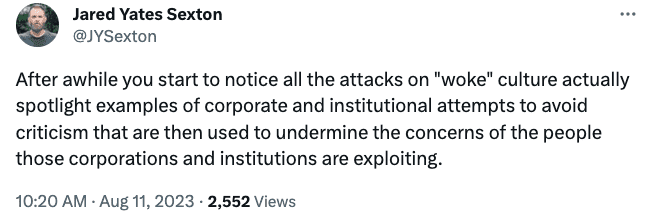
Jared Yates Sexton
tweets Aug 11, 2023: After awhile you start to notice all the attacks on 'woke' culture actually spotlight examples of corporate and institutional attempts to avoid criticism that are then used to undermine the concerns of the people those corporations and institutions are exploiting.
Jared Yates Sexton continues: And let's make it clear: there are no 'woke' corporations or institutions. There are wealthy and powerful people who either see an opportunity to profit or are concerned their exploitation will be laid bare. That's it. Period.

"...once you start pulling on the thread of conservative bad faith you inevitably notice that it makes its way through the entire national sweater." — A.R. Moxon, "One Must Imagine Charlie Brown Happy," The Reframe, Feb 18, 2024

"...a four-letter word...has, in some ways, come to stand in the place of traditional partisan orientations: care. Do you care or don't you?
* * *
Care is deeply political. ... To stand on the right side of history is to care. To be committed to social justice is to care. Self-care is imperative..."
— Hil Malatino (Trans Care, University of Minnesota Press, 2020)

Thursday, August 15, 2019

The chief eunuch in 'The Boy Fortune Hunters in China' (1909)

The Boy Fortune Hunters is a series by L. Frank Baum, the author of The Wonderful Wizard of Oz, writing under the pseudonym Floyd Akers. The fourth volume, The Boy Fortune Hunters in China, was published in 1909 by the Reilly and Britton Co.

In this story, set in 1908, three American boys — Sam Steele of Chelsea, Mass., age 18, the narrator; Archie Ackley, "about my age"; and Joseph Herring, "a little younger" and "rich" — sail across the Pacific to China and conspire to steal a royal treasure from the palace of a dead prince, out from under the nose of the ever-loyal chief eunuch. They travel with two South Sea Islanders, Nux and Bryonia, who had been rescued at sea by Sam's uncle. The uncle then renamed them after the medicines he used to save their lives. They were subsequently "devoted" to this man, and they learned English from him. "Indeed, I had come to regard both Nux and Bry," Sam says, "as my own personal followers, and well had they proven their claim to this title. They were nearly as dark as Africans, but very intelligent and faithful in every emergency." Nux and Bry follow Sam, Archie, and Joe everywhere, but they do not direct the action and they do not seem to be considered full members of the adventure club.

Skipping the first thirteen chapters, I will focus on the action involving the Chief Eunuch Wi-to.

Chapter XIV introduces the Chief Eunuch. After traveling for weeks in northwestern China, emerging from "a dark and gloomy teak forest" on the backs of elephants and arriving in Kwang-Kai-Nong, the adventurers receive a dinner invitation from "the noble governor [Mai Lo] and the great Wi-to." Wi-to is the "Chief Eunuch and the Supreme Ruler of the palace of Price Kai," second in power only to the governor. He speaks serviceable English and is friendly to the adventurers. When they first meet, he "gave us a whimsical look and raised a pair of bright, intelligent eyes to meet our own."

Sam says: "My notion of eunuchs had been that they were fierce creatures of powerful build, usually Ethiopians, and greatly to e feared. I had heard tales of their absolute power in the palaces of the nobles, and that even the mighty Empress Tsi An had failed to curb the influence of her palace eunuchs. So it pleased me to find Wi-to more agreeable in manner and speech than the imperturbable governor..." Sam informs the eunuch that their party intends "to escort the remains of your master [the late Prince Kai, who had taught the eunuch English] and our beloved friend to his old home."

"I did not know whether it was proper to address the Chief Eunuch as 'your Highness' or not; but perhaps the compliment pleased him, for he smiled, then screwed up his face into a semblance of grief, then smiled again."

'We are deeply grieved and inconsolable,' said he, cheerfully.

It turns out that "the shrewd eunuch" was eager to learn that one of the adventurers, Sam, had been acquainted with Prince Kai.

Wi-to oddly claims that English, which for him is a second language, "is an excellent language to converse in, and easier than our own...for it is much more simple."

In Chapter XV, there is a funeral procession to the capital, Kai-Nong. Wi-to's elephant brings up the rear behind the adventurers' elephants. They arrive at the palace walls and enter the gardens.

"Sixty gorgeously appareled men, armed with scimitars and broad axes, formed a circle around the elephant that bore the casket and prepared to guard it. They were stalwart, erect fellows, of proud bearing but evil and ferocious countenances, and each wore a yellow turban coiled upon his head, with a golden clasp, in effigy of the Sacred Ape, fastening the folds just above the forehead.

These were the eunuchs, the palace guards, or servants and attendants of the harem.

* * *

We all dismounted here, and the mahouts led away the elephants. Some of the eunuchs bore the casket of the Prince up the broad steps of the terrace, while Wi-to bowed low, first to the Governor and then to us, and welcomed us to the Royal House of Kai."

In Chapter XVI, "The Governor Shows His Teeth," left alone with Mai Lo and Wi-to, Sam says, "we seemed quite alone with these two natives, one of whom we knew distrusted and hated us." Wi-to "looked at us shrewdly and with an expression more grave and reserved than he had yet shown us," and leaves. "We were much annoyed at this discourteous treatment" at mid-afternoon, as they felt that Wi-to owed them lunch.

The palace entrance is flanked by two bronze statues "of the Sacred Ape, its grinning jaws filled with ivory teeth and its eyes set with immense rubies." One of the adventure boys, Archie, says: "Looks as if they had allowed us to come this far so that they might murder us." Sam replies: "We've got to win the good will of the eunuch or we're done for." Mai Lo returns and tells them he is not bound to honor the late Prince Kai's hospitality toward them; they must immediately leave for Shanghai or they will be killed. The boys object. Mai Lo blows a whistle, and Sam"motioned to Nux and Bry. Instantly my blacks had pounced upon the governor and drawn him behind us, holding him secure, while from a dozen nooks about the hall sprang eunuchs with drawn scimitars, who ran swiftly toward us."

Sam stops this onslaught by yelling "Stop!" even though the assailants "knew no English" and, moreover, do not answer to him. His comrade Archie, armed with a revolver, addresses the governor Mai Lo as "you yellow monkey" and demands that he call off his army "or I'll put a bullet through your head!" Sam shows Prince Kai's ring to the eunuchs "and said sternly: 'Wi-to!'" which for some reason causes them to bow low and summon Wi-to, who also kneels at the sight of Prince Kai's ring.

In Chapter XVII, "Wi-to Proves Faithful," the boy adventurers show Wi-to a letter written by Prince Kai, documenting that Prince Kai had given his ring to the boys and not to the governor Mai Lo. Sam presents his theory that Mai Lo is an opportunist who has returned to the city only to steal Prince Kai's treasure, and not to commit suicide according to what he says would be Shinto tradition. Wi-to, surprised and agitated, says: "You must be right." But, he asks, "you think I will side with you against the powerful governor?...I can destroy you foreigners with a word, and sweep you from my path. Then I can make an alliance with Mai Lo and together we could rob the ancestral halls and escape to some other country to enjoy the wealth." He adds that he is "of lowly birth, and as a child my parents sold me to the House of Kai to become a eunuch. My consent was not asked. Why should I be faithful to my masters?" Joe, one of the boy adventurers, says: "It's your nature," and adds, "A eunuch is of no use in the world outside of his own province. Here you have power. In Europe you would be despised and insulted." Wi-to agrees that they are right — he has been loyal for these reasons in the past. He adds that, if he stays, he is likely to remain in his current position and "be the real master here," so he doesn't need to steal anything from the palace.

Wi-to says he'll protect the boys from Mai Lo as long as they remain in the palace. "With that he clapped his hands together and two eunuchs stepped forward from behind a screen, so silently that their appearance startled me." One of the eunuchs, called Tun, will be their personal servant. Unlike the majority of the palace eunuchs, he speaks a little English. Wi-to says "he is a Manchu and will be faithful."

In Chapter XVIII, the boys became aware of an increasing number of palace eunuchs who are "invariably respectful and even humble, but they were an ill-looking crew, and we were never at ease in their presence." Wi-to then shows them the Sacred Apes who are actual beasts in a cage, one of whom is considered King Ape because he ate an imperial ancestor and thus is considered to contain the man's spirit.

In Chapter XIX, Wi-to explains that there is a harem and that the Prince's sister will soon be presented to the Emperor. Sam says that this sounds "almost as horrible as the story of the King Ape." Wi-to supposes that American women belong to American men and the men must not care about their property very much given that they allow the women so much freedom.

In Chapter XX, Sam continues to remind Wi-to that Mai Lo might try to steal the treasure. In private, Sam explains to Joe: "I want him to get suspicious of Mai Lo, and watch that old fox so carefully that he won't get a chance to steal anything until we get through. Besides, it will relieve us of any suspicions...he's crafty enough to believe that we wouldn't talk about robbing the Ancestral Halls if we had any idea of doing it ourselves."

In Chapter XXI, the boys risk their lives to have a casual conversation with three pretty girls. Sam, in his narrative voice, insists (though no one asked him) that when he falls in love someday, "it will be with an American girl, and it won't matter much whether she is beautiful or not, so long as I love her." He only chatted with the Chinese girls insofar as "every well regulated young fellow is fond of chatting with nice girls," and the Chinese girls offered "a pleasant change" from their dangerous adventures.

In Chapter XXII, they trespass into a vault and discover the jewels. One of the boys takes a handful of pearls.

In Chapter XXIII, Sam says, "Often we passed the magnificently attired household eunuchs, singly or in groups; but we had now become familiar sights to these creatures, and they merely touched their yellow turbans respectfully and passed on." The boys become aware that Mai Lo has discovered their trespass.

In Chapter XXIV, Wi-to is drunken and uncharacteristically babbling. "His face was haggard and worn, his eyes puffy and bloodshot and his person untidy." The boys find a cabinet with jewel-encrusted weapons but are not prepared to steal anything yet.

In Chapter XXV, a newly sober Wi-to personally slays a eunuch who shirked his work while Wi-to had been drunk: "it taught us how little human life was valued in this strange land." Mai Lo surprises the boys while they are chatting illicitly with the girls. Archie offers to shoot Mai Lo, but Sam tells him to stand down. Meanwhile, Sam wonders why Bry, who had been standing guard outside the pavilion, "was still silent. What could have become of our faithful black?" It then occurs to Sam that Mai Lo had simply approached from another direction. Mai Lo orders the boys to leave immediately for Shanghai or die. They refuse, so he whistles and a dozen eunuchs armed with scimitars run out. "Three revolvers cracked and three of the eunuchs fell," and the boys take their opportunity to run away, whereupon they are joined by "a rescue party, consisting of Nux and Bry at the head of a band of eunuchs led by Wi-to himself." Wi-to says, however, that he cannot protect the boys any longer now that they have violated the harem.

In Chapter XXVI, Sam begins by bemoaning that Wi-to's "oriental education and surroundings had saturated his otherwise liberal mind with the conventions and prejudices of his people; and he had a supreme contempt for women and could not tolerate such an unwarranted act as we had committed; in other words, making the acquaintance of three pretty and interesting girls who were inmates of harems." The eunuch apparently feels torn, "in one breath condemning us to horrible tortures and in the next trying to figure out a way to save us." The boys "could not bring ourselves to realize that we had merited punishment." The boys realize it's their last opportunity to steal treasure before they are kicked out of the palace.

In Chapter XXVII, they realize they must find a way to escape with their lives and their treasure.

In Chapter XXVIII, Mai Lo meets his death at the hands of the Sacred Ape.

In Chapter XXIX, they take possession of Mai Lo's severed head and debate how they will convince everyone else of their story that Mai Lo committed suicide by confronting the escaped ape.

In Chapter XXX, Wi-to agrees to endorse the boys' story about Mai Lo's death, as he is mainly glad that his enemy is dead. The boys escape with their treasure. "The eunuchs carried down our heavy cases and loaded them upon the elephants, and while the bearers must have thought them tremendously heavy they dared not complain, and the Chief Eunuch's suspicions were in no way aroused. Wi-to seemed really grieved to lose his guests, and we thanked him cordially..." Sam muses, "I have often wondered if...the treasure we abstracted...[was] ever missed."

Friday, July 26, 2019

Three weeks, no shower, and 'Kafka By Way of Orwell'

The Dallas News tells the following story.

An 18-year-old U.S. citizen was recently detained by U.S. Border Patrol. He was born in Dallas and lives in Texas. He has dual citizenship with Mexico, and he has a U.S. visitors visa that he used dozens of times to travel back and forth. When Border Patrol stopped him, the man was "carrying a Texas ID, wallet-sized birth certificate and Social Security card." The government wrote up a "Notice to Appear" dated June 29, 2019 that says:

The Department of Homeland Security alleges that you:
1. You are not a citizen or national of the United States;
2. You are a native of MEXICO and a citizen of MEXICO;
* * *
6. [After being stopped at the Falfurrias, Texas Border Control Checkpoint on or about June 27, 2019] you falsely represented yourself to be a citizen of the United States..."

Notice to Appear dated June 29, 2019. The Department of Homeland Security alleges that you are not a citizen of the US and that you falsely represented yourself to be a citizen of the US.

He is a U.S. citizen. Nonetheless, Border Patrol detained him and his younger brother. After two days, his younger brother chose to be deported "so that he could tell his mother what was happening with his situation and that of his brother." The 18-year-old man was held for 23 days, during which time he was not allowed to shower and lost 26 pounds.

The Dallas Morning News reported his story on July 22, and the man was released from custody the next day.

On July 25, Brian Hastings, Chief of Law Enforcement at the U.S. Border Patrol, testified about the matter before the House Judiciary Committee. Hastings claimed that the man was detained because he had "claimed to be a Mexican National who was born in Reynosa, Mexico....with no immigration documents to be in or remain in the U.S....At no time in Border Patrol custody did he say that he was a U.S. citizen.”

In response to this, the man's attorney produced the U.S. Dept. of Homeland Security's "Notice to Appear" with its statement that "you falsely represented yourself to be a citizen of the United States." This written statement, signed by Sherman Kemp, Acting Patrol Agent in Charge, contradicts Hastings' testimony. Furthermore, two weeks into the 18-year-old's detainment, his lawyer presented his birth certificate to ICE, and yet he wasn't released for another week.

Now free, the man says that Hastings' testimony is "a lie. I showed them my documents and I told them right away that I was a U.S. citizen.” The conditions he endured in Border Patrol custody, according to the Dallas News, almost coerced him to choose deportation.

(It's not the first time a U.S. citizen has been detained. In March 2019, a 9-year-old girl was apprehended on her way to school and held for two days. Authorities blamed the girl for giving "inconsistent information." Again, she is 9.)

And in September 2018, Jennifer Wright wrote for Harper's Bazaar:

Hispanic U.S. citizens, some of whom were in the U.S. military, are not being allowed to renew their passports. This is reportedly happening to “hundreds, even thousands” of Latinos, according to a report in the Washington Post. They’re getting letters from the State Department saying it does not believe they are citizens. The government claims their citizenships are fraudulent. “I’ve had probably 20 people who have been sent to the detention center—U.S. citizens,” Jaime Diez, an attorney in Brownsville, told The Washington Post.

The Washington Post also reports on ICE officials coming to citizens' homes and taking their passports away. This is an escalation from a few months ago, when Americans were detained by ICE officials just for speaking Spanish to one another."

In response

A a Twitter thread by @AlexandraErin referred to the officer's testimony as "Kafka By Way of Orwell logic" and excellently describes the situation.

"To the fascist mindset, there's no contradiction here. ... All of this could have been averted, they want us to know, if he had been honest from the start and simply told them he was a citizen. But instead he lied. He was deceitful. They know he lied because he had the cheek to falsely claim he's a citizen. Falsely claiming he's a citizen is something any lying immigrant might do. It's a distinct and separate act, they are sure, from a citizen simply stating the truth. Very much this. They make up their mind about your motives, which colors whatever you say, even if it's the exact right thing and the literal truth, and they will never grant that this is the same as telling them the truth. No contradiction, to them. When things got hot with media scrutiny and politicians getting involved in the teenager's detention, the people he'd pleaded his case to, I guarantee, did not think "Why didn't we listen?" but "Why couldn't he have just told us, the right way, so we'd know he meant it?" "Falsely claiming to be a citizen" is a distinct enough act in their mind that a ~*certain type*~ of person can manage it, even if they happen to be an actual citizen. Which just makes it cheekier, of course. The nerve of making them look foolish by falsely claiming the truth! ... What is truth to a fascist? The truth is what they say, and only when they say it, only when it is useful. ... And so the shock and dismay and outrage of the right when they realize their opponents and targets were telling the truth is genuine, is honest, maybe the most honest thing about them. They feel cheated. They feel... lied to. "What do you mean by telling me the truth, just because it's true? That's a dirty trick. I've never seen anything more underhanded, more unscrupulous..."

She continues by pointing out that, had he chosen to allow the Dept. of Homeland Security to deport him, it may have been difficult for him to re-enter the US, the country where he lives and of which he is a citizen by birth. "The creation of a stateless other is part of the model." Thus, he was not truly "free to leave at any time" (as one Internet commenter tried to argue with her).

His only power to end the torture was to agree that he was An Illegal, agreed he had no right to due process and no right to remain here, and agreed to do what they wanted. It wasn't true, but it was the only answer the torturers would have accepted. Which is the purpose of torture. Not to get at the truth, but to establish something already believed by the torturer as true. ...you can't gain information through torture. It's confirmation bias through pain. The torture ends when the torturer hears the truth. "The truth" therefore must be something the torturer already knows, otherwise how can they know it's true?

2026, Second Trump doesn't want due process:

I need people to understand that this administration’s litigating position is (1) federal law currently mandates the detention, without bond, of every noncitizen who is allegedly unlawfully present and (2) constitutionally, they don’t get a day in court. they’re generally losing, but they’re trying.

[image or embed]

— Evan Bernick, a finite mode with a smol hooman and a lorg floof (@evanbernick.bsky.social) July 16, 2026 at 11:35 AM

In case you missed it

Have you seen inside the book 'To Climates Unknown'?

The alternate history novel To Climates Unknown by Arturo Serrano was released on November 25, the 400th anniversary of the mythical First ...