Showing posts with label climate change. Show all posts

Saturday, July 4, 2026

U.S. 250th: This Fourth of July (2026) is hot because of climate change

If you're in the US, you may have noticed it's hot.

Independence Day Parade In D.C. Canceled Over Dangerous Heat (Sebastian Murdock, HuffPost, July 4, 2026):

"The Independence Day Parade set to take place Saturday morning in Washington, D.C., was canceled Friday night over concerns about extreme heat.

Temperatures in the area are expected to reach as high as 102 degrees.

"This decision was made after extensive and careful consideration of the safety of our participants, spectators, and staff as the top priority," said Todd Marcocci, president of Under the Sun Productions Inc., the organizer of the parade.

The Great American State Fair on the National Mall was temporarily closed on Friday due to the heat. Trump said he plans to give a speech Saturday night, though some White House officials have expressed concern that it could be sparsely attended.

“I do not understand why we are doing this so late,” one White House official told CNN. “I’m really not sure who thought this was a good idea.”

It's climate change.

tree

Thousands of Trump supporters on the National Mall ordered to evacuate from the thunderstorm have sought shelter inside the National Museum of African American History and Culture. Y'all...

— Charlotte Clymer (@charlotteclymer.bsky.social) July 4, 2026 at 8:07 PM

Canada, France, Spain, UK, & Norway are on fire. The US has raining ash, air that is dangerous to breath, & because of the heat, is at risk for even more fires. China, Angola, Yemen, Tanzania, & Texas are experiencing record floods. CLIMATE CHANGE IS REAL. IT AFFECTS THE ENTIRE PLANET.

— Cory Laran (@corylaran.bsky.social) July 19, 2026 at 11:16 AM

Wednesday, March 13, 2024

Climate change: Dire predictions

Yes, the patterns of living beings are changing, you're not mistaken

"You're not crazy. Spring is getting earlier. Find out how it’s changed in your town.": Readers told us how spring has changed where they live. Our map shows where leaves are sprouting sooner. Harry Stevens, Climate Lab columnist, Washington Post, March 13, 2024

small yellow flower growing from cracked earth

Scientists have been sounding the alarm for years

"The Great Barrier Reef Has Been Forever Changed By Global Warming, Scientists Warn: Rising temperatures in 2016 caused a catastrophic die-off of almost 30 percent of the iconic reef. Dominique Mosbergen, CNN, Apr 18, 2018

The worst-case scenarios are probably correct

Global Warming: Our Most Dire Predictions for the Future of the Planet Are Probably Right, Sydney Pereira, Newsweek, Dec 7, 2017

Indeed, they are coming to pass

"Australia’s Great Barrier Reef suffers ‘extensive’ coral bleaching, as scientists fear seventh mass bleaching event," Helen Regan, CNN, February 28, 2024

‘Like wildfires underwater’: Worst summer on record for Great Barrier Reef as coral die-off sweeps planet, Rebecca Wright, Ivan Watson and Tom Booth, CNN, May 4, 2024

We are still trying to communicate it

Apocalypse How? What Novels Screw Up About Climate Change: We're obsessed with grim environmental tales, but most of them miss the point. Casey Williams, HuffPost, Apr 21, 2018

As one example, Williams says that “journalist David Wallace-Wells’ 2017 article 'The Uninhabitable Earth' fuses literary conventions with hard reporting to conjure apocalyptic visions of a warming world.”

Read it:

The Uninhabitable Earth: Famine, economic collapse, a sun that cooks us: What climate change could wreak — sooner than you think. David Wallace-Wells. New York Intelligencer. July 2017.

Seen from space, the rainforest has decreasing forest:

"In 2001, I flew my first flight into space aboard Space Shuttle Endeavour. Roughly a decade later, I commanded that same space shuttle on its final flight. That trip was my fourth journey -- and at least for now, my final one -- from this planet into space.

* * *

When I first looked down upon the Amazon rainforest in 2001, I saw vast areas of jungle and a wide and winding copper colored river that went on and on and on. A river that was impossible to miss and like no other on the planet. By 2011, however, the part that was most noticeable wasn't the river or the jungle but the large swaths of empty land.

* * *

This year has been an unequivocal disaster for the future of the planet. President Donald Trump has managed to take a wrecking ball to years' worth of hard work and painstaking negotiations. If not undone, our retreat from the Paris Climate Accords and the EPA's Clean Power Plan alone mean our planet's temperature will rise at a greater rate and our citizen's health will degrade. Other changes in environmental regulations on drilling and auto and appliance efficiency will only make matters worse."

&,dash; Mark Kelly: This year has been an unequivocal disaster for the future of the planet, Mark Kelly, CNN, December 27, 2017

Released yesterday, a sobering summary on findings in climate change research over the last year. Among other things, that Climate extremes are harming maternal and reproductive well-being. Increasing heat is making more of the planet uninhabitable. 10insightsclimate.science

[image or embed]

— Prof Lisa Schipper (@lisaschipper.bsky.social) October 29, 2024 at 3:35 AM

really hard to escape the feeling that every climate-related disaster that doesn't get you personally just brings you closer to the one that will

— dan solomon (@dansolomon.com) January 8, 2025 at 11:43 PM

all we can do is try our best to take care of the ones whose turn it is because we will need them when it's us. that's all i got

— dan solomon (@dansolomon.com) January 8, 2025 at 11:45 PM

Monday, June 12, 2023

The Lucretius Problem: 'The difficulty...imagining and assimilating things outside [one's] own personal experience'

trees

"It's not just our infrastructure that’s built for a different time, it’s our mindset. Whether it’s the depth of the snow, the volume of the rainfall, or the speed of the flames, when it comes to extreme weather, our heads are still in the 20th century.

There is actually a name for this phenomenon: the Lucretius Problem. Lucretius (Titus Lucretius Carus) was a Roman poet and philosopher who identified this cognitive disconnect more than 2000 years ago. Nassim Taleb, author of The Black Swan: The Impact of the Highly Improbable, paraphrases Lucretius this way: “The fool believes the tallest mountain in the world will be equal to the tallest he has observed.” In essence, the Lucretius Problem is rooted in the difficulty humans have imagining and assimilating things outside their own personal experience."

* * *

"Baffling to those trying to communicate the hazards of 21st century weather is the way in which responsible authorities continually underestimate accurate predictions, despite persistent warnings (over decades now), that we must expect lethal and unfamiliar extremes from every kind of weather. Most dismaying to climate scientists and weather analysts is how each of these failures mirrors, in microcosm, our collective failure to prepare for the larger, systemic threats posed by global climate disruption. In March, the IPCC issued its latest report, which said, in effect, Time’s up! on the supreme challenge of cutting CO2 emissions. As she watched this red alert from world-class scientists slip down the rankings on The New York Times homepage, a scholar and climate activist named Genevieve Guenther tweeted, 'It's utterly surreal, the dissonance.'"

— "Even As Smoke Engulfs Us, We Can't Wrap Our Heads Around Climate Change", John Vaillaint, Time Magazine, June 7, 2023. Adapted from Vaillant’s Fire Weather: A True Story from a Hotter World


For more: ""What we can't conquer, we destroy and deny". It's a 4-minute read on Medium.

"Rabbi Pinhas' disciples said, 'We are afraid that the Evil-Urge will pursue us.' Rabbi Pinhas replied, 'Don't worry. You have not gotten high enough for it to pursue you. For the time being, you are still pursuing it.'"

— Samuel H. Dresner. Prayer, Humility, and Compassion. Hartford: Hartmore House, 1957 (reprinted 1969), 121.


Go way back — to 400,000 years ago, say — and you would find lions, elephants, and other exotic fauna grazing on arid plains [in Europe]. ... Remarkably, what brought those animals to this part of the world was a climate just 3 degrees Celsius or so warmer than today. There are people alive now who will live in a Britain that warm again.

— Bill Bryson. At Home: A Short History of Private Life. New York: DoubleDay, 2010. p. 451.


“What is the use of a house if you haven’t got a tolerable planet to put it on?”

— Henry David Thoreau, quoted in “Sunbeams,” The Sun, December 2012, p. 48.


What are the cultural mythologies of our time? How do they cloud our ability to think through these issues?

The notion that history encodes progress, however erratic, is something that may appear to future generations a projection of impossible naivety and narcissism. Our sense that every generation is going to live differently, let alone better, is really a projection of the last couple hundred years in the West. I think it is quite possible that we will look back on it — as soon as 50 years from now — as a really weird anomaly, this strange idea that we ever expected that the world could continue providing ever more abundance for us."

— “The Strange Optimism of Climate Alarmist David Wallace-Wells.” Rick Carp. Rolling Stone. March 12, 2019.


“As the threats of suicide piled up, I began to see a coordinated campaign to harass me, and as disturbing as it was, it was also sadly fascinating in what it revealed. These men were trying to terrorize me with what they saw as the only logical conclusion to my anti-racist, feminist work: the mass suicide of white men. They wanted me to know that they saw my work to end violent misogyny and white supremacy, and they saw that it was a threat, not only to their norms and their status but to their very lives.

These men wanted me to know that they were miserable, they felt screwed over, and they felt demonized. They wanted me to know that the only option available to address white male patriarchy was either to maintain the status quo that was making us all miserable, or death. They wanted me to know that they were not capable of growth or change and that any attempts to bring about that growth or change would end them.

Nobody is more pessimistic about white men than white men."

— Ijeoma Oluo. “The White Men Who Threaten Me With Their Own Suicide.” Medium: GEN. December 1, 2020.


“today, a forest caught fire and it will scorch for days. weeks. the whole park will become an oven. so much fur singed. so many hibernations interrupted. today, all the bees died and no one said a thing.”

— Sara Ryan. “This is a Time Capsule.” Excellent Evidence of Human Activity. Denver: The Cupboard, 2019. Vol. 38.


"It has long been thought that environmental crises are, in part or in sum, crises of narrative, which is to say crises of belief. At least as far back as Henry Nash Smith’s Virgin Land: The American West as Symbol and Myth (1950), critics and commentators have been calling for new stories, new myths, and new symbols with which to better fit ourselves to the world not of economy, whose false narratives have led us to apocalypse, but of truth, of science — a call that has taken on a note of alarm in the era of global warming; we need those new narratives now. If only we can get the story right, runs the liturgical refrain of an enormous number of op-eds, scientific papers, academic panels, TED talks, white papers, think pieces, essays, books, and tweets from across the ideological spectrum — if only we can flip the script to fit the facts, then we can save the planet and ourselves.

* * *

Jeremiah's time has passed. Both Carbon Ideologies and The Uninhabitable Earth seem to sense it: believing the right narrative and having the right facts were never going to be enough. There may be no absolution for what we have done. In my life, I’ve worked with a MacArthur genius and a researcher who split the Nobel Prize for his climate work; I’ve shared my writing with dozens of devoted ecocritics and environmental humanists, green essayists and poets, and journalists and editors — true believers, all — and none of them, none of us, not with the millions of pages we've read between us, the stats, facts, and library stacks we’ve combed, not one of us lives as if the words we’ve read matter.

And I wonder: what, now, in the Anthropocene, is the point of reading?"

— “Reading in the Anthropocene.” Daegan Miller. Guernica. June 16, 2021.


"As it has been mentioned, the main difficulty in replacing the industrial order is not the physical nature of the situation, but its psychic entrancement. This mythic commitment preceded the actuality of the industrial achievement. It was, rather, a condition for, not the consequence of, the industrial achievement. So, too, with the ecological pattern: the myth is primary, although its early realization must be achieved and valid indications established of its possibilities for the future. A taste for existence with in the functioning of the natural world is urgent. Without a fascination with the grandeur of the North American continent, the energy needed for its preservation will never be developed. Something more than the utilitarian aspect of fresh water must be evoked if we are ever to have water with the purity required for our survival. There must be a mystique of the rain if we are ever to restore the purity of the rainfall."

— Thomas Berry. The Dream of the Earth. San Francisco: Sierra Club Books, 1988. p 33.


"Environmentalists are not likely to make significant headway in mobilizing the rest of us to lower our own levels of consumption unless environmentalism can challenge the rip-off consciousness and the selfishness of the competitive marketplace. What the environmental movement has failed to emphasize is a nonutilitarian, nonreductionist, nonmaterialist view of the earth — the possibility of a consciousness that does not reduce everything to the question 'What's in it for me?'"

— Michael Lerner. The Left Hand of God: Taking Back Our Country from the Religious Right. HarperSanFrancisco, 2006. p. 74.


"They have called, for example, for UK carbon emissions to be reduced to net zero by 2025. Wouldn’t it be better, we asked, to pursue some intermediate aims?

* * *

Softer aims might be politically realistic, but they are physically unrealistic. Only shifts commensurate with the scale of our existential crises have any prospect of averting them. Hopeless realism, tinkering at the edges of the problem, got us into this mess. It will not get us out.

Public figures talk and act as if environmental change will be linear and gradual. But the Earth’s systems are highly complex, and complex systems do not respond to pressure in linear ways. When these systems interact (because the world’s atmosphere, oceans, land surface and lifeforms do not sit placidly within the boxes that make study more convenient), their reactions to change become highly unpredictable. Small perturbations can ramify wildly. Tipping points are likely to remain invisible until we have passed them. We could see changes of state so abrupt and profound that no continuity can be safely assumed.

* * *

Decades of institutional failure ensures that only “unrealistic” proposals — the repurposing of economic life, with immediate effect — now have a realistic chance of stopping the planetary death spiral. And only those who stand outside the failed institutions can lead this effort.

Two tasks need to be performed simultaneously: throwing ourselves at the possibility of averting collapse, as Extinction Rebellion is doing, slight though this possibility may appear; and preparing ourselves for the likely failure of these efforts, terrifying as this prospect is. Both tasks require a complete revision of our relationship with the living planet.

* * *

Because we cannot save ourselves without contesting oligarchic control, the fight for democracy and justice and the fight against environmental breakdown are one and the same. Do not allow those who have caused this crisis to define the limits of political action. Do not allow those whose magical thinking got us into this mess to tell us what can and cannot be done."

— "The Earth Is in a Death Spiral. It Will Take Radical Action to Save Us", The Guardian, Nov 15, 2018


"There is a lot of talk these days about the need to lead lower-carbon lifestyles. There is also a lot of finger-pointing going on and, some argue, virtue signaling. But who is truly walking the climate walk? The carnivore who doesn’t fly? The vegan who travels to see family abroad? If nobody is without carbon sin, who gets to cast the first lump of coal?

* * *

However, the true solution, pricing carbon, requires policy change.

* * *

But appearing to force Americans to give up meat, or travel, or other things central to the lifestyle they’ve chosen to live is politically dangerous: it plays right into the hands of climate-change deniers whose strategy tends to be to portray climate champions as freedom-hating totalitarians.

* * *

But a price on carbon needs to be designed such that marginalized communities most at risk from climate impacts aren’t adversely impacted economically as well.

— “Lifestyle Changes Aren’t Enough to Save the Planet. Here’s What Could.” Michael E. Mann. Time. September 12, 2019.


"What we call 'Climate Leviathan' exists to the extent that some sovereign — a body evolving out of the UN’s climate frameworks, perhaps — exists who can invoke the exception, declare an emergency, and decide who may emit carbon and who cannot. This sovereign must be planetary in a dual sense: capable of acting both at the planetary scale (since climate change is understood as a massive collective action problem) and in the name of planetary management for the sake of life on Earth. A task of biblical proportions, amounting to an impossible global accounting of everything, like determining 'a weight for the wind and apportion[ing] the waters by measure,' to quote the book of Job.

Climate Leviathan is defined by this dream of a planetary sovereign. It’s a regulatory authority armed with democratic legitimacy, binding technical authority on scientific issues, and a panopticonlike capacity to monitor the vital granular elements of our emerging world: fresh water, carbon emissions, climate refugees, and so on.

* * *

Leviathan could take one of two broad forms. On one hand, a variety of authoritarian territorial sovereignty could emerge in nations or regions where political-economic conditions prove amenable to transcending capital. On the other hand, we could see Leviathan emerge as the means by which to perpetuate the rule of northern liberal, democratic capitalist states.

* * *

Climate Leviathan will be the fundamental regulatory ideal motivating elites in the near future. Still, it is neither inevitable nor invincible; it is strong and coherent but not uncontested. It is threatened from within by the usual burdens of any state-capitalist project divided by multiple accumulation strategies, and it is almost impossible to imagine that it will actually reverse climate change."

— "The Age of Climate Authoritarianism Is Upon Us", Geoff Mann and Joel Wainwright, OneZero, Jan 28, 2020


"We save only what we love, we love only what we understand, we understand only what we are taught."

— Baba Diome, Senegalese naturalist


For more: "Climate change is expensive, but that's not the point". It's a 9-minute read on Medium.

Wednesday, June 15, 2022

What projects can help us reach climate goals?

Alicia Elliott writes:

"The most recent report claims that rich countries must end their oil and gas production entirely by 2034 — 12 short years away — in order to cap global warming at 1.5 degrees Celsius and give poorer countries time to replace fossil fuel income. Considering how reluctant our world is to give up fossil fuels — or, more directly, the money made by fossil fuels — it's hard to see this happening."

In a 2018 article, Casey Williams explained that "Climate change doesn’t describe a single future catastrophe, but a slow and uneven unraveling, a drawn-out apocalypse that began long ago and that will stretch to an end that probably won’t feel like much of an ending at all." It affects different people differently. "For the wealthy and well-connected, climate change will not feel catastrophic most of the time." Therefore, to address climate change may be to address "the everyday injustices that make the present unbearable for so many."

Faron Sage says,"Projects like Moral Imaginations and Thrutopia and activists like Rob Hopkins and Manda Scott are creating a wonderful ground swell of imaginative possibilities that are profoundly necessary to fire our collective inspiration."

Kathryn Schulz, writing in 2015 about earthquake anticipation or "ecological reckoning" in general, said: "apocalyptic visions are a form of escapism, not a moral summons, and still less a plan of action."

Earth seen from space

Thursday, May 12, 2022

Climate solution: Mangroves and salt marshes

Water covers most of the planet. The ocean regulates the air we breathe and affects the weather. Yet sea levels are "predicted to increase more in the next thirty years than they have in the previous century," the United Nations Framework Convention on Climate Change notes.

In a May 10, 2022 blog post, they quote Loreley Picourt, secretary general of the Ocean & Climate Platform and the co-focal point for Ocean and Coastal Zones for the Marrakech Partnership-Global Climate Action Agenda at UN Climate Change, as saying that "the speed of this [irreversible sea level rise] and its associated risks (such as erosion and submersion, loss of coastal habitats and ecosystems, salinization of land and groundwater) will be considerably slowed down [if] warming levels are kept below 1.5°C.”

This is important: sea level rise is happening, and once it happens it is generally irreversible, but it can be slowed.

The article goes on to say:

"There are solutions available today, including Nature-based Solutions (NbS), such as planting mangroves and salt marshes, which not only contribute to carbon sequestration but have huge biodiversity benefits."

It adds:

"The Sea’ties Declaration was launched during the One Ocean Summit earlier this year, and has so far been signed by 40 mayors, governors and city networks across the world. It calls for an acceleration in the transformation of cities and their territories, highlighting four priorities: the mobilisation of science and observation systems; the integration of societal issues within adaptation plans; the fostering of adaptive and hybrid solutions; and the increase of public funding and private investments for adaptation to sea level rise."

Those four priorities, in other words:

  • scientists keeping track of changes in the physical environment, as that is the problem that needs to be fixed
  • addressing social issues that people care about, or else they won't get on board with adaptation plans that affect them in ways they care about
  • actually coming up with climate solutions
  • adapting to all the changes we can't stop, which will require money

However

Ben See posted Twitter threads with these articles:

International Day for the Conservation of the Mangrove Ecosystem, UNESCO, 26 July

Drowned? Existing mangroves could fall to sea level rise by 2050 by Michael Taylor, Thomson Reuters Foundation. 5 June 2020

Shocked scientists find 400km of dead and damaged mangroves in Gulf of Carpentaria, Graham Readfearn, Guardian, Oct 3 2019

IUCN advises “in danger” status for three World Heritage sites, IUCN, 7 Jun 2019

Sarker, S., Reeve, R., Thompson, J. et al. Are we failing to protect threatened mangroves in the Sundarbans world heritage ecosystem?. Sci Rep 6, 21234 (2016).

Avoiding mangrove destruction by avoiding carbon dioxide emissions. Ken Caldeira. August 27, 2012. 109 (36) 14287-14288

Mangrove-dependent Animals Globally Threatened, American Institute of Biological Sciences, July 7, 2009

A half-million dollars won't beat back climate change

$500K Sand Dune Designed to Protect Coastal Homes Washes Away in Just 3 Days, Dan Ladden-Hall, Daily Beast, Mar. 11, 2024

Rising sea level

Why seas are surging, Washington Post, gift link

See also

"Re-envisioning Environment". It's an 8-minute read on Medium.

open ocean, a photo angle close to sea level
Image by Pexels from Pixabay

Monday, May 2, 2022

Asking for activists in the climate emergency

Margaret Klein Salamon, executive director of the Climate Emergency Fund and author of Facing the Climate Emergency: How to Transform Yourself With Climate Truth, wrote "If You’re Anxious About the Climate, Try This" (New York Times, May 1, 2022). In that essay, she says:

I resolved to use my psychological expertise to help Americans wake up from the delusion of normalcy, and treat climate like an emergency...In these “climate emotions conversations,” participants often speak of their grief, terror, rage, shock, betrayal, guilt and alienation.

Recognizing and expressing feelings is just the beginning. Once someone awakens to problems and feels motivated, they take action.

...in 2019, after weeks of protests that shut down parts of London led by the climate activist group Extinction Rebellion, Britain declared a climate emergency and became the first major economy to legally commit to reaching “net zero” emissions by 2050.

Climate Emergency Fund supports...

...Scientist Rebellion, a group of over 1,000 scientists around the world. They are angry and fearful of climate change, and have engaged in various forms of civil disobedience including chaining themselves to the White House fence, and covering the Spanish Parliament building with paint the color of blood.

To stop human-caused climate change, the planet needs activists.

For more information, read Margaret Klein Salamon's book:

See also: "‘This Is The Team’: Collective Change on Climate". It's a 7-minute read on Medium.

By the way, Joe Walsh said in July 2022:

"Republicans have been obsessed for the last 30 to 40 years in fighting the fight at the state and local level. That's where they've been waging war. Democrats have been focusing on the national level and thinking every solution has to come out of Washington, D.C. The Democrats are getting their clocks cleaned at the state and local level because of that obsession."
walrus on ice

A common assumption about public opinion and climate change is weather events will wake skeptics up to threats of a warming planet. This paper suggests an alternative scenario, affected voters turn *away* from green parties. Perhaps weather shocks are experienced by many first as economic shocks.

[image or embed]

— Omar Wasow (@owasow.bsky.social) November 29, 2024 at 11:49 AM

Thursday, April 21, 2022

To meet climate goals, when do we have to 'walk and bike a lot more'? Now.

Farhad Manjoo in the New York Times:

"While it’s very nice that cars are transitioning from gas to electricity, switching the fuel source of our automobiles is unlikely to be enough to meet our goals for emissions reductions to combat climate change. Combating climate change also requires American to drive less and walk and bike a lot more than we do now."
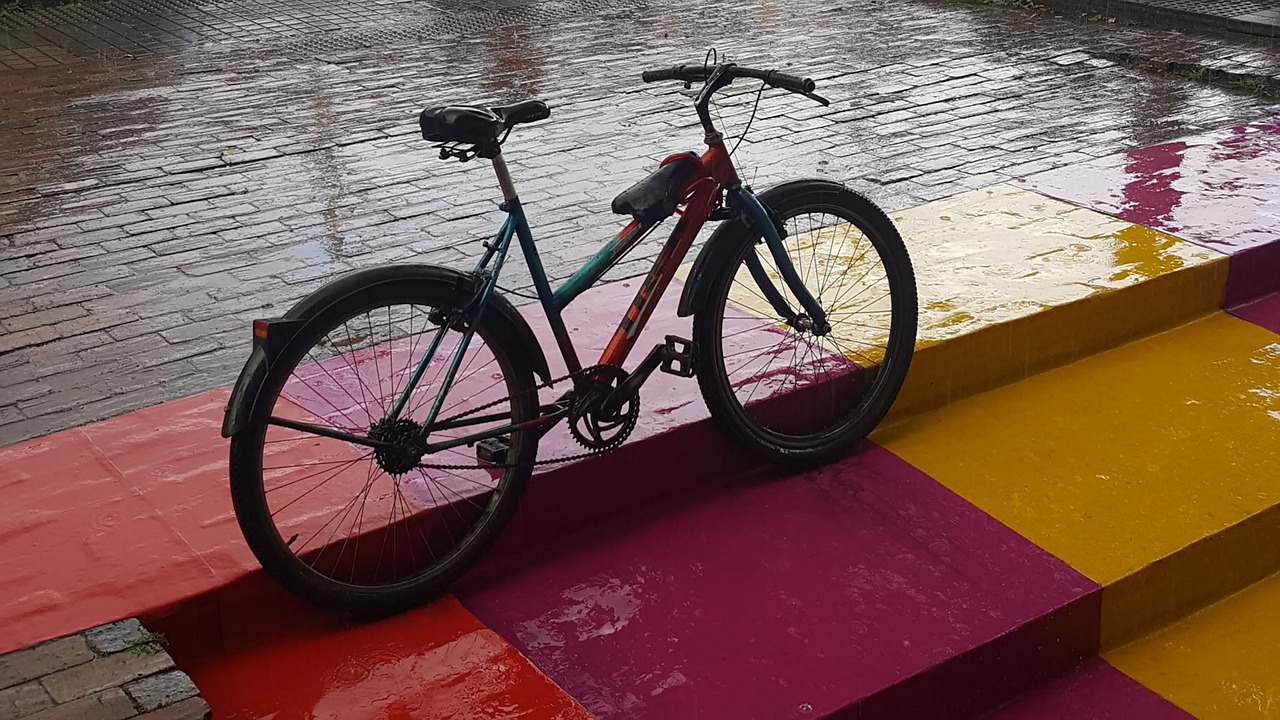
bicycle in the rain on an urban street

So, regarding bike safety:

"American states and cities now have an opportunity to do [the] same [as Amsterdam]. But they must act fast, and they must act decisively. This is no time for half-decade-long action plans."
"Riding a Bike in America Should Not Be This Dangerous." Farhad Manjoo. New York Times. April 21, 2022.

In the 2020s, we must reduce driving 25%

Matthew Lewis tweets on Aug 26, 2023: It’s not 'oh well first we can get everyone an electric car, then see if they drive less.' That’s a ~ 3 degree future you’re talking about. It’s reduce driving 25% *this decade* — amount of time it would take to build tons of infill housing, world-class safe streets …
So not only would electric sprawl suck to live in, and be built in areas at extreme risk of climate catastrophe, but it wouldn’t even actually help us achieve our climate targets. That’s stupid, IMO.

People can come together in different ways

"In an influential essay in 1938, Lewis Mumford, perhaps the greatest American critic of urban planning, defined a city as that place where 'the diffused rays of many beams of life fall into focus.' Cities, said Mumford, are the culmination of humankind’s domination of the earth; they’re where the need for industry and cooperation have come together. Cities are the great sites of monumental and public life they are living museums of themselves, cathedrals to their own glory and to the forms of life they make possible; cities are where vastly different kinds of people can come together with different functions, and desires, and needs, that somehow are orchestrated into the great four-dimensional fold of human social life."

Why Are We So Obsessed with Making Cities Greener? Des Fitzgerald Wonders What "Nature" Actually Is. Des Fitzgerald. LitHub. November 21, 2023.

Electric bicycles!

now do e-bikes! virtually no air pollution, significant safer streets, virtually no road wear or maintenance costs, no noise pollution, builds better and more resilient communities... sh*t - i wonder why congress refuses to subsidize the sh*t out of these climate wonders

[image or embed]

— Mike Eliason (@holz-bau.bsky.social) October 7, 2024 at 1:18 PM

No, which country sells the most stuff is not, in fact, 'way more important than climate change'

Thanks. If this exchange had happened earlier, I would have used it in the piece. This is the problem, right here.

[image or embed]

— JW Mason (@jwmason.bsky.social) October 23, 2024 at 9:55 AM

See also: "'This is the Team': Collective Change on Climate". It's a 7-minute read on Medium. You may also consider a paid membership on the platform.

If you like the bike photo, feel free to use it elsewhere. If you'd like to give credit, it's by Tucker Lieberman and you can find it on Pixabay.

This week we're collabing with the co-hosts of @thewaroncars.bsky.social to chat about how pro-car propaganda works, its history, and how it shows up in our politics today, especially in this year's NYC mayor's race! www.youtube.com/watch?v=kN-e...

[image or embed]

— Cancel Me, Daddy Podcast (@cancelmedaddy.bsky.social) October 8, 2025 at 4:12 PM

And here is in audio format, and it's available wherever you listen to podcasts! podcasts.apple.com/us/podcast/w...

[image or embed]

— Cancel Me, Daddy Podcast (@cancelmedaddy.bsky.social) October 9, 2025 at 12:05 PM

“Air pollution fell substantially as Paris restricted car traffic and made way for parks, people-streets and bike-lanes.” Better for the climate, better for health, better for livability and quality of life. Common sense. Such a no-brainer, it’s remarkable that more cities HAVEN’T done the same.

[image or embed]

— Brent Toderian (@brenttoderian.bsky.social) October 27, 2025 at 9:31 PM

This isn't mine, and I can't definitively find the original source. But I love this little bit of wisdom: "If you're a fifteen-minute walk from a coffee shop, but the server there has to drive an hour to get to work, you don't live in a walkable city. You live in a theme park."

[image or embed]

— Michael Crider (@michaelcrider.bsky.social) January 28, 2026 at 2:59 PM

Sunday, March 27, 2022

NYT opinion: Russia's invasion of Ukraine is fueled by fossils

Please check out Farhad Manjoo's opinion in the New York Times:

On one hand, it would seem uncontroversial to point out that Russia’s invasion of Ukraine is a war enabled and exacerbated by the world’s insatiable appetite for fossil fuels. It couldn’t not be so: Russia is a petrostate...By accelerating our transition to cheap and abundant renewable fuels, we can address two grave threats to the planet at once: the climate-warming, air-polluting menace of hydrocarbons and the dictators who rule their supply.

And yet American politicians on the left sure seem incapable of drawing out this connection, don’t they?

"If the 'climate lobby' were truly so powerful," Manjoo says, "it might have long ago prevented Europe from building its society upon a devilish bargain with Russian energy."

But that is past. Looking forward: Will the Democrats be able to pass Build Back Better legislation — with or without Sen. Joe Manchin?

"We’re in a Fossil Fuel War. Biden Should Say So." Farhad Manjoo. New York Times. March 24, 2022.

Also, Thomas L. Friedman:

This is our umpteenth confrontation with a petro-dictator whose viciousness and recklessness are possible only because of the oil wealth he extracts from the ground. No matter how the war ends in Ukraine, it needs to end with America finally, formally, categorically and irreversibly ending its addiction to oil.

"How to Defeat Putin and Save the Planet." Thomas L. Friedman. New York Times. March 29, 2022.


CNN explains:

"The September 2022 sabotage of the Nord Stream 1 and 2 pipelines, which pumped methane gas from Russia to Germany, was a major flashpoint in the energy war between Europe and Russia. Amid its invasion of Ukraine, Russia halted all gas supplies to Europe via the Nord Stream 1 at the time, blaming Western sanctions for causing technical difficulties. Authorities have yet to determine who was behind the sabotage.

At the time of the leak, UN Environment Programme detected on satellite a massive plume of concentrated methane. It later reported the ruptures were likely the largest single release of methane ever recorded."

— "Sweden’s climate pollution should have been down. The Nord Stream pipeline leak sent it skyrocketing," Rachel Ramirez, CNN, December 14, 2023

See also: "In near unanimous vote, European lawmakers call for Russia to be declared a 'terrorist' regime" CNN, October 2022.

heating pipes

October 2024: Russia appears to be getting help from North Korean soldiers to invade Ukraine.

We scrutinized unverified Russian social media videos and located North Korean soldiers training at a military complex in Russia’s Far East, potentially preparing for deployment. I know lots of ppl canceled subscriptions, so I’m sharing a gift link and threading screenshots here. wapo.st/3UqOYpz

[image or embed]

— Michelle Ye Hee Lee (@myhlee.bsky.social) October 26, 2024 at 10:31 AM

Trump pushes Erdoğan to stop buying Russian oil as shutdown looms in the US, by Maureen Chowdhury, Samantha Waldenberg and Adam Cancryn, CNN, September 25, 2025

Friday, March 18, 2022

Biden's fossil fuel reduction goals during Russia's war on Ukraine

As described in an article today in the Huffington Post, U.S. President Joe Biden

has committed to achieving net zero carbon emissions by 2050, meaning America’s forests, farm fields and clean-industrial projects would remove more carbon from the atmosphere each year than the country’s cars, power plants and factories emit. To achieve that goal, he passed an infrastructure bill with some renewable energy incentives and pursued a much more ambitious set of renewable energy tax credits as part of the stalled Build Back Better legislation. Using the powers of the executive branch, Biden also revoked authorization for the Keystone XL oil pipeline and raised federal fuel-economy standards for cars and trucks.

* * *

So long as Biden does not reauthorize Keystone XL, which would incentivize fossil-fuel extraction over the long term, the president’s efforts to limit the political fallout from higher gas prices are compatible with Biden’s plans to phase out fossil fuels, according to Andrew Dessler, an atmospheric scientist at Texas A&M University.

On the other hand, Biden has released oil from the Strategic Petroleum Reserve and this week decided to "increase liquefied natural gas exports to Europe to decrease [Europe's] reliance on Russian gas."

Source: "Gas Price Hikes Test The Climate Action Movement", by Daniel Marans and Alexander C. Kaufman, Huffington Post, 18 March 2022.

See also: "War May Change How We Rely on Big Oil". It's a 3-minute read on Medium. Consider a paid membership on the platform.

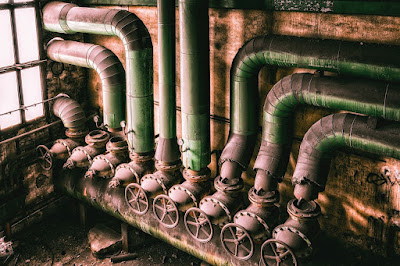
tubing with valves on the wall of a building
Image by Tama66 at Pixabay

Wednesday, November 17, 2021

Against ecological catastrophe, all of humanity should be playing on the same side

Two recent podcast episodes that mention climate change, on the periphery, but in nuanced ways.

First, this episode of the Rachel Maddow show, "Steven Bannon indicted (again), giving new teeth to January 6th Committee" (13 November 2021). It is guest-hosted by Ali Velshi. At the end, climate activist Bill McKibben is interviewed about the failures at the COP26 climate conference. Velshi quotes an 11-page online article from McKibben's Substack blog: "It's gone from talking about phasing out coal to phasing out unabated coal, from talking about ending fossil-fuel subsidies to ending inefficient fossil-fuel subsidies. And on the deepest question, how much and how fast we're planning to cut emissions heating the planet, there's been no real advance." McKibben responds that the COP26 conference in Glasgow was hampered by U.S. politics. "Truly, this is not what people had hoped for. We're not catching up to the physics of global warming at this pace." (41:40–41:45) "For folks who don't think this is existential" — that is, not an emergency — "we're making progress" since any tiny incremental improvement, by definition, counts as progress over whatever we had before. "But better progress doesn't matter if the Earth is going to flood and burn." (43:00–43:17) McKibben responds: "Here's our problem: Most political questions that we talk about, we solve at some level by compromises. The problem with climate change is: it's not quite like that. The real debate that's going on isn't Republicans vs. Democrats, or industry vs. environmentalists, or Americans vs. Chinese. Those are all important subjects. But the real underlying debate is: Human beings versus physics. And the problem with that debate is: Physics is immature. It refuses to compromise. It doesn't know how to negotiate at all. It just does what it wants to do. And our job is to meet its challenge. The scientists have told us that if we wanted to meet those temperature targets we set in Paris which are a bare minimum for civilizational thriving then we have to cut emissions in half by 2030. That's possible. Scientists and engineers have done a great job in lowering the cost of solar power, wind power, and batteries to the point where this is the cheapest energy on the Planet Earth. But we still have to overcome both inertia and the vested interests of the fossil fuel industry which is on full display again in Glasgow. There are 500 fossil fuel lobbyists there; that's bigger than the delegation of any country gone to Glasgow."(43:18–44:42)

(Bannon, by the way, was described in Naomi Klein's 2023 book Doppelganger as "now a full-time propagandist for authoritarian and neofascist movements from Italy to Brazil.")

Second, this episode of the Ezra Klein show, "How Far-Right Extremism Invaded Mainstream Politics" (16 November 2021).

The historian Nicole Hemmer guest-hosts the episode. Her work "focuses on right-wing media and American politics. She is an associate research scholar with the Obama Presidency Oral History Project at Columbia University and the author of Messengers of the Right: Conservative Media and the Transformation of American Politics." Twitter: @PastPunditry. She is interviewing the historian Kathleen Belew, who co-edited A Field Guide to White Supremacy and wrote Bring the War Home: The White Power Movement and Paramilitary America, "which tells the story of how groups — including the Ku Klux Klan, neo-Nazis and Aryan Nations — coalesced into a radical white-power movement after the Vietnam War. These groups were united by a core set of beliefs about the threats of demographic change and governmental overreach, perceived hostility toward white Americans and the necessity of extra-political, often violent, action to achieve their aims." Twitter: @kathleen_belew

How does a sense of victimization influence right-wing politics? Hemmer said that these are "increasingly extreme and increasingly apocalyptic politics. Right? Because if you constantly feel that you are being victimized, that something is being stolen from you, there is a level of emotion that comes along with that." (52:30–53:00) "Different kinds of 'end times' scenarios," including climate change, can influence that, Belew responded. (53:28-53:35) In reality, "we have a series of imminent threats to our way of life...We have intensely polarized conversations about what that is and what it means." Unfortunately, "we are not talking to each other about anything, right to left, anymore," and "we're consuming different narratives about the end of the world and different imaginaries about what the future might look like. We have not had the big conversation, collectively, about our history." (54:05–54:35)

"Is there a difference between the apocalypticism around demographic change and the apocalypticism around climate change?"
"I think one huge difference is where it directs our energy. A fear of climate change directs people to work together to solve common problems and creates an idea of global citizens who will have to face a crisis together or perish. At its most extreme, a fear of demographic change as we see in the white power movement causes people to encamp, to guard resources, to isolate, and to — at its most extreme — commit acts of violence against people they see as 'other.'" (55:45–56:25)

Both comments are making a similar point: Against ecological catastrophe, all of humanity should be playing on the same side.

OOP New York Times got receipts on John Roberts being like, 'I know this isn't how anything works, but a Democratic president is about to implement a policy!!' www.nytimes.com/2026/04/18/u...

[image or embed]

— Barred and Boujee aka Madiba Dennie (@audrelawdamercy.blacksky.app) April 18, 2026 at 9:41 AM

Taking the batteries out of the fire alarm

[image or embed]

— Dr Charlie Gardner (@charliejgardner.bsky.social) June 3, 2026 at 12:16 PM

Monday, November 15, 2021

UN Secretary-General on COP26 conference: 'We did not achieve these goals'

As reported by Annabelle Timsit in The Washington Post yesterday:

“We must end fossil fuel subsidies, phase out coal, put a price on carbon, protect vulnerable communities from the impacts of climate change and make good on $100 billion climate finance commitment to support developing countries,” United Nations Secretary General António Guterres said in a video after the agreement won approval from nearly 200 nations. “We did not achieve these goals at this conference...”
George Monbiot wrote that,:
just as the complex natural systems on which our lives depend can flip suddenly from one state to another, so can the systems that humans have created. Our social and economic structures share characteristics with the Earth systems on which we depend. They have self-reinforcing properties – that stabilise them within a particular range of stress, but destabilise them when external pressure becomes too great. Like natural systems, if they are driven past their tipping points, they can flip with astonishing speed. Our last, best hope is to use those dynamics to our advantage, triggering what scientists call “cascading regime shifts”.

A fascinating paper published in January in the journal Climate Policy showed how we could harness the power of “domino dynamics”: non-linear change, proliferating from one part of the system to another. It points out that “cause and effect need not be proportionate”, a small disturbance, in the right place, can trigger a massive response from a system and flip it into a new state.

Monbiot says: "We could use this property to detonate positive change." With actions today, "small interventions by government could trigger cascading change." While "we should never underestimate the power of incumbency, and the lobbying efforts that an antiquated industry will use to keep itself in business," change is possible.

But that change did not come from COP26.

Saturday, March 27, 2021

Recorded Speaker Series: HERE for Climate

"Talking about climate change with others reinforces the reality of the climate crisis," Caroline Peters writes for the AHA's HERE for Climate initiative.

You can watch the recorded speaker series.

#HEREforClimate

In case you missed it

Have you seen inside the book 'To Climates Unknown'?

The alternate history novel To Climates Unknown by Arturo Serrano was released on November 25, the 400th anniversary of the mythical First ...